



Additive manufacturing (AM) technology has been researched and developed for more than 20 years. Rather than removing materials, AM processes make three-dimensional parts directly from CAD models by adding materials layer by layer, offering the beneficial ability to build parts with geometric and material complexities that could not be produced by subtractive manufacturing processes. Through intensive research over the past two decades, significant progress has been made in the development and commercialization of new and innovative AM processes, as well as numerous practical applications in aerospace, automotive, biomedical, energy and other fields. This paper reviews the main processes, materials and applications of the current AM technology and presents future research needs for this technology.


The ASTM F42 Technical Committee defines additive manufacturing (AM) as the “process of joining materials to make objects from three-dimensional model data, usually layer upon layer, as opposed to subtractive manufacturing methodologies” [ 1]. It is also known as additive fabrication, additive processes, direct digital manufacturing, rapid prototyping, rapid manufacturing, layer manufacturing and solid freeform fabrication. The term AM describes additive fabrication processes in the broadest way that includes AM of prototypes (for design verification, form and fit checking), tools, patterns, and concept parts, as well as functional parts with required properties for direct industrial applications and services.
Since the late 1980s, AM processes have been investigated, and some have been developed commercially. They include, among others, Stereolithography (SLA) [ 2], Fused Deposition Modeling (FDM) [ 3], Selective Laser Sintering (SLS) [ 4], Laminated Objective Manufacturing (LOM) [ 5], Three Dimensional Printing (3DP) [ 6], and Laser Metal Deposition (LMD) [ 7]. The materials used in these processes include photo-curable resin, polyamide, wax, acrylonitrile-butadiene-styrene (ABS), polycarbonate, metal/ceramic/polymer powders, adhesive coated sheets, etc. Using AM technology, three-dimensional parts are fabricated directly from CAD models and built in a layer-by-layer manner. AM technology allows freeform fabrication of geometrically complex parts without special fixtures as required in material removal processes. AM processes significantly shorten the lead time, are cost-effective for single parts and small batches, and can build parts not possible with subtractive manufacturing processes [ 8].
Over the past 20+ years, the research community has developed novel AM processes and applied them in the aerospace [ 9], automotive [ 10], biomedical [ 11, 12] and other fields (e.g., digital art and architectural design). The driving force from industry also has changed AM techniques from prototype fabrication to rapid tooling and rapid manufacturing [ 13]. Popular applications of these techniques in the early phases included visual aids, form evaluation, fit assessment, etc. After intensive research and development in the areas of materials, processes, software and equipment, rapid tooling applications have been developed by directly or indirectly employing AM technology in the fabrication of tools, dies and molds. AM also has been used to produce prototype parts with desired material properties for evaluation and testing, as well as to manufacture small or medium quantities of end-use products. Currently, the direct fabrication of functional end-use products has become the main trend of AM technology.
Although AM techniques have progressed greatly, many challenges remain to be addressed. These challenges include the limited materials that can be used in AM processes, relatively poor part accuracy caused by the “stair-stepping” effect [ 14], poor repeatability and consistency of the produced parts, and lack of standards for AM processes. This paper reviews the existing AM processes, their underlying techniques, commercial systems, materials used in AM fabrication, and applications in the aerospace, automotive, biomedical, and energy fields. Future research needs of AM technology also are presented.
Various AM processes have been introduced to the commercial market by industrial companies [ 15], including the Electro Optical Systems (EOS) in Germany, Arcam in Sweden, MCP Tooling Technologies in the UK, and Stratasys, 3D Systems, Optomec, and Z Corporation in the United States, among others. There are several systems to classify the AM processes, e.g., the one proposed by the ASTM F42 Committee [ 1] classifies the AM processes into seven areas. In this paper, according to the state of starting material used, AM processes are divided into the following four broad categories [ 16, 17]: (1) liquid, (2) filament/paste, (3) powder and (4) solid sheet. The working principles of AM processes with the different states of material are summarized in Table 1.
 | Tab.1 Working principles of AM processes |
Stereolithography (SLA) [ 2], the first commercially available AM technology, is characterized by the conversion of a liquid photosensitive resin to a solid state by selective exposure of a resin vat to ultraviolet (UV) light. In this process, a CAD model is sliced into layers, each of which then is scanned by the UV light to cure the resin selectively for each cross-section. After a layer is built, the platform descends by one layer thickness. Then, a resin-filled blade sweeps across the part’s cross-section, re-coating it with one layer thickness of fresh resin. The subsequent layer then is scanned, adhering to the previous layer. Commercial SLA machine vendors include 3D Systems (USA), EOS (Germany), and CMET (Japan). In addition to the typical polymeric parts, variants of the SLA process have been developed to fabricate ceramic and metal parts by using suspensions of ceramic or metal particles in a photo-curable monomer vat [ 18, 19, 20]. Researchers have also developed alternative processes using digital mask generators, e.g., the digital micromirror device (DMD), to build structures using photo-curable polymers [ 21, 22]. Compared to the UV-laser based SLA process, the DMD based SLA process is cheaper due to the elimination of an expensive laser system, and is much faster because a whole layer is exposed at once instead of scanning with a single laser beam.
Multi-Jet Modeling (MJM) [ 23] is an AM process using a technique akin to ink-jet printing but using multiple nozzles. The print head generates jets oriented in a linear array. Each individual jet dispenses UV curable polymer (or wax) on demand. The MJM head shuttles back and forth to build each single layer, followed by a UV lamp flashing to cure the deposited polymer. When one layer is completed, the platform is descended by one layer thickness and the next layer is built upon the previous layer. This process is repeated until the entire part is built. The advantages of the MJM process include cost-effectiveness, shorter build time and office-friendliness. The commercial manufacturer of the MJM equipment is 3D Systems. Another similar process, Jetted Photopolymer, uses wide area inkjets to deposit layers of photopolymers to build parts. Jetted Photopolymer process was developed by Objet (Israel), which recently was acquired by Stratasys.
Rapid Freeze Prototyping (RFP) [ 24, 25, 26, 27, 28], is an interesting but not yet commercialized AM process that builds ice parts by selectively depositing and freezing water droplets layer by layer. In this process, the building environment is kept at a temperature below water’s freezing point. In building each layer, water is ejected through a nozzle and deposited onto the previously solidified ice surface. The newly deposited water layer is cooled mainly by the ice surface of the previous layer through conduction. As a result, the deposited water freezes rapidly and binds to the previous layer, forming a new layer. RFP is an environmentally friendly process because it uses water as the build material. Example ice parts built by the RFP process are shown in Fig. 1. Besides making ice sculptures, a potential industrial application is investment casting with ice patterns [ 27].
 | Fig.1 Example ice parts built by the RFP process |
Fused Deposition Modeling (FDM) [ 29] was developed in the late 1980s. The major manufacturer of FDM systems is Stratasys Inc. (USA). This process deposits a thread of molten material usually from a plastic filament, onto a substrate with the use of a movable head. The material is heated to a temperature slightly above its melting point within the head, then extruded though a nozzle to a substrate and cooled down until it solidifies and forms a layer. Advances have been made in research to include the use a multi-nozzle system [ 30, 31, 32], where each nozzle deposits a different material in order to fabricate objects with novel properties.
Robocasting [ 33, 34], developed at Sandia National Laboratories, is an AM technique that extrudes aqueous ceramic pastes layer by layer to fabricate a 3D part. In robocasting, ceramic paste is extruded through a nozzle and deposited on a substrate. After the deposition of each layer, the vertical axis of the gantry system moves up by one layer thickness, and the next layer is deposited. This step repeats until the complete part is built. Control of paste properties is essential for the robocasting process. The paste dries from a fluid-like state to a solid-like state normally within 10 to 15 s of being deposited so that the next layer can be added without a long wait. If the paste is too thin, the deposits will come out as liquid beads that spread uncontrollably. If it is too thick, the deposits will look like rope. With proper paste viscosity and consistency, each deposited layer maybe a rectangular cross-section with relatively straight walls and flat tops.
Freeze-form Extrusion Fabrication (FEF) [ 35, 36, 37, 38], developed at the Missouri University of Science and Technology (Missouri S&T), is similar to robocasting, but each layer solidifies by freezing the deposited aqueous paste. The entire machine is encased in a freezer box, maintaining the temperature below the freeze point of water in order to solidify the paste after it is extruded on the substrate. The FEF process has several unique advantages, including greatly reduced organic binder, environmental friendliness, low equipment cost, and the ability to make functionally graded components from multiple materials.
This category of AM processes centers around the application of material in powder form and selective formation of the part by a localized heat source to build each layer. Variations include Selective Laser Sintering (SLS), in which powder is first spread in a layer and then scanned selectively by a laser, and Laser Metal Deposition (LMD), in which powder is sprayed and deposited locally and melted by a focused high-power laser beam. Two variations derived from the earlier SLS process focus on fabricating metal parts. They are Selective Laser Melting (SLM), in which powder is fully melted instead of partially melted in SLS, and Electron Beam Melting (EBM), in which an electron beam functions as the heat source. Another powder-based AM process is Three-Dimensional Printing (3DP), in which a part is created from the powder bed by selectively spraying liquid binder, which solidifies to form a layer. Compared with other AM processes, distinguishing advantages of powder-based AM processes are that they cover a wide range of materials from those with low to high melting points, and they do not require any support structures to build parts.
Selective Laser Sintering (SLSTM, or Laser Sintering (LS)) [ 39, 40, 41, 42, 43] is an AM process that uses a laser beam to selectively fuse and sinter polymer particles by scanning cross-sections on the surface of a powder bed layer-by-layer into an object that has a desired 3-dimensional shape based on a CAD model. After each cross-section is scanned, the powder bed is lowered by one layer thickness, a new layer of material is spread on top, and the process is repeated until the part building is complete. SLS can produce parts from a relatively wide range of powder materials, including wax, polymers, polymer/glass composites, polymer/metal powders, metals, and ceramics [ 44, 45]. The binding mechanisms include solid state sintering, chemically induced binding, liquid phase sintering, and partial melting [ 43]. For metal and ceramic parts, the metal or ceramic particles are coated with polymer or mixed with polymer particles serving as the binder. Post processing is required to remove the binder and fully sinter the part. Unlike some other AM processes such as SLA and FDM, SLS does not require support structures because the part being fabricated is surrounded by unsintered powder. Major commercial manufacturers of SLS equipment include 3D System and EOS.
Selective Laser Melting (SLM) [ 46, 47, 48, 49] is a process derived from SLS. It completely melts the metal powder with a high-power laser beam to form a metallic part that is almost completely dense and does not require post processing. This results in mechanical properties equal to or even better than those of rolled metal sheets. The SLM process is more difficult to control due to the large energy input to melt metal particles, which causes problems such as balling, residual stress development, and part deformation [ 46]. The manufacturers of commercial SLM equipment include the MCP Realizer, EOS and SLM Solutions. Currently available alloys used in this process include stainless steel, cobalt chromium, inconel, and titanium.
Electron Beam Melting (EBM) [ 50, 51, 52, 53, 54, 55], an AM technology that has emerged very recently, is similar to the SLM process in some sense because it also uses a power bed. The major difference is that the EBM process uses an electron beam rather than a laser beam as its energy source. EBM builds parts by melting metal powder layer by layer with an electron beam in a high vacuum chamber. The fabricated parts are fully dense, free of voids, and extremely strong. Compared to SLM, EBM generally has a superior build rate because of its higher energy density and higher scanning speed; however, the part’s surface finish is not as good. The EBM process is developed and commercialized by Arcam in Sweden.
Laser Metal Deposition (LMD) [ 56, 57, 58, 59, 60, 61], also known as Laser Engineered Net Shaping (LENS), Direct Metal Deposition (DMD), or laser cladding, is an AM process in which, as in SLM, the powder is completely melted by a laser beam, resulting in fully dense parts without the need for post processing. The major difference between LMD and SLM is in the provision of the powder material. In LMD, the powder material is locally supplied by a powder feeding nozzle (coaxial or off-axial), while in SLM, the part is fabricated in a powder bed. LMD can build very thin walls because of the very small heat-effect zone generated during the process. LMD also can build up material layers directly on the surfaces of a 3D part and thus can be used for repair and wear/corrosion protection applications [ 56]. Commercial vendors of the LMD process include Optomec (LENSTM), AeroMet (LasformTM) and Precision Optical Manufacturing (DMDTM).
Three-Dimensional Printing (3DP) [ 62, 63, 64, 65, 66, 67, 68] is an AM process in which the part is built in a powder bed. An ink-jet printing head is used to spray a liquid binder into a layer of powder, and the binder solidifies to form a solid layer. Then, the piston holding the part descends by one layer thickness, and a new layer of powder is applied. The 3DP process is quite flexible in terms of the types of materials that can be used. Any combination of a powdered material with a binder that has low enough viscosity to form droplets could be used. Plastic, ceramic, metal, and metal-ceramic composite parts can be produced using 3DP. The disadvantage is that the parts are porous because of density limitations on the distribution of dry powder. Post-processing steps including sintering and/or infiltration are applied in order to make fully functional parts [ 69]. The system is commercialized by 3D Systems and Z Corporation (which was acquired by 3D Systems in 2012).
In the Laminated Object Manufacturing (LOM) [ 70, 71, 72, 73, 74] process, solid material is supplied in sheet form. Process steps involve cutting a cross-section in the sheet and attaching the cross-section to the part being built. A sheet of material is spread across a movable substrate, and a laser cuts it along the contours of the part’s geometry determined by the CAD model. The layers bond when a hot roller compresses the sheet and activates a heat-sensitive adhesive. The materials used in this process can be layers of adhesive-coated paper, plastic, or laminated metal. The main advantage of this method lies in its high fabrication speed [ 75], which is achieved because the laser only has to scan through the contour of the part and not the whole cross-section. Because the quality of the surface finish depends upon the thickness of the sheet, achieving a very good surface finish is difficult. The major commercial LOM system is from Helisys Inc. (USA), which later went out of business and was succeeded by Cubic Technologies (USA).
In its early development, AM technology was applied to produce plastic prototypes, and many AM processes (i.e., SLA, SLS, FDM, 3DP) have been developed to produce parts with various plastics. After intense development and exploration, AM technology has become more and more capable of producing complex net-shaped or nearly net-shaped parts in materials that can be directly used as functional parts, including metals, ceramics and composites. Table 2 lists the types of materials that can be processed by AM technology and the corresponding processes. The various types of materials are discussed in the following sections.
| Tab.2 Materials and corresponding AM processes |
A polymer is a large molecule composed of repeating structural units, including a large class of natural and synthetic polymers. For AM processes, polymer materials such as photosensitive resin, Nylon, elastomer, ABS and wax can be used to produce parts with the SLA, SLS, FDM and 3DP processes. Nylon, i.e., polyamide (PA) [ 76, 77], is one of the most widely used and investigated polymers in the SLS process because it melts and bonds by laser better than other polymers [ 41]. ABS plastic is also a popular material for use in the FDM process [ 78]. Photo-curable polymers, which are used by the SLA process, cure when exposed to a laser with a certain wavelength. Various polymers have been processed by the 3DP process, such as waxes, elastomerics, and starch-based polymers [ 79]. Nylon, elastomer, ABS plastic and wax are thermoplastics, which change from a harder (solid and glassy) structure to a softer structure before finally melting into a viscous flowing liquid when heated to high temperatures. Photosensitive resins are usually thermosetting polymers, which will decompose rather than melt at high temperatures. The polymeric parts produced by AM technology can be used for prototypes, sacrificial patterns for investment casting, and even functional parts. In addition to industrial polymers, biocompatible polymers, such as poly-e-caprolactone (PCL) and polyetheretherketone (PEEK) and starch-based polymers, also have been investigated with the SLS [ 80, 81], FDM [ 82, 83] and 3DP processes [ 79] for biomedical applications such as implants and tissue scaffolds.
Polymer based components in medium and large quantities usually are manufactured “indirectly” by injection molding in industry. AM processes can be used to fabricate these molds (called rapid tooling) to reduce the time and cost of new tool development, which will be discussed in the next section.
Metal products can be produced using AM processes in either an ‘indirect’ way, in which a binder is used to bond metal particles forming a 3D part and post-processing is required after the AM process, or a ‘direct’ way, in which metal particles are fully melted by the AM process to make the final part directly. Also, metal parts can be produced by employing the shells, cores or sacrificial patterns fabricated by AM processes (called rapid tooling) in investment casting or sand casting [ 84]. A classification of metal AM processes is given in Fig. 2.
 | Fig.2 Classification of metal AM processes |
Metal parts can be fabricated by the SLS process either by partially melting the metal particles [ 41] or by melting the low-melting-point binder to bond the metal particles together [ 85, 86]. The binders used can be polymer, such as phenolic polymer, or low-melting-point metal, such as SnS. The metal parts fabricated using these processes require post-processing, including removal of the polymer binder, thermal sintering and liquid-metal infiltration (if needed), to achieve a fully dense part. For example, a nearly fully dense Ti6Al4V part can be fabricated using the SLS process and Hot Isostatic Pressing (HIP) process, in which the SLS laser beam fuses the boundaries of the metal particles followed up by the HIP process [ 40]. Metal parts also can be built indirectly using other non-melting methods, such as 3DP, SLA and LOM. In the 3DP process, a liquid binder is sprayed onto the surface of a metal powder bed and used to bond metal particles. SLA uses UV light to cure the suspension made by mixing small metal particles into a liquid photo-curable resin. Post processing has to be performed in order to achieve desired properties for these processes. For example, a 420 stainless steel tool was built using 3DP, and then the binder was removed and the tool infiltrated with Cu-10 Sn bronze [ 87]. Metal green parts in stainless steel 316L and 17-4 PH were fabricated via SLA by using a suspension with photo-curable resin and metal particles [ 88]. Metal parts also have been fabricated using the LOM process by joining metal sheets in a layer-by-layer fashion. As a critical step in the process, layer joining determines the strength of the part in the direction perpendicular to the layers, which can be joined by layer diffusion welding, soldering, and adhesives.
The direct method includes an AM process, such as SLM, EBM, or LMD/LENS, which uses a high-power laser/electron beam as the heating source. The bonding mechanism of these processes is full melting [ 41, 43]. A metal powder bed is used in SLM and EBM, and metal particles are continuously fed into the melt pool created by the high-power laser beam in LMD/LENS. Fully dense metal parts that have nearly the same or even better mechanical properties as the bulk metal can be produced. Table 3 lists the mechanical properties of the metal materials from these processes as well as the reference values for comparison. Stainless steels (304, 316, 410, 420, 17-4PH), tool steels (H13), nickel alloys (IN617, 625, 718), cobalt alloys (#6 Stellite, #21 Stellite), titanium alloys (Ti6Al4V, Ti-6-2-4-2), and a variety of hardfacing or cladding alloys have been processed successfully with LENS [ 89, 90] and SLM [ 91] by companies including Optomec, EOS, etc. and research institutes. Titanium alloys (e.g., Ti6Al4V, Ti6Al4V ELI) and the CoCr alloy have been qualified for use in the EBM process by Arcam [ 92]. Other materials, such as the nickel-based superalloys IN718 and 625, H13 steel, Stainless steels 316L and 17-4PH, and Aluminum alloys, have also been researched and developed. For example, the microstructure and mechanical properties of IN718 fabricated using EBM were investigated by Strondl et al. [ 93]. H13 steel parts were produced using EBM by Cormier et al. [ 50]. NiTi shape memory alloy was processed using EBM by Otubo and Antunes [ 94]. Figures 3 and 4 show some of the parts fabricated using these processes, including thin wall parts such as turbine blades and complex structures such as diamond lattice structure.
| Tab.3 Mechanical properties of materials processed by laser or electron beam based full-melting processes |
 | Fig.3 (a) Example metal parts fabricated using LENS (Source: Optomec [ 133]); (b) fine grid structure for use in the medical field (material: Cobalt chrome alloy) fabricated using SLM (Source: Concept Laser [ 134]) |
 | Fig.4 Titanium 3D-micro-framework-structure based on a diamond lattice fabricated using EBM (Source: [ 51]) |
Metal parts also can be produced using rapid casting by combining AM produced patterns, or casing shells and cores, and subsequently casting with molten metal, such as in investment casting and sand casting [ 84]. These molds (shells or cores), usually in ceramic/sand, can be fabricated using the same processes such as SLS, 3DP [ 95] and SLA, that are used to produce ceramic parts. For example, Si and Zr sands provided by 3D Systems and EOS can be used to produce molds and cores with the SLS process for metal casting. Ceramic molds for investment casting of turbine airfoils were fabricated by Das et al. [ 96, 97] via the Large Area Maskless Photopolymerization (LAMP) process, in which parts were built by curing the suspensions of ceramic powders in monomer solutions using UV light. Casting patterns built using AM processes were also applied to investment casting, such as polymer patterns via SLA, wax patterns via FDM, paper patterns via LOM, polymer patterns via 3DP and SLS. Figure 5 shows a metal cast and the corresponding shells and core made by Z Corporation using 3DP [ 98].
 | Fig.5 A cast metal part and the corresponding shells and core made by Z Corporation using 3DP (Source: [ 98]) |
Ceramics are inorganic, non-metallic, solid materials. Examples include alumina, silica and zirconia. Ceramics usually have great chemical resistance and ability to withstand high temperatures, and they have been applied widely in industry. However, these materials are very brittle and hard, which makes them difficult to manufacture, especially for producing parts with complex geometries. AM technology has been successfully demonstrated its advantages in producing ceramic parts through both ‘direct’ and ‘indirect’ methods.
Industrial ceramics (e.g., Si3N4, Al2O3, SiO2, ZrB2), advanced ceramics (e.g., lead zirconate titanate (PZT)) and biocompatible ceramics (e.g., hydroxyapatite) have been investigated to fabricate porous and dense parts using AM processes such as FDM, SLS, 3DP and SLA. These processes typically create a ceramic green body with a high content of organic or inorganic binders. Then, binder burnout and densification of the green body are conducted in a conventional sintering step. Several examples are discussed below.
Various functional components made of advanced ceramics [ 99] (i.e., alumina structures with photonic bandgap properties, bismuth titanate, and piezoelectric actuators) and structural parts in Si3N4, SiO2 [ 100, 101] have been fabricated by using ceramic loaded polymer filaments in the FDM process. For the ceramic FDM ceramic process, also called fused deposition of ceramics (FDC), the green part is built by a hot extrusion process in which a ceramic particle loaded thermoplastic filament is extruded through a small nozzle and then subjected to conventional binder removal and sintering processes to produce fully dense components.
Fully dense parts in Ti3SiC2, a new class of ceramics with unique electrical and mechanical properties, were fabricated using 3DP by spraying a liquid binder onto the powder bed, followed by cold isostatic pressing and sintering [ 102]. A ZrB2 part (fuel injector strut for aircraft engine) [ 103], alumina and silica cores and shells for investment casting (Fig. 6) [ 104], graphite bipolar plates for fuel cells [ 105], and bio-ceramic bone scaffolds [ 106] were fabricated using SLS by laser scanning the mixture of ceramic powder and binder and then removing the binder and sintering the parts in a furnace. Ceramic parts also have been produced by the SLA process, in which ceramic green bodies are created by laser scanning a ceramic suspension consisting of ceramic powder (i.e., silica, alumina, silicon nitride and PZT) dispersed within a photo-curable resin [ 107, 108, 109].
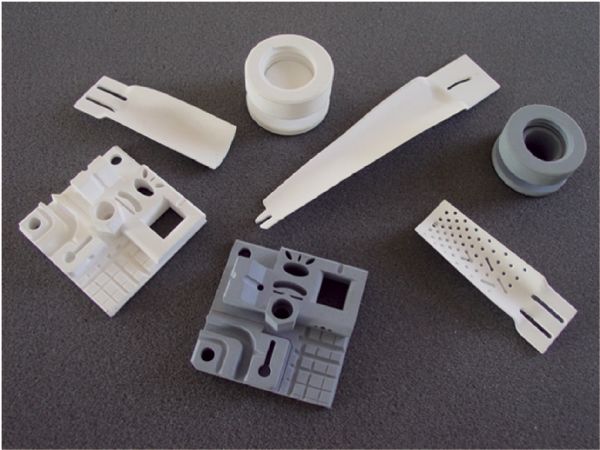 | Fig.6 Alumina and silica ceramic cores produced using SLS for investment casting of turbine blades and other ceramic parts (Source: Phenix Systems [ 104]) |
Direct fabrication of ceramic parts using AM processes is much more challenging due to the high melting temperatures of ceramics such as Al2O3 (>2000℃) and SiO2 (>1700℃), and also the large thermal gradients, thermal stresses and residual stresses associated with melting/re-solidifying in the laser based AM processes. Research attempts were carried out to directly manufacture fully dense ceramic components using AM processes. For example, the SLM process was investigated to fabricate ceramic parts from a mixture of zirconia and alumina by completely melting the ceramic powder [ 110]. The ceramic powder bed was preheated to a temperature higher than 1600℃ to reduce thermal stresses, and nearly fully dense, crack-free parts were obtained without any post-processing. Fully dense, net-shaped, alumina parts were produced using LENS by direct laser melting of the ceramic powder [ 111]. The as-processed structures show anisotropy in mechanical properties with a high compressive strength normal to the build direction and columnar grains along the build direction.
Composites are engineered or naturally occurring materials made from two or more constituent materials with significantly different physical or chemical properties that remain separate and distinct at the macroscopic or microscopic scale within the finished structure but exhibit properties that cannot be achieved by any of the materials acting alone. The materials in a composite can be mixed uniformly, resulting in a homogeneous compound (uniform composite), or non-uniformly, resulting in an inhomogeneous compound (e.g., functionally graded materials) in which the composition varies gradually over volume, leading to corresponding changes in the properties of the composite material.
Uniform composites fabricated using AM processes are usually done by employing a pre-prepared mixture of proper materials, such as a mixed powder bed for SLS, SLM and 3DP, a filament in mixed materials for FDM, a composite laminate for LOM, or a mixture of liquid photo-curable resin with particulates for SLA. The composite materials that can be produced with AM technology include a polymer matrix, ceramic matrix, metal matrix, and fiber and particulate reinforced composites [ 112]. One of the most important uniform composite families for industrial application is fiber-reinforced composite. The AM processes can be used to produce fiber-based composites include FDM and LOM. AM processes, such as SLS and 3DP, are not ideal for working with fiber-based composites because making a smooth layer of the powder-fiber mixture is difficult in these processes. Incorporating the use of long or continuous fibers rather than short fibers into AM processes is difficult and has been limited to LOM [ 113]. FDM and LOM require the fabrication of respective fiber-reinforced composite filament tapes and laminates as a pre-step before AM processing. Several examples will be discussed later.
Metal-metal composites (e.g., Fe-Cu and stainless steel-Cu), metal-ceramic composites (e.g., WC-Cu, WC-Co, WC-CuFeCo, TiC-Ni/Co/Mo, ZeB2-Cu, and TiB2-Ni), and ceramic-ceramic composites (e.g., Si-SiC) have been processed by SLS/SLM [ 112]. These processed composites can be classified into two categories: those that aim to facilitate the process using a liquid-phase sintering mechanism, and those that combine various materials to achieve properties not possible with a single material. Examples of composites in the first category include Fe-Cu and stainless steel-Cu used in SLS, in which Cu acts as a binder to bond Fe or stainless steel particles rather than a reinforcement phase to enhance the mechanical or other properties of the final product. An example of the second category is the bio-composite poly-epsilon-caprolactone and hydroxyapatite (PCL/HA) bone scaffold fabricated using SLS, with the addition of HA to enhance the strength and biocompatibility of PCL [ 114, 115]. In terms of fabrication methods, SLS of composites can be achieved by varying the composition of the powder mixture, using in situ chemical reactions or conducting post-processing procedures (e.g., infiltration). Various polymer matrix composites, metal matrix composites, and short fiber-reinforced composites have been processed by using this method. Composites also have been manufactured through laser-induced chemical reactions that in situ create chemical compounds. One example is the fabrication of a Cu-based metal matrix composite reinforced with TiB2 and TiC from a powder mixture of Cu, Ti and B4C [ 116]. Conducting post-processing on laser-sintered materials is another way to manufacture composites (e.g., using a furnace for chemical reactions and infiltration). A common example of a composite produced using this method is the Si/SiC composite. A laser-sintered SiC preform is infiltrated at room temperature with phenolic resin, which converts to carbon in a furnace and reacts with the infiltrated Si to form SiC, thus producing the Si/SiC composite [ 117, 118].
In addition to SLS, 3DP also can be used to make composites, either by changing the component of the powder mixture or by infiltrating porous 3DP preforms with metal or alloy. An example of the former method is hyroxyapatite/apatite-wollastonite glass ceramic composite in situ fabricated using the proper powder mixture to improve the strength of bone scaffold [ 119]. An example of the latter method is dense TiC/Ti-Cu composites fabricated by infiltrating TiCu alloy into a porous carbon preform produced using 3DP [ 120].
By developing a feedstock filament with the proper composite, polymer-metal and polymer-ceramic composites could be produced with FDM. ABS-Iron composites have been made using FDM with a single-screw extruder by appropriately producing an iron particulate-filled polymeric filament [ 121]. Fibers, such as short glass fibers [ 122] and nanofibers (vapor-grown carbon fibers) [ 123], have been added into ABS filaments to improve the mechanical properties of the parts built using FDM. The fabrication of composites using LOM depends directly on the development of composite laminates, such as fiber or particulate reinforced sheets. Polymer matrix and ceramic matrix composites have been made with curved LOM by laying-up and shaping composite laminates from prepreg feedstocks, followed by vacuum bag/oven curing and consolidation [ 124, 125].
AM processes that can deliver different materials (usually through multiple feeding systems) to the building areas have the ability to build components with FGM, which is one of the primary advantages of AM technology that conventional methods cannot realize. This ability offers the flexibility to control the composition and optimize the properties of the built part. One example is a pulley that contains more carbide near the hub and rim to make it harder and more wear resistant, and less carbide in other areas to increase compliance [ 126]. Another example is a missile nose cone with an ultra-high temperature ceramic graded to a refractory metal from outside to inside in order to sustain extreme external temperatures while attaching easily to the metallic missile nose.
As a powder deposition process, LMD/LENS has the ability to vary the degree of material composition, leading to FGM by feeding different material powders from multiple nozzles. Porous Ti6Al4V implants with functionally graded Co-Cr-Mo coating have been produced using LENS by Bandyopadhyay et al. [ 127, 128]. These implants exhibited a high degree of hardness with an excellent interaction between the bone cell and other materials. The microstructure is shown in Fig. 7. The composition gradient was achieved by gradually increasing the feed rate of the Co-Cr-Mo alloy and accordingly decreasing the feed rate of the Ti6Al4V alloy powder. The graded structures exhibited good bonding between individual layers, avoiding the issue of cracking that will occur if 100% Co-Cr-Mo is transitioned from 100% Ti6Al4V. A functionally graded TiC/Ti composite [ 129] and a compositionally graded Ti-TiO2 structure [ 57] were fabricated with LENS by employing different powders carried by non-reactive gases through different nozzles. Graded nickel-titanium components were built from Ti6Al4V to IN 718 using LENS by Domack and Baughman [ 130]. One process developed by Wang et al. [ 131] went beyond feeding different powders. They combined powder and wire for LMD, which allowed for multi-material fabrication without the mixing and waste of blown, unused feedstock powders.
 | Fig.7 Typical microstructure and Co distribution of LENS processed Co-Cr-Mo graded coating on porous Ti6Al4V alloy (Source: [ 127]) |
Several ceramic actuators and sensors with novel properties have been fabricated using a variant FDM process developed by Jafari et al. [ 30]. The modified system has multiple deposition units and the ability to deposit up to four different types of materials in any given layer. The Freeze-form Extrusion Fabrication (FEF) process can produce FGM parts by employing multiple extruders with different materials in different extruders. Material compositions are varied by controlling the extrusion speed of each extruder. Figure 8(a) shows the triple-extruder FEF equipment developed at Missouri S&T [ 132], and the fabricated FGM part with a gradient from 100% Al2O3 to 50% Al2O3 and 50% ZrO2 is shown in Fig. 8(b).
 | Fig.8 (a) Triple-extruder FEF system; (b) FGM part with a gradient from 100% Al2O3 to 50% Al2O3 and 50% ZrO2 fabricated using the triple-extruder FEF process (Source: [ 132]) |
The development of innovative, advanced AM techniques has progressed greatly in recent years, yielding broader and broader industry applications. Compared with subtractive manufacturing, AM is particularly suitable for producing low volumes of products, especially for parts with complex geometries. AM processes also offer great potential for customization, such as fabricating personalized implants for hip and knee replacements. The following review AM applications in the aerospace, automobile, biomedical and energy fields.
Aerospace components often have complex geometries and are made usually from advanced materials, such as titanium alloys, nickel superalloys, special steels or ultra-high-temperature ceramics, which are difficult, costly and time-consuming to manufacture. Additionally, aerospace production runs are usually small, limited to a maximum of several thousand parts. Therefore, AM technology is highly suitable for aerospace applications.
Optomec [ 89, 133] used the LENS process to fabricate complex components for satellites, helicopters and jet engines. An example is a 1/6 scale mixing nozzle for gas turbine exhaust for Bell helicopter, as shown in Fig. 9(a). Arcam [ 92] applied its EBM system to produce functional parts for end users. Some of these applications included commercial and military aircraft, space applications, missiles and various subsystems (e.g., engines and accessories) which use light-weight materials such as titanium alloys. For example, an EBM-produced compressor support case for a gas turbine engine using Ti6Al4V is shown in Fig. 9(b). The turbine blades, which are typical thin-wall parts with complex channels inside, were produced using SLM from Inconel 718 and cobalt chrome alloy by Concept Laser [ 134] and Morris Technologies [ 135], respectively, as shown in Figs. 9(c) and 9(d). A hollow static turbine blade in stainless steel (Fig. 9(e)) was cast using a ceramic mold and cores fabricated using 3DP by Prometal [ 136]. An engine housing (Fig. 9(f)) was produced using SLM by Concept Laser [ 134]. Also, AM built plastic parts, such as vents and ducts, have been used in aerospace industry. Meanwhile, polymers that are flame retardant, such as PEEK, have been developed for AM processes to meet the aerospace requirements.
 | Fig.9 (a) Mixing nozzle for gas turbine exhaust produced by LENS (Source: Optomec [ 133]); (b) compressor support case for gas turbine engine produced by EBM (Source: Arcam [ 92]); (c) turbine blade with internal cooling channels produced by SLM (Source: Concept Laser [ 134]); (d) turbine blades fabricated by SLM (Source: Morris Technologies [ 135]); (e) hollow static turbine blade cast using the mold and cores fabricated by 3DP (Source: Prometal [ 136]); (f) engine housing produced by SLM (Source: Concept Laser [ 134]) |
In addition to directly manufacturing functional parts for aerospace applications, AM techniques also are used to repair aircraft engine parts in order to reduce the cost and extend the lifetime of such parts as compressors, turbine and combustor castings, housing parts, and blades [ 89]. Optomec has demonstrated that LENS can successfully repair parts used in gas turbine engines such as vanes, stators, seals and rotors, and even geometrically complex parts such as airfoils, blisks, ducts and diffusers [ 90, 133, 137]. Fraunhofer ILT (Germany) [ 56, 138] has been successfully certified by Rolls-Royce Deutschland for 15 different repair applications using LMD, including repair of high-pressure turbine case and compressor front drum. A blisk repaired by Optomec is shown in Fig. 10.

Xue and Islam (National Research Council Canada) [ 139] investigated LMD with various materials, such as IN 625, IN 738, Ti6Al4V, and Fe-based tool steel, showing that LMD-processed materials have mechanical properties comparable to and sometimes better than conventionally cast or wrought materials. Some example parts (e.g., airfoils, shown in Fig. 11) for aerospace application were given. Besides fabricating parts, researchers also have applied LMD/LENS techniques to repair expensive and complex parts for aerospace applications. Xue and Islam [ 139] demonstrated repair of the tips and seal of a damaged IN 738 blade. Richter et al. [ 140] applied LMD to repair a Ti6-2-4-2 blade and studied the microstructure, hardness, residual stress, mechanical properties, and fatigue of the repaired parts. A geometry-based adaptive toolpath LDM process was developed by Qi et al. [ 141] to improve the geometric accuracy of the repaired part such as an airfoil, which has a wall thickness usually varied from sub-millimeters at the edges to several millimeters in the middle of the cross-section.
 | Fig.11 (a) Airfoil (material: IN 738) produced by LMD on cast IN 738 substrate; (b) airfoil with embedded cooling channels (material: Ti6Al4V) produced by LMD (Source: [ 139]) |
A hybrid process combining multi-axis laser deposition and CNC machining was developed by Liou et al. [ 142, 143]. By rotating the building part with a multi-axis system, the process can create overhanging features without support structures. The hybrid process provides greater build capabilities, accuracy and surface quality and has been applied successfully to the building and repair of functional metallic parts. An example of a repaired die core is shown in Fig. 12 [ 144]. Other AM processes, such as SLA, FDM and 3DP, can fabricate metal parts (e.g., turbine blades) for aerospace applications by building casting patterns for investment casting. Integrally cored ceramic molds for investment casting of turbine blades have been fabricated using ceramic stereolithography [ 145], and as well as by gelcasting ceramic slurry into plastic molds made from SLA patterns [ 146, 147].
 | Fig.12 A die core repaired using an LDM based hybrid rapid manufacturing system: (a) before the repair, showing the top of the core damaged and the surrounding surface worn; (b) after deposition, showing the portion requiring repair covered with new material; (c) after surfacing machining, showing the repaired core. (Source: [ 144]) |
Aside from the direct benefits of AM processes, special structures such as porous mesh arrays and open cellular foams can be produced by varying their density and stiffness to provide unique energy efficiency and excellent corrosion resistance and to impact on the absorption features, thermal management, and stiffness and strength of the sandwich cores. Numerous potential applications in aerospace, aeronautics and automotive systems can benefit from this density-compensated strength and stiffness. Figure 13 shows a Ti6Al4V open cellular foam fabricated using EBM from a CAD model based on CT scans of common aluminum alloy foam [ 148, 149]. The strength of these foams can be as much as 40% higher than that of fully dense EBM-fabricated components.
 | Fig.13 Example of an enlarged Ti6Al4V open cellular foam prototype fabricated using EBM (Source: [ 148]) |
Another aerospace application of AM is the building of wind tunnel testing models for aircraft, missiles, airfoils, etc. to study the aerodynamic characteristics of the designs. AM techniques reduce the time and cost associated with manufacturing these models, which usually have complicated geometries. For example, Daneshmand et al. [ 150] used SLS to build a wing-body-tail launch vehicle configuration model with glass-reinforced Nylon (Fig. 14). The aerodynamic data obtained from the SLS built model agreed well with the data from the physical model produced by CNC machining.
 | Fig.14 Wing-body-tail launch vehicle configuration model for wind tunnel testing produced by SLS using glass-reinforced Nylon (Source: [ 150]) |
In addition to metallic components, the aerospace industry also places great demands on ceramic parts, especially those made of ultra high temperature ceramics (UHTC) such as ZrB2 and ZrC, which have an excellent ability to withstand extremely high thermal (>2000℃) and tough chemical environments. Such parts can be applied in, for example, hypersonic flight systems and rocket propulsion systems. It is difficult to fabricate geometrically complex UHTC parts using traditional manufacturing techniques such as drilling and milling operations because of the extremely brittle nature of ceramics. AM technology provides a promising way to make 3D UHTC parts that are difficult to make by conventional means. For example, a fuel injector strut with crossing channels inside that potentially could be used for a hypersonic aircraft engine was fabricated by SLS using ZrB2 to provide resistance to extremely high temperatures [ 103]. Also, scaled-down versions of missile nose cones made of Al2O3 and ZrB2 were fabricated using FEF [ 36, 37, 38], which extrudes aqueous ceramic pastes layer by layer below the water freezing temperature (Fig. 15(a)). Green parts fabricated using the FEF process first undergo freeze-drying followed by binder burnout and finally sintering to produce dense ceramic components, as shown in Figs. 15(b) and 15(c). The FEF process also can be extended beyond the fabrication of monolithic ceramics to the production of FGM parts by employing a triple-extruder mechanism, as shown in Fig. 8. Possible applications of FGM parts include fabrication of UHTC-refractory metal parts consisting of a UHTC graded to a refractory metal for the leading edges of hypersonic vehicles, nose cones of missiles, and nozzle throats of spacecraft propulsion engines, which are required to sustain extremely high temperatures and thermal gradients for future aerospace systems.

New product development is critical for the automotive industry, but developing a new product is often a very costly and time-consuming process. The automotive industry has been using AM technology as an important tool in the design and development of automotive components because it can shorten the development cycle and reduce manufacturing and product costs. AM processes also have been used to make small quantities of structural and functional parts, such as engine exhausts, drive shafts, gear box components and breaking systems for luxury, low-volume vehicles. Unlike passenger cars, vehicles for motorsports usually use light-weight alloys (e.g., titanium) and have highly complex structures and low production volumes. Companies and research institutes also have successfully applied AM techniques to manufacture functional components for racing vehicles.
CRP Technology (Italy) [ 151] has successfully applied AM techniques including SLS, SLM and EBM to develop and produce various components for motorsports. The produced parts include F1 gearboxes (titanium), MotoGP 250R air boxes, motorbike dashboards and supports, camshaft covers for MotoGP engines, reed valves, F1 suspension systems, etc. Significant advantages have been realized by applying AM technology. For example, the F1 gearbox produced using these new design and fabrication techniques saves 20%-25% weight and approximately 20% volume, and it has twice in torsion stiffness, less gear wear, and less power absorption. Figure 16(a) shows a titanium upright (which transmits the engine’s rotational power to wheels) made for the Minardi F1 team by CRP Technology via rapid casing based on polystyrene patterns made by SLS. Optomec [ 133] produced Ti6Al4V components including suspension mounting brackets (Fig. 16(b)) and drive shaft spiders for the Red Bull Racing car using LENS, resulting in a>90% material reduction, as well as significantly reduced time and cost. Arcam [ 92] applied EBM using Ti6Al4V to produce parts such as gearboxes (Fig. 16(c)), suspension parts and engine parts with lattice structures for race cars. Using SLM, Concept Laser [ 134] produced many steel and aluminum components for cars, including wheel suspensions, oil pump housings, engine blocks, exhaust manifolds and valve blocks; two examples are shown in Figs. 16(d) and 16(e). Prometal [ 136] successfully applied its Prometal process (a rapid casting technique based on 3DP) to manufacture engine components, such as cylinder heads, intake manifolds, and engine blocks, for the development of passenger car engines and production of race engines. This process significantly reduces the development time for car engines; for example, an intricate shape engine block that includes cooling passages and oil recirculation lines (Fig. 16(f)) can be produced completely in only one week.
 | Fig.16 (a) F1 upright (right) cast via rapid casting process using polystyrene patterns produced by SLS (left) (Source: CRP Technology [ 151]); (b) suspension mounting bracket for Red Bull Racing produced by LENS (Source: Optomec [ 133]); (c) race car gear box produced by EBM (Source: Arcam [ 92]); (d) exhaust manifold produced by SLM (Source: Concept Laser [ 134]); (e) oil pump housing produced by SLM (Source: Concept Laser [ 134]); (f) engine block cast using the mold and cores fabricated by 3DP (Source: Prometal [ 136]) |
Universities and research institutes also have investigated AM technology for automotive applications. For example, Vilaro et al. [ 152] fabricated a water pump for motorsports cars (Fig. 17(a)) by SLM using aluminum alloy (AlSi10Mg). Their experimental results showed that the produced parts have mechanical properties equivalent to conventional heat-treated AlSi10Mg.
In addition to the direct manufacturing of functional parts, rapid tooling [ 153] has been studied widely and applied in automotive industries for quite a few years. Much research has demonstrated the flexibility of AM to fabricate complicated components for the automobile industry by using casting patterns, or molds and cores built by SLS, FDM, SLA, 3DP and LOM. For example, one part used in the automotive industry (Fig. 17(b)) was produced by investment casting starting from 3D-printed starch patterns and 3D-printed molds [ 154].
 | Fig.17 (a) Water pump for a motorsports car produced by SLM (Source: [ 152]); (b) automotive part produced by investment casting with 3D-printed starch patterns and molds (Source: [ 154]) |
AM technology also offers a fast way to make parts with previously unattainable properties in order to improve fuel efficiency and engine life. For example, an engine part with a lattice structure may reduce the engine’s weight while enhance its stiffness (Fig. 18), and metal matrix composites may provide extraordinarily durable, low-inertia valves. A titanium aluminide alloy with low density and high specific strength (ratio of elastic modulus vs. density) and stiffness (ratio of yield strength vs. density) was investigated using EBM for its potential to fabricate automotive engine components (e.g., engine exhaust valves and pistons) [ 155]. Ti6Al4V open cellular foams fabricated using EBM demonstrated high potential for novel applications in automotive systems due to their light weight and exceptional mechanical properties [ 148]. An intake system for a 600cc formula automotive engine was designed to minimize pressure losses and maintain an equal charge for each cylinder supply; it was manufactured using a combination of FDM and subsequent lamination of a carbon-fiber composite material [ 156], as shown in Fig. 19.
 | Fig.18 Engine part with lattice structure fabricated by EBM using Ti6A14V to reduce engine weight while enhance stiffness (Source: Arcam [ 92]) |

Recent developments in AM technology, as well as in biomaterials, biologic sciences and biomedicine, have broadened the application of AM techniques in the biomedical field to such products substantially as orthopedic implants, tissue scaffolds, artificial organs, medical devices, micro-vasculature networks, and biologic chips (produced by printing/patterning cells and proteins [ 157]).
Many companies, research institutes and universities are exploring ways to apply AM processes to manufacturing of medical implants. The application of AM in orthopedic and dental implants benefits significantly from the ability of AM technology to manufacture complex geometries and structures, to make rough, engineered surface for more effective bone integration, and to allow implants to be personalized to match each patient’s individual needs. Arcam [ 92] has applied EBM to manufacture a wide range of implant types such as acetabular cups (Fig. 20(a)), hips, knees, shoulders and spinal implants, and a number of implants have been certified on the market. For example, using Arcam EBM technology, Adler Ortho Group [ 158] launched the CE-certified Fixa Ti-Por acetabular cup in the European market in 2007, and more than 2000 of these cups have been implanted. Another fast-growing area for AM applications is the dentistry business [ 159]. Several companies including Concept Laser and MTT Technologies are using SLM to produce copings for crowns and bridges. Figures 20(b) and 20(c) show examples of a dental prosthesis and a dental bridge, respectively.
 | Fig.20 (a) Acetabular cups with designed porosity (material: Ti6Al4V) produced using EBM (Source: Arcam [ 92]); (b) dental prosthesis (material: Ti6Al4V) produced using SLM (Source: Concept Laser [ 134]); (c) 3-unit dental bridge (material: CL111 CoCr) produced using SLM (Source: Concept Laser [ 134]) |
Research institutes and universities also have explored the application of AM to biomedical implants. Ti6Al4V implants (Fig. 21(a)) with tailored mechanical properties that mimic the stiffness of bone in order to reduce stress shielding have been fabricated by EBM [ 53], and functional hip stems (Fig. 21(b)) with designed porosity have been made from titanium by LENS [ 127]. Cellular Ti6Al4V structures with interconnected pores (see Fig. 4) for bone implants were fabricated using EBM by Heinl et al. [ 51, 55], demonstrating the suitability of these implants for tissue ingrowth and vascularization. SLM also has been used to fabricate implant parts in biocompatible metal alloys (i.e., Ti6Al4V and CoCrMo) [ 160].

In tissue engineering, three-dimensional scaffolds play a vital role as extra-cellular matrices onto which cells can attach, grow and form new tissues. The conventional fabrication of tissue scaffolds has relied on techniques such as solvent casting, melt molding, freeze drying, and foam replication to create the shape and architecture of a scaffold. These methods have limitations in the areas of manual interaction requirements, difficulty in the control of complicated internal architectures, and reproducibility. In contrast, fabrication of tissue scaffolds using AM technology allows versatility in the use of biomaterials and the fabrication of scaffolds with complex geometries and designed internal architectures [ 12, 161, 162, 163, 164]. AM processes have been used both directly to manufacture scaffolds (in biodegradable polymer, bioactive ceramic or glass [ 165]) and indirectly as a ‘manufacturing tool’ for the molds required to cast scaffolds [ 11].
The methods employed to fabricate tissue scaffolds directly can be using SLA [ 166], 3DP [ 67, 79], FDM [ 167, 168] or SLS [ 163, 169]. Researchers have demonstrated the ability to make tissue scaffolds from biopolymers such as PCL and PEEK, bioceramics such as hydroxyapatite (HA) and β-tricalcium-phosphate ( β-TCP), and bioglasses such as the 13-93 glass using 3DP [ 67, 79, 170] and SLS [ 171, 172]. Multiple materials also can be used to fabricate scaffolds. For example, HA reinforced PCL scaffolds can be fabricated using the FDM process to improve the mechanical strength of the biopolymer [ 167]. The fabrication of apatite-mullite glass-ceramic bone scaffolds using SLS was investigated both with binder (for bonding glass-ceramic particles) and without binder (by directly melting glass-ceramic particles) [ 106, 169]. Photopolymerizable biomaterials, such as polyethylene glycol (PEG) and polyethylene oxide, were used in the SLA process to fabricate bioactive scaffolds with living cells encapsulated inside, for a variety of tissue engineering applications [ 173, 174].
In addition, several new AM variations have been developed for biomedical applications. HA scaffolds have been made using robocasting [ 175], in which a syringe deposits highly concentrated colloidal suspensions in layers to form a scaffold, followed by drying and sintering. Another FDM-based extruding deposition method, called precision extruding deposition (PED), was applied by Shor et al. [ 176] to fabricate PCL tissue engineering scaffolds. In contrast to the conventional FDM process that requires the use of precursor filaments, the PED process directly extruded scaffold materials in a granulated form, thereby avoiding the need for filament preparation.
SLS and FEF have been applied to fabricate bone tissue scaffolds in bioactive glass (13-93 glass), a new generation of biomaterial that not only bonds with the surrounding tissue but also actively aids in tissue regeneration [ 177, 178]. The bone scaffolds fabricated using SLS and FEF are shown in Figs. 22(a) and 22(b), respectively. Figure 23 shows the SEM images of the bio-test results with MLO-A5 cells seeded on the commercial scaffold (BD CaP) and the SLS scaffold after two days of incubation. The higher-magnification SEM images in Figs. 23(c) and 23(d) show that the cells visible on both the BD CaP scaffold and the SLS scaffold appear anchored well by lamellipodia and filopodial extensions. The optical image of cell-seeded SLS scaffolds incubated after 2, 4, and 6 days is shown in Fig. 24. The relative intensity of purple formazan staining on these scaffolds increased dramatically with the duration of incubation, indicating that metabolically active cells undergoing vigorous growth on the scaffolds and the fabricated bone scaffolds promote cell growth.
 | Fig.22 (a) Bone scaffolds fabricated using SLS; (b) bone scaffolds with 600 µm pores fabricated using FEF (Source: [ 177]) |
 | Fig.23 SEM images of MLO-A5 cells on control BD CaP (a, c) and SLS-1 scaffolds (b, d) after 2 days of incubation (Source: [ 178]) |
 | Fig.24 MTT labeling of MLO-A5 cells on porous 13-93 SLS scaffolds after culture intervals of 2, 4, and 6 days (Source: [ 178]) |
Indirect AM of tissue scaffolds are normally obtained by building a mold (in polymer) using an AM process and then casting with biocompatible materials into the mold cavity to form a scaffold. Lin et al. [ 179] fabricated porous β-TCP scaffolds with a polygradient controllable structure of both macro and micro pores by combining FDM and freeze drying. An artificial bone with a porous internal structure was fabricated by injecting calcium phosphate cement (CPC) into an SLA mold [ 180]. Scaffolds with villi features were produced by solvent casting into 3D printed plaster molds, followed by particulate leaching [ 65].
Biofabrication [ 181] using living cells, a new paradigm of AM application in the biomedical industry, has evolved through the convergence of engineering and life sciences. Biologics or biomaterials are used as building blocks to fabricate biologic and bio-application oriented substances, devices, and therapeutic products through a broad range of engineering, physical, chemical and biologic processes. Biofabrication encompasses an extremely wide range of applications in tissue engineering, disease pathogenesis and drug studies, biochips and biosensors, drug delivery, in-cell printing, patterning, assembly, and organ printing.
AM techniques for cell manipulation have been developed, e.g., syringe-based cell deposition for tissue constructs [ 157]; inkjet-based cell printing [ 182, 183]; micro-contact printing of cells and bacteria; cell manipulation by mechanical, optical, electrical, magnetic, and ultrasound methods for micro-fluidics; and cell patterning by photo- or electro-etching and soft lithography. A syringe-based, layered, direct cell writing, bioprinting process with a multi-nozzle was developed at Drexel University [ 157]. The system has the ability to deposit multiple cell types and bioactive factors in controlled amounts at a precise spatial position for the freeform fabrication of biopolymer-based, three-dimensional, liver cell-embedded tissue constructs. Boland et al. [ 184, 185, 186] developed a process (Fig. 25) by which a printer can print gels and cells, and cell aggregates into a 3D gel. Their process consists of the following three stages: 1) pre-processing (creating CAD models, which can be generated from CT scanned data), 2) processing (printing) and 3) post-processing (perfusion of printed organs and their biomechanical conditioning).
 | Fig.25 A bioprinter and images of printed cells and tissue constructs. (a) Schematic representation of the bioprinter model; (b) bovine aortic endothelial cells printed in 50 µm drops in a line; (c) cross-section of the p(NIPA-co-DMAEA) gel showing the thickness of each sequentially placed layer; (d) actual bioprinter; (e) print head with nine nozzles; Endothelial cell aggregates ‘printed’ on collagen (f) before and (g) after their fusion (Source: [ 184, 185, 186]) |
Renewable energy (e.g., solar energy, wind energy) and clean energy (e.g., hydrogen energy) are promising solutions for reducing environmental burden and the dependence on fossil energy. As one of the “green” energy devices, fuel cells provide great advantages such as high efficiency, high power density, and low emissions. The potential applications include portable power supply, automotive system, and distributed power system. However, the high cost and low durability obstruct the wide application of fuel cells [ 187]. Ample opportunities exist for AM technology to contribute to the area of energy, such as through the rapid development and fabrication of prototypes to reduce the cost and lead-time of research and development of new products, and the exploration of novel designs to improve the energy efficiency and power density. For example, Bourell et al. [ 188, 189, 190, 191] developed an SLS based process to fabricate the graphite composite bipolar plate, which is one of the most important components in Polymer Electrolyte Membrane (PEM) fuel cells. Guo et al. [ 192, 193, 194, 195, 196, 197] investigated the effect of different graphite materials on the electrical conductivity and mechanical strength of the SLS fabricated bipolar plates, and also compared their in situ performance with the bipolar plates made by injection molding and compression molding. Figure 26 shows some examples of the fabricated bipolar plates. By using SLS the cost and lead-time of developing new bipolar plates can be reduced dramatically compared to conventional methods such as injection molding and compression molding, in which expensive metal molds have to be manufactured. AM technology also expands the design possibilities and makes it easier to realize novel designs that might be able to improve energy efficiency and/or power density. A bipolar plate with a bio-inspired “leaf” design of the flow field (Fig. 26(d)) was fabricated using the SLS process, showing an over 20% improvement in PEM fuel cell power density compared to the conventional designs (e.g., designs in Figs. 26(a)-26(c)) because of the more uniform distribution of gas fuels [ 194].


Although AM technology recently has undergone significant development, it still is not widely accepted by most industries. Improving the technology to the point of changing this mindset and gaining industry acceptance, as well as broadening, developing and identifying manufacturing applications that are only possible with AM processes, are the critical targets for the next 5-10 years. The report of 2009 US NSF workshop “Roadmap for Additive Manufacturing: Identify the Future of Freeform Proceeding” contains a comprehensive discussion of AM research needs in the future [ 198].
For a manufacturing process to be adopted widely by industry, the repeatability and consistency of the manufactured parts are critical. These are required over the build volume and between builds of each machine, as well as across different machines of the same make. Currently, the inability of AM technology to guarantee material properties for a given process is inhibiting its industry adoption because many companies do not have confidence that manufactured parts will have the mechanical properties required to meet specific application needs. A main reason for this problem is that the existing AM systems are still predominantly based on rapid prototyping machine architectures, which are surrounded by a different mentality regarding the requirements of the produced parts. Additionally, to broaden and develop new applications, novel AM processes, such as those for bio-applications using cells, biologics or biomaterials as building blocks and those for micro and nano engineering, need to be investigated and developed. To achieve these goals, AM technology and its applications require significant further research and development in terms of designs, materials, new processes and machines, process modeling, process control, bio-additive manufacturing, and energy and sustainability applications. The following summarizes the main recommendations from the above mentioned NSF workshop on Roadmap for Additive Manufacturing.
The unique capabilities of AM processes, including their ability to fabricate complex shapes, tailor materials and properties, and handle functional complexities, greatly enhance the freedom of designers to explore novel applications of this technology. However, it is not easy for designers to take advantage of these capabilities. To address this issue, the following developments are needed:
1) Conceptual design methods to aid designers in defining and exploring design spaces enabled by AM, methods for simultaneous product-process design and multifunctional design, and methods by which to assess lifecycle costs and impacts of parts and products fabricated by AM.
2) A new foundation for computer-aided design systems that overcomes the limitations of parametric, boundary-representation solid modeling in representing very complex geometries and multiple materials.
3) Composable simulation capabilities for primitive shapes, materials, material compositions, etc., multiscale modeling and inverse design methodologies to assist in navigating complex process-structure-property relationships, and improved finite element analysis software that can make use of such capabilities.
4) Methods by which to model and design successfully despite shape, property, process and other variabilities.
5) CAD systems for non-experts, which will be necessary for areas related to toys, collectables, housewares, game avatars, etc.
The ability to achieve predictable and repeatable operations is critical. Process variability must be reduced, as must the sensitivity to process variations. To achieve this, research in the following areas is needed:
1) Process-structure-property relationships modeled and integrated with CAD/E/M tools for each material and process.
2) Closed-loop adaptive control systems, the control algorithms of which based on predictive models of system response to process changes.
3) New sensors (process, shape/precision/surface finish) that can operate in build-chamber environments, sensor fusion and interpretation methods, computer-aided inspection systems integrated into control systems, and machine learning technologies suitable for AM machine control and improvement.
Research opportunities in AM materials, processes and machines include the following:
1) A better understanding of the basic physics and chemistry of AM processes that capture complexities in the multiple interacting physical phenomena inherent in most AM processes.
2) Processes based on scalable and fast material processing methods, such as processes that can fabricate a line (e.g., ink-jet printing) or area (e.g., mask-projection) to greatly increase machine throughput.
3) New, open-architecture controllers for AM machines and the development of reconfigurable, standard machine modules that could impact on the field.
4) Exploitation of unique characteristics that differentiate AM from conventional manufacturing processes, such as the anisotropic nature of AM, as well as the production of epitaxial metallic structures, fabrication of functionally gradient materials, and embedding of components (e.g., sensors and actuators) during the fabrication process.
5) Screening methodologies for advanced manufacturable materials to answer why some materials can be processed by AM and some cannot. Material “allowables” (range of material properties) should be developed for new materials that enter the market.
6) Micro and nano AM research to develop better tools with which to build structures and devices atom by atom, and design tools for nano-manufacturing.
7) Development of sustainable (green) materials, including recyclable, reusable, and biodegradable materials, to reduce environmental impact.
Research opportunities of AM technology in the biomedical field include the following:
1) Design and modeling methods for fabricating implants and medical devices that are customized to individual patients, including software tools to interpret CT/MRI imaging data.
2) Development of viable Bio-additive Manufacturing (BAM) processes to construct 3D biologic and tissue models using living biologics and to fabricate scaffolds, including “smart scaffolds” with embedded sensors.
3) Computer-aided BAM including modeling, analysis and simulation of cell responses and cell-tissue growth behavior.
AM technology can save material and energy usage and lessen environmental burden compared with conventional manufacturing processes. Research opportunities relating to energy and sustainability include the following:
1) Design energy system components to take advantage of AM capabilities.
2) Pursue maintenance, repair, and overhaul in the aerospace and other industries as a potential application of AM.
3) Develop cradle-to-grave lifecycle inventory of engineering materials for AM processes.
4) Develop equitable indicators for measuring sustainability in AM processes and products.
Various additive manufacturing processes, techniques and systems have been developed for over 20 years. With advances in this technology, the applications of AM processes have continued to shift from rapid prototyping to rapid manufacturing of tooling and end-use parts for aerospace, automotive, biomedical and other applications. AM processes, materials, applications and future research needs are reviewed in this paper. Based on the state of starting material, AM processes are classified into four categories: liquid, filament/paste, powder, and solid sheet. The techniques of creating a layer include UV light induced polymerization, ink-jet printing, extrusion, laser melting, etc. Polymers are the initially investigated materials in AM technology, and recently more and more attention has been paid to AM of metals, ceramics and composite materials to fabricate functional parts. High-power laser and electron beam based AM processes have demonstrated the capability of additive technology to manufacture fully dense metal components with mechanical properties comparable to those of bulk metal. Although attempts have been made to directly fabricate ceramic components by AM, intensive research is still needed before successful commercialization can be made. Various uniform composites including polymer-ceramic, metal-metal, metal-ceramic, and ceramic-ceramic have been investigated using AM processes. With the ability to locally control the material composition, AM technology has been developed to build functionally graded materials having new properties that conventional materials do not possess. AM technology has begun to exhibit great application potential and advantages in the aerospace, automotive, biomedical, and energy fields, by providing a cost-effective and time-efficient way to produce low-volume, customized products with complicated geometries and advanced material properties. Although AM technology offers numerous advantages over subtractive manufacturing methods, it is still regarded as a niche technology by most industries. To gain further acceptance from industry, research and development is needed in terms of designs, materials, novel processes and machines, process modeling and control, biomedical applications, and energy and sustainability applications in order to broaden the applications of AM technology and elevate it to a mainstream technology.
| 1 |
|
| 2 |
|
| 3 |
|
| 4 |
|
| 5 |
|
| 6 |
|
| 7 |
|
| 8 |
|
| 9 |
|
| 10 |
|
| 11 |
|
| 12 |
|
| 13 |
|
| 14 |
|
| 15 |
|
| 16 |
|
| 17 |
|
| 18 |
|
| 19 |
|
| 20 |
|
| 21 |
|
| 22 |
|
| 23 |
|
| 24 |
|
| 25 |
|
| 26 |
|
| 27 |
|
| 28 |
|
| 29 |
|
| 30 |
|
| 31 |
|
| 32 |
|
| 33 |
|
| 34 |
|
| 35 |
|
| 36 |
|
| 37 |
|
| 38 |
|
| 39 |
|
| 40 |
|
| 41 |
|
| 42 |
|
| 43 |
|
| 44 |
|
| 45 |
|
| 46 |
|
| 47 |
|
| 48 |
|
| 49 |
|
| 50 |
|
| 51 |
|
| 52 |
|
| 53 |
|
| 54 |
|
| 55 |
|
| 56 |
|
| 57 |
|
| 58 |
|
| 59 |
|
| 60 |
|
| 61 |
|
| 62 |
|
| 63 |
|
| 64 |
|
| 65 |
|
| 66 |
|
| 67 |
|
| 68 |
|
| 69 |
|
| 70 |
|
| 71 |
|
| 72 |
|
| 73 |
|
| 74 |
|
| 75 |
|
| 76 |
|
| 77 |
|
| 78 |
|
| 79 |
|
| 80 |
|
| 81 |
|
| 82 |
|
| 83 |
|
| 84 |
|
| 85 |
|
| 86 |
|
| 87 |
|
| 88 |
|
| 89 |
|
| 90 |
|
| 91 |
|
| 92 |
|
| 93 |
|
| 94 |
|
| 95 |
|
| 96 |
|
| 97 |
|
| 98 |
|
| 99 |
|
| 100 |
|
| 101 |
|
| 102 |
|
| 103 |
|
| 104 |
|
| 105 |
|
| 106 |
|
| 107 |
|
| 108 |
|
| 109 |
|
| 110 |
|
| 111 |
|
| 112 |
|
| 113 |
|
| 114 |
|
| 115 |
|
| 116 |
|
| 117 |
|
| 118 |
|
| 119 |
|
| 120 |
|
| 121 |
|
| 122 |
|
| 123 |
|
| 124 |
|
| 125 |
|
| 126 |
|
| 127 |
|
| 128 |
|
| 129 |
|
| 130 |
|
| 131 |
|
| 132 |
|
| 133 |
|
| 134 |
|
| 135 |
|
| 136 |
|
| 137 |
|
| 138 |
|
| 139 |
|
| 140 |
|
| 141 |
|
| 142 |
|
| 143 |
|
| 144 |
|
| 145 |
|
| 146 |
|
| 147 |
|
| 148 |
|
| 149 |
|
| 150 |
|
| 151 |
|
| 152 |
|
| 153 |
|
| 154 |
|
| 155 |
|
| 156 |
|
| 157 |
|
| 158 |
|
| 159 |
|
| 160 |
|
| 161 |
|
| 162 |
|
| 163 |
|
| 164 |
|
| 165 |
|
| 166 |
|
| 167 |
|
| 168 |
|
| 169 |
|
| 170 |
|
| 171 |
|
| 172 |
|
| 173 |
|
| 174 |
|
| 175 |
|
| 176 |
|
| 177 |
|
| 178 |
|
| 179 |
|
| 180 |
|
| 181 |
|
| 182 |
|
| 183 |
|
| 184 |
|
| 185 |
|
| 186 |
|
| 187 |
|
| 188 |
|
| 189 |
|
| 190 |
|
| 191 |
|
| 192 |
|
| 193 |
|
| 194 |
|
| 195 |
|
| 196 |
|
| 197 |
|
| 198 |
|
| 199 |
|