CONCENTRATIONS AND FLUXES OF DISSOLVED NUTRIENTS IN THE YANGTZE RIVER: LONG-TERM TRENDS AND ECOLOGICAL IMPACTS
Yandan FU, Jiahui KANG, Ziyue LI, Xuejun LIU, Wen XU()
College of Resources and Environmental Sciences, National Academy of Agriculture Green Development, Key Laboratory of Plant-Soil Interactions of the Ministry of the Environment, China Agricultural University, Beijing 100193, China.
• Historic trends in nutrient loading and flux in the Yangtze River were analyzed
• Decreasing trends in the concentrations and fluxes of DSi were found
• Significant increasing trends in DIN and DIP concentrations were observed
• The frequency of and area covered by red tide outbreaks substantially increased
• Atmospheric deposition become a vital factor influencing DIN loadings and fluxes
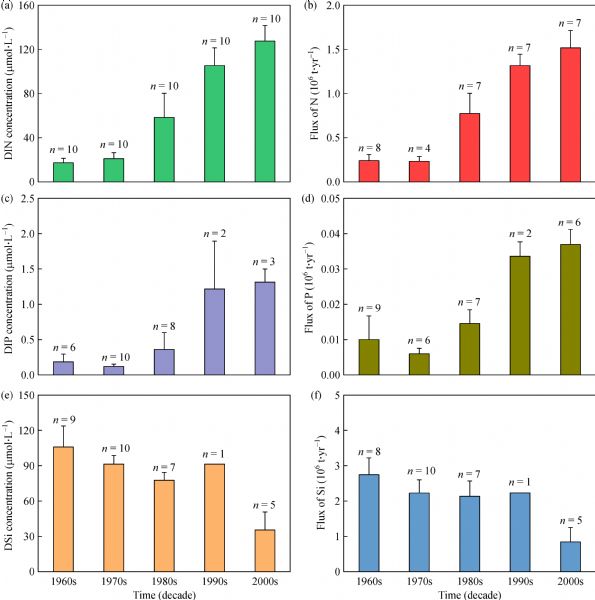
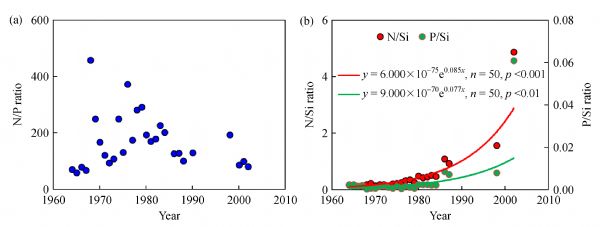
Intensifying human activity in the Yangtze River basin has substantially increased nutrient concentrations in the Yangtze River Estuary, leading to degradation of the coastal environment. Analysis of nutrient determinations published over the past 50 years reveals a gradual decreasing trend in the concentrations and fluxes of dissolved silicate (DSi). However, both dissolved inorganic nitrogen (DIN) and dissolved inorganic phosphate (DIP) concentrations have increased significantly since the 1970s. The frequency of and area covered by red tide outbreaks have increased greatly during this period, mainly due to changes in nutrient supply ratios [i.e., N/P (DIN/DIP), N/Si (DIN/DSi), P/Si (DIP/DSi)]. A strong correlation was found between the riverine DIN fluxes and the estimated DIN inputs from the major N sources, particularly fertilizers and atmospheric deposition. The data provide a comprehensive assessment of nutrients in the Yangtze River basin and their ecological impacts and indicate a potentially significant influence of atmospheric deposition on DIN loadings and fluxes.
M Voss, H W Bange, J W Dippner, J J Middelburg, J P Montoya, B Ward. The marine nitrogen cycle: recent discoveries, uncertainties and the potential relevance of climate change. Philosophical Transactions of the Royal Society, 2013, 368(1621): 20130121 https://doi.org/10.1098/rstb.2013.0121
2
B D Wang. Cultural eutrophication in the Changjiang (Yangtze River) plume: history and perspective. Estuarine, Coastal and Shelf Science, 2006, 69(3–4): 471–477 https://doi.org/10.1016/j.ecss.2006.05.010
3
S P Seitzinger, E Mayorga, A F Bouwman, C Kroeze, A H W Beusen, G Billen, G Van Drecht, E Dumont, B M Fekete, J Garnier, J A Harrison. Global river nutrient export: a scenario analysis of past and future trends. Global Biogeochemical Cycles, 2010, 24(4): GB0A08 https://doi.org/10.1029/2009GB003587
4
C C Chen, G C Gong, F K Shiah. Hypoxia in the East China Sea: one of the largest coastal low-oxygen areas in the world. Marine Environmental Research, 2007, 64(4): 399–408 https://doi.org/10.1016/j.marenvres.2007.01.007
R J Diaz, R Rosenberg. Spreading dead zones and consequences for marine ecosystems. Science, 2008, 321(5891): 926–929 https://doi.org/10.1126/science.1156401
7
D M Anderson, J M Burkholder, W P Cochlan, P M Glibert, C J Gobler, C A Heil, R M Kudela, M L Parsons, J E J Rensel, D W Townsend, V L Trainer, G A Vargo. Harmful algal blooms and eutrophication: examining linkages from selected coastal regions of the United States. Harmful Algae, 2008, 8(1): 39–53 https://doi.org/10.1016/j.hal.2008.08.017
8
J Heisler, P M Glibert, J M Burkholder, D M Anderson, W Cochlan, W C Dennison, Q Dortch, C J Gobler, C A Heil, E Humphries, A Lewitus, R Magnien, H G Marshall, K Sellner, D A Stockwell, D K Stoecker, M Suddleson. Eutrophication and harmful algal blooms: a scientific consensus. Harmful Algae, 2008, 8(1): 3–13 https://doi.org/10.1016/j.hal.2008.08.006
9
D J Conley, H W Paerl, R W Howarth, D F Boesch, S P Seitzinger, K E Havens, C Lancelot, G E Likens. Controlling eutrophication: nitrogen and phosphorus. Science, 2009, 323(5917): 1014–1015 https://doi.org/10.1126/science.1167755
10
J J Elser, T Andersen, J S Baron, A K Bergstrom, M Jansson, M Kyle, K R Nydick, L Steger, D O Hessen. Shifts in lake N:P stoichiometry and nutrient limitation driven by atmospheric nitrogen deposition. Science, 2009, 326(5954): 835–837 https://doi.org/10.1126/science.1176199
11
R C Tian, F X Hu, J M Martin. Summer nutrient fronts in the Changjiang (Yantze River) Estuary. Estuarine, Coastal and Shelf Science, 1993, 37(1): 27–41 https://doi.org/10.1006/ecss.1993.1039
12
S M Liu, J Zhang, H T Chen, Y Wu, H Xiong, Z F Zhang. Nutrients in the Changjiang and its tributaries. Biogeochemistry, 2003, 62(1): 1–18 https://doi.org/10.1023/A:1021162214304
13
Z Lin, J K Levy, X Xu, S Zhao, J Hartmann. Weather and seasonal climate prediction for flood planning in the Yangtze River Basin. Stochastic Environmental Research and Risk Assessment, 2005, 19(6): 428–437 https://doi.org/10.1007/s00477-005-0007-4
14
M T Li, K Q Xu, M Watanabe, Z Y Chen. Long-term variations in dissolved silicate, nitrogen, and phosphorus flux from the Yangtze River into the East China Sea and impacts on estuarine ecosystem. Estuarine, Coastal and Shelf Science, 2007, 71(1–2): 3–12 https://doi.org/10.1016/j.ecss.2006.08.013
15
Z J Dai, J Z Du, X L Zhang, N Su, J F Li. Variation of riverine material loads and environmental consequences on the Changjiang (Yangtze) Estuary in recent decades (1955–2008). Environmental Science & Technology, 2011, 45(1): 223–227 https://doi.org/10.1021/es103026a
16
W J Yan, S Zhang, P Sun, S P Seitzinger. How do nitrogen inputs to the Changjiang basin impact the Changjiang River nitrate: a temporal analysis for 1968–1997. Global Biogeochemical Cycles, 2003, 17(4): 1–8 https://doi.org/10.1029/2002GB002029
17
H Xu, Z Y Chen, B Finlayson, M Webber, X D Wu, M Li, J Chen, T Y Wei, J Barnett, M Wang. Assessing dissolved inorganic nitrogen flux in the Yangtze River, China: sources and scenarios. Global and Planetary Change, 2013, 106: 84–89 https://doi.org/10.1016/j.gloplacha.2013.03.005
18
D M Anderson, P M Glibert, J M Burkholder. Harmful algal blooms and eutrophication: nutrient sources, composition, and consequences. Estuarine Research Federation, 2002, 25(4): 704–726 https://doi.org/10.1007/BF02804901
19
H W Paerl. Coastal eutrophication and harmful algal blooms: importance of atmospheric deposition and groundwater as “new” nitrogen and other nutrient sources. Limnology and Oceanography, 1997, 42(5): 1154–1165 https://doi.org/10.4319/lo.1997.42.5_part_2.1154
20
X J Liu, Y Zhang, W X Han, A H Tang, J B Shen, Z L Cui, P Vitousek, J W Erisman, K Goulding, P Christie, A Fangmeier, F S Zhang. Enhanced nitrogen deposition over China. Nature, 2013, 494(7438): 459–462 https://doi.org/10.1038/nature11917
21
J X Zhu, Q F Wang, N P He, M D Smith, J J Elser, J Q Du, G F Yuan, G R Yu, Q Yu. Imbalanced atmospheric nitrogen and phosphorus depositions in China: implications for nutrient limitation. Journal of Geophysical Research: Biogeosciences, 2016, 121(6): 1605–1616 https://doi.org/10.1002/2016JG003393
22
X J Liu, L Duan, J M Mo, E Z Du, J L Shen, X K Lu, Y Zhang, X B Zhou, C He, F S Zhang. Nitrogen deposition and its ecological impact in China: an overview. Environmental Pollution, 2011, 159(10): 2251–2264 https://doi.org/10.1016/j.envpol.2010.08.002
23
W J Yan, E Mayorga, X Y Li, S P Seitzinger, A F Bouwman. Increasing anthropogenic nitrogen inputs and riverine DIN exports from the Changjiang River Basin under changing human pressures. Global Biogeochemical Cycles, 2010, 24(4): GB0A06 https://doi.org/10.1029/2009GB003575
24
C Chai, Z M Yu, Z L Shen, X X Song, X H Cao, Y Yao. Nutrient characteristics in the Yangtze River Estuary and the adjacent East China Sea before and after impoundment of the Three Gorges Dam. Science of the Total Environment, 2009, 407(16): 4687–4695 https://doi.org/10.1016/j.scitotenv.2009.05.011
25
M Strokal, C Kroeze, M R Wang, Z H Bai, L Ma. The MARINA model (model to assess river inputs of nutrients to seAs): model description and results for China. Science of the Total Environment, 2016, 562: 869–888 https://doi.org/10.1016/j.scitotenv.2016.04.071
26
W Xu, Y H Zhao, X J Liu, A J Dore, L Zhang, L Liu, M Cheng. Atmospheric nitrogen deposition in the Yangtze River Basin: spatial pattern and source attribution. Environmental Pollution, 2018, 232: 546–555 https://doi.org/10.1016/j.envpol.2017.09.086
27
P Huang, J B Zhang, A N Zhu, X L Xin, C Z Zhang, D H Ma. Atmospheric deposition as an important nitrogen load to a typical agroecosystem in the Huang-Huai-Hai Plain. 1. Measurement and preliminary results. Atmospheric Environment, 2011, 45(20): 3400–3405 https://doi.org/10.1016/j.atmosenv.2011.03.049
28
P Huang, J B Zhang, D H Ma, Z F Wen, S J Wu, G Garland, P E Pereira, A N Zhu, X L Xin, C Z Zhang. Atmospheric deposition as an important nitrogen load to a typical agro-ecosystem in the Huang-Huai-Hai Plain. 2. Seasonal and inter-annual variations and their implications (2008–2012). Atmospheric Environment, 2016, 129: 1–8 https://doi.org/10.1016/j.atmosenv.2016.01.015
29
C C Sun, Z Y Shen, M Xiong, F B Ma, Y Y Li, L Chen, R M Liu. Trend of dissolved inorganic nitrogen at stations downstream from the Three Gorges Dam of Yangtze River. Environmental Pollution, 2013, 180: 13–18 https://doi.org/10.1016/j.envpol.2013.05.003
30
X C Liu, A H W Beusen, L P H Van Beek, J M Mogollon, X B Ran, A F Bouwman. Exploring spatiotemporal changes of the Yangtze River (Changjiang) nitrogen and phosphorus sources, retention and export to the East China Sea and Yellow Sea. Water Research, 2018, 142: 246–255 https://doi.org/10.1016/j.watres.2018.06.006
31
S Gao, Y P Wang. Changes in material fluxes from the Changjiang River and their implications on the adjoining continental shelf ecosystem. Continental Shelf Research, 2008, 28(12): 1490–1500 https://doi.org/10.1016/j.csr.2007.02.010
32
J Garnier, G Billen, J Némery, M Sebilo. Transformations of nutrients (N, P, Si) in the turbidity maximum zone of the Seine estuary and export to the sea. Estuarine, Coastal and Shelf Science, 2010, 90(3): 129–141 https://doi.org/10.1016/j.ecss.2010.07.012
33
C Humborg, V Ittekkot, A Cociasu, B Bodungen. Effect of Danube River dam on Black Sea biogeochemistry and ecosystem structure. Nature, 1997, 386(6623): 385–388 https://doi.org/10.1038/386385a0
34
K Q Xu, Z Y Chen, Y W Zhao, Z H Wang, J Q Zhang, S Hayashi, S Murakami, M Watanabe. Simulated sediment flux during 1998 big-flood of the Yangtze (Changjiang) River, China. Journal of Hydrology, 2005, 313(3–4): 221–233 https://doi.org/10.1016/j.jhydrol.2005.03.006
35
F Chen, L J Hou, M Liu, Y L Zheng, G Y Yin, X B Lin, X F Li, H B Zong, F Y Deng, J Gao, X F Jiang. Net anthropogenic nitrogen inputs (NANI) into the Yangtze River Basin and the relationship with riverine nitrogen export. Journal of Geophysical Research: Biogeosciences, 2016, 121(2): 451–465 https://doi.org/10.1002/2015JG003186
36
H J Wang, H Z Wang. Mitigation of lake eutrophication: loosen nitrogen control and focus on phosphorus abatement. Progress in Natural Science, 2009, 19(10): 1445–1451 https://doi.org/10.1016/j.pnsc.2009.03.009
37
X B Xu, Y Tan, S Chen, G S Yang. Changing patterns and determinants of natural capital in the Yangtze River Delta of China 2000–2010. Science of the Total Environment, 2014, 466–467: 326–337 https://doi.org/10.1016/j.scitotenv.2013.07.043
38
J P Huang, C H Zhou, X Lee, Y X Bao, X Y Zhao, J Fung, A Richter, X Liu, Y Q Zheng. The effects of rapid urbanization on the levels in tropospheric nitrogen dioxide and ozone over East China. Atmospheric Environment, 2013, 77: 558–567 https://doi.org/10.1016/j.atmosenv.2013.05.030
39
Y N Kang, M X Liu, Y Song, X Huang, H Yao, X H Cai, H S Zhang, L Kang, X J Liu, X Y Yan, H He, Q Zhang, M Shao, T Zhu. High-resolution ammonia emissions inventories in China from 1980 to 2012. Atmospheric Chemistry and Physics, 2016, 16(4): 2043–2058 https://doi.org/10.5194/acp-16-2043-2016
40
Z J Dai, J Z Du, X L Zhang, N Su, J F Li. Variation of riverine material loads and environmental consequences on the Changjiang (Yangtze) Estuary in recent decades (1955–2008). Environmental Science & Technology, 2011, 45(1): 223–227 https://doi.org/10.1021/es103026a
41
Q X Wang, H Koshikawa, C Liu, K Otsubo. 30-year changes in the nitrogen inputs to the Yangtze River Basin. Environmental Research Letters, 2014, 9(11): 115005 https://doi.org/10.1088/1748-9326/9/11/115005
42
C B Officer, J H Ryther. The possible importance of silicon in marine eutrophication. Marine Ecology Progress Series, 1980, 3(1): 83–91 https://doi.org/10.3354/meps003083
43
J E Cloern. Our evolving conceptual model of the coastal eutrophication problem. Marine Ecology Progress Series, 2001, 210(4): 223–253 https://doi.org/10.3354/meps210223
44
D J Li, J Zhang, D J Huang, Y Wu, J Liang. Oxygen depletion off the Changjiang (Yangtze River) Estuary. Science in China. Series D: Earth Sciences, 2002, 45(12): 1137–1146 https://doi.org/10.1360/02yd9110