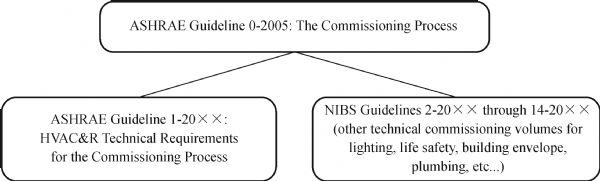
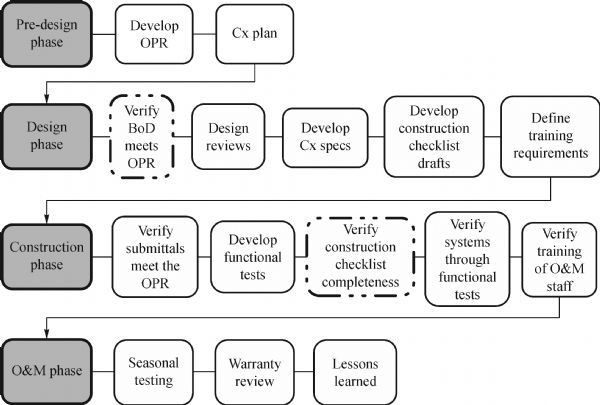
The demand for commissioning services for new-building construction projects is experiencing rapid growth. Commissioning (Cx) is touted as being a quality-focused process for ensuring the owner’s project requirements (OPR) are met by design, final construction, and the operations of a building. To an owner this is just what is needed to receive a perfect building at occupancy. However, as many owners have realized, the Cx process does not guarantee the completed building will be what was expected. It should be pointed out that this is typically not caused by the Cx process, but the Cx process should or could have identified, in the early phases of the project, many of the issues that made it through to the completed building. There are a number of reasons why the Cx services received may not be optimal. Often it is poor communication and the transfer of knowledge between project teams. Cx should and can facilitate both communication and the transfer of knowledge from phase to phase. An adaptation of the quality function deployment (QFD) four-phase model can accomplish this by filling the gaps among the major Cx activities and provide a standard approach to the process. The four-phase model effectively links each of the Cx activities to each other and back to the OPR, providing a method for improved communication and knowledge transfer. This paper investigates some potential reasons for inconsistent Cx services, presents an argument for the need of a Cx standard, and proposes a potential standard.
. [J]. Frontiers of Engineering Management, 2015, 2(1): 39-51.
William L. Gillis, Elizabeth A. Cudney. A Standard for the Commissioning Process. Front. Eng, 2015, 2(1): 39-51.
Commissioning Process Management Professional (CPMP)
ASHRAE
3 projects
No
115 questions 2.5?hours
3 years, 45 PDHs
Certified Commissioning Authority (CxA)
AABC Cx Group
3 projects
No
100 questions 3?hours
Annual fee only
Certified Commissioning Professional (CCP)
BCA
3 projects
Optional
125 questions 2?hours
3 years, proof of continued Cx work
Associate Commissioning Professional (ACP)
BCA
None
Optional
125 questions 2?hours
None
Commissioning Process Authority Provider (Cx-AP)
UW-Madison
2-4 projects, square feet, construction cost minimums
40 hours
4 parts 2.5?hours
5 years, fee only
Qualified Commissioning Process Provider (QCxP)
UW-Madison
None
40 hours
4 parts 2.5?hours
Valid for 5 years
Tab.1
Commissioning certification
Range of professional requirements
ASHRAE’s CPMP range of professional requirements
Government-issued license as a professional engineer or architect with at least 3?years’ facilities operation/management, construction, design, or consulting experience
High school diploma or equivalent or construction-related trades training or building operations training from a nationally or internationally recognized trade association with at least 10 years’ facilities operation/management, construction, design, or consulting experience
BCA’s CCP range of professional requirements
Four-year undergraduate degree or higher in a building science field (such as mechanical or electrical engineering, construction science, and construction) and a minimum of continuous 3?years as Cx provider in a lead role within the past 5?years
Two-year undergraduate degree in a non-building sciences field or high school diploma or general educational development (GED) and a minimum of continuous 3?years as a Cx provider in lead role within the past 5?years and a minimum of 12?years of building-related experience
Tab.2
Fig.3
Building
# of RFIs
Cos
# of warranty issues
# of WOs
# of Cx issues
Quantity
Cost ($ million USD)
Design issues
Construction issues
#1
312
173
$ 3.9
—1
752
—3
—3
#2
23
34
$ 0.2
3
—4
263
44
Tab.3
1
AABC Commissioning Group. (2005). ACG Commissioning Guideline: For Building Owners, Design Professionals, and Commissioning Service Providers. Washington, DC, US: AABC Commissioning Group
2
American Society of Heating, Refrigerating and Air-Conditioning Engineers, Inc. (2005). ASHRAE Guideline 0-2005, the Commissioning Process. Atlanta, GA, US: ASHRAE, Inc.
Building Commissioning Association. (2011). New construction building commissioning best practice. Beaverton, OR, US: Building Commissioning Association
5
California Commissioning Collaborative. (2006). California commissioning guide: New buildings. California: California Commissioning Collaborative
6
S. Doty, (2007a). Quantifying commissioning benefits. Energy Engineering, 104(3), 20–35
7
S. Doty, (2007b). Simplifying the commissioning process. Energy Engineering, 104(2), 25–45
8
S. Doty, (2007c). Tips for applying commissioning. Energy Engineering, 104(3), 6–19
9
R. T Ellis,. (2008). Commissioning: Commissioning is just the start. Engineered Systems, 25(12), 18
10
R. T Ellis,. (2009a). Commissioning: Some solutions really aren’t. Engineered Systems, 26(11), 20
11
R. T Ellis,. (2009b). Commissioning: Commissioning & energy conservation. Engineered Systems, 26(10), 20
12
R. T Ellis,. (2009c). Commissioning and incomplete design documents. Engineered Systems, 26(5), 16
13
H. J Enck,. (2010). Commissioning high performance building. ASHRAE Journal, 52(1), 12
14
E. Mills, H. Friedman, T. Powell, N. Bourassa, D. Claridge, T. Haasl, & M. A. Piette (2004). The cost-effectiveness of commercial-buildings commissioning: A meta-analysis of energy and non-energy impacts in existing buildings and new construction in the United States, LBNL-56637. Berkely, CA, US: Lawrence Berkeley National Laboratory
15
G. R. Newsham,, S. Mancini,, & B. J Birt,. (2009). Do LEED-certified buildings save energy? Yes, but…. Energy and Buildings, 41(8), 897–905 https://doi.org/10.1016/j.enbuild.2009.03.014
16
M. Nicholson,, & K. Molenaar, (2000). Building commissioning: Ensuring quality and savings. In: K. D. Walsh, ed. Proceedings of Construction Congress VI: Building Together for a Better Tomorrow in an Increasingly Complex World. Reston, VA, US: American Society of Civil Engineers, 1074–1082
17
A. Shakoorian, (2006). Performance assessment of building commissioning process as a quality assurance system (Dissertation for the Doctoral Degree). Atlanta, GA, US: Georgia Institute of Technology
18
P. C. Tseng, (2005). Commissioning sustainable buildings. ASHRAE Journal, 47(9), S20–S24
19
C. Turner,, & M. Frankel, (2008). Energy performance of LEED® for new construction buildings. White Salmon, WA, US: New Building Institute. [2013-02-03].
20
U.S. General Services Administration. (2005). The building commissioning guide. Washington, DC, US: U.S. General Services Administration
21
U.S. Green Building Council. (2009). LEED reference guide for green building design and construction. Washington, DC, US: U.S. Green Building Council
22
U.S. Green Building Council. (2010). One billion square Feet of LEED certified green building projects worldwide. 2010-11-10
23
R. Wilkinson, (2012). Commissioning provisions of the international green construction code. Heating Plumbing Air Conditioning, 84(4), 26–31
24
K.M. Ye,, & H. Rahman, (2011). Attentiveness of building commissioning in the Malaysian construction industry. World Academy of Science, Engineering & Technology, 80, 255–259