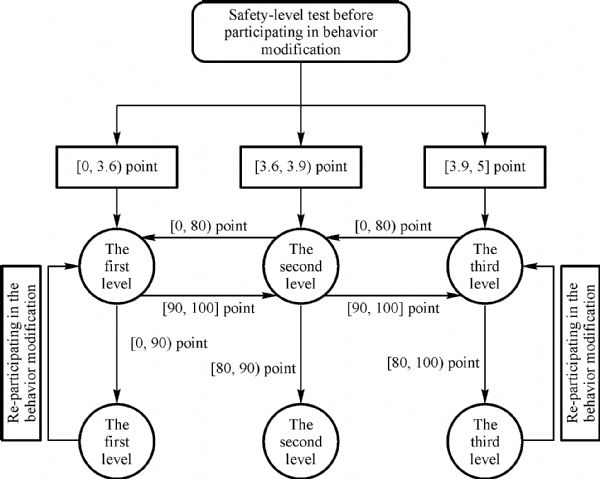
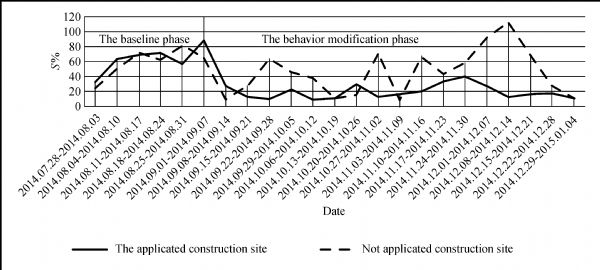
With the rapid development of metro construction in China, construction accidents frequently happen, which are significantly attributable to workers’ unsafe behavior. Behavior-based safety (BBS) is an effective method to modify workers’ unsafe behavior. This paper introduces the study on big data-based metro construction behavior modification, aiming to solve the problem of current research without consideration of workers’ personal characters. First, the behavior modification pushing mechanism based on content-based personalized recommendation is studied. Secondly, the development of behavior modification system of metro construction (BMSMC) is introduced. Thirdly, BMSMC practical applications using the unsafe behavior rate, S as a measuring indicator is implemented. Observations at one metro construction site in Wuhan indicate that the unsafe behavior rate of modified scaffolders at this work place decreased by 69.3%. At the same time, as of unmodified scaffolders at another work place for comparison, the unsafe behavior rate decreased by 56.9%, which validates the effectiveness of this system.
. [J]. Frontiers of Engineering Management, 2015, 2(2): 131-136.
Lie-yun Ding, Sheng-yu Guo. Study on Big Data-based Behavior Modification in Metro Construction. Front. Eng, 2015, 2(2): 131-136.
A. Abbas,, K. Bilal,, L. Zhang,, & S. U. Khan, (2015). A cloud based health insurance plan recommendation system: A user centered approach. Future Generation Computer Systems, 43−44, 99–109 https://doi.org/10.1016/j.future.2014.08.010
2
E. R. Azar,, & B. McCabe, (2012). Automated visual recognition of dump trucks in construction videos. Journal of Computing in Civil Engineering, 26, 769–781 https://doi.org/10.1061/(ASCE)CP.1943-5487.0000179
3
M. Balabanović,, & Y. Shoham, (1997). Fab: Content-based, collaborative recommendation. Communications of the ACM, 40, 66–72 https://doi.org/10.1145/245108.245124
4
M. A. Beyer,, & D. Laney, (2012). The Importance of ‘Big Data’: A Definition. Stamford, CT: Gartner
5
H. Y. Chang,, S. C. Huang,, & C. C. Lai, (2014). A personalized IPTV channel-recommendation mechanism based on the MapReduce frame work. Journal of Supercomputing, 69, 225–247 https://doi.org/10.1007/s11227-014-1145-6
6
D. Chen,, & H. Tian, (2012). Behavior based safety for accidents prevention and positive study in China construction project. Procedia Engineering, 43, 528–534 https://doi.org/10.1016/j.proeng.2012.08.092
7
D. Chen,, & D. Ren, (2015). Behavior based safety (BBS) for accident prevention and positive study in construction enterprise. In: 2015 International Conference on Management Engineering and Management Innovation (ICMEMI-15). Amsterdam: Atlantis Press, 50–57 https://doi.org/10.2991/icmemi-15.2015.10
K. Y. Chung, (2014). Effect of facial makeup style recommendation on visual sensibility. Multimedia Tools and Applications, 71, 843–853 https://doi.org/10.1007/s11042-013-1355-6
10
J. Gantz,, & D. Reinsel, (2011). Extracting value from chaos. IDC Iview, 1142, 9–10
11
E. S. Geller, (2000). The Psychology of Safety Handbook. Boca Raton: CRC Press LLC
12
S. Guo,, H. Luo,, X. Jiang,, & C. Xiong, (2015). Metro worker’s behavior safety knowledge visualization research. China Safety Science Journal, 25, 140–145
13
S. Han,, & S. Lee, (2013). A vision-based motion capture and recognition framework for behavior-based safety management. Automation in Construction, 35, 131–141 . https://doi.org/10.1016/j.autcon.2013.05.001
14
H. W. Heinrich,, D. Petersen,, & N. Roos, (1950). Industrial Accident Prevention. New York: McGraw-Hill
15
M. K. Khrib,, M. Jemni,, & O. Nasraoui, (2009). Automatic recommendations for e-learning personalization based on web usage mining techniques and information retrieval. Educational Technology & Society, 12(4), 30–42 https://doi.org/10.1109/ICALT.2008.198
16
H. Li,, M. Lu,, S. C. Hsu,, M. Gray,, & T. Huang, (2015). Proactive behavior-based safety management for construction safety improvement. Safety Science, 75, 107–117 https://doi.org/10.1016/j.ssci.2015.01.013
17
R. Likert, (1932). A technique for the measurement of attitudes. Archives of Psychology, 22(140), 1–55
18
H. Lingard,, & S. Rowlinson, (1997). Behavior-based safety management in Hong Kong’s construction industry. Journal of Safety Research, 28(4), 243–256 https://doi.org/10.1016/S0022-4375(97)00010-8
19
H. Lingard,, & S. Rowlinson, (2005). Occupational Health and Safety in Construction Project Management. New York: Spon Press
20
S. Liu, (2015). Wuhan metro construction in 2015 [Online message]. Sina Hubei. Retrieved on 2015-July-23 (in Chinese)
21
V. Mayer-Schönberger,, & K. Cukier, (2013). Big Data: A Revolution That Will Transform How We Live, Work, and Think. New York: Houghton Mifflin Harcourt
22
C. Musto, (2010). Enhanced vector space models for content-based recommender systems. In: Proceedings of the Fourth ACM Conference on Recommender Systems. Barcelona: ACM, 361–364 https://doi.org/10.1145/1864708.1864791
23
M. J. Pazzani,, & D. Billsus, (2007). Content-based recommendation systems. In: P. Brusilovsky,, A. Kobsa,, & W. Nejdl,, eds. The Adaptive Web. Berlin: Springer, 325–341 https://doi.org/10.1007/978-3-540-72079-9_10
24
A. Popescul,, D. M. Pennock,, & S. Lawrence, (2001). Probabilistic models for unified collaborative and content-based recommendation in sparse-data environments. In: Proceedings of the 17th Conference on Uncertainty in Artificial Intelligence. San Francisco: Morgan Kaufmann Publishers Inc, 437–444
25
X. Qian,, H. Feng,, G. Zhao,, & T. Mei, (2014). Personalized recommendation combining user interest and social circle. IEEE Transactions on Knowledge and Data Engineering, 26(7), 1763–1777 https://doi.org/10.1109/TKDE.2013.168
26
K. Shrestha,, P. P. Shrestha,, D. Bajracharya,, & E. A. Yfantis, (2015). Hard-hat detection for construction safety visualization. Journal of Construction Engineering, 2015, 1–8 https://doi.org/10.1155/2015/721380
27
G. R. Smith, (1999). A behavior-based approach to construction: Applied behavior analysis for construction safety. Implementation of Safety and Health on Construction Sites, 337
28
J. Teizer,, & P. A. Vela, (2009). Personnel tracking on construction sites using video cameras. Advanced Engineering Informatics, 23(4), 452–462 https://doi.org/10.1016/j.aei.2009.06.011
29
S. Xu,, & H. Luo, (2014). A behavior safety training system based on visual language. Journal of Civil Engineering and Management, 31(3), 51–55, 77
30
M. Zhang,, & D. Fang, (2013). A continuous behavior-based safety strategy for persistent safety improvement in construction industry. Automation in Construction, 34, 101–107 https://doi.org/10.1016/j.autcon.2012.10.019
31
X. Zhou, (2014). Situation of current development of domestic urban rail transit and problems to be concerned [Online forum paper]. World Rail Traffic Net. Retrieved on 2015-July-23 (in Chinese)