1. State Key Joint Laboratory of Environmental Simulation and Pollution Control, School of Environment, Tsinghua University, Beijing 100084, China 2. Yangtze Delta Region Institute of Tsinghua University, Jiaxing 314000, China 3. Guangdong Provincial Key Laboratory of Environmental Pollution Control and Remediation Technology, School of Environmental Science and Engineering, Sun Yat-sen University, Guangzhou 510275, China
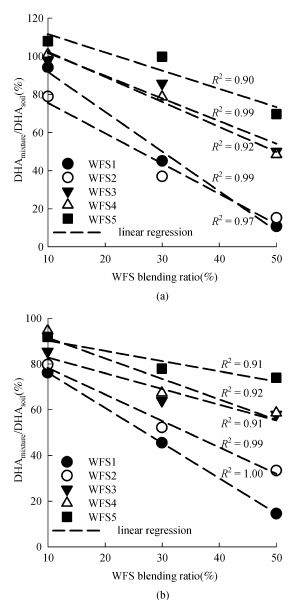
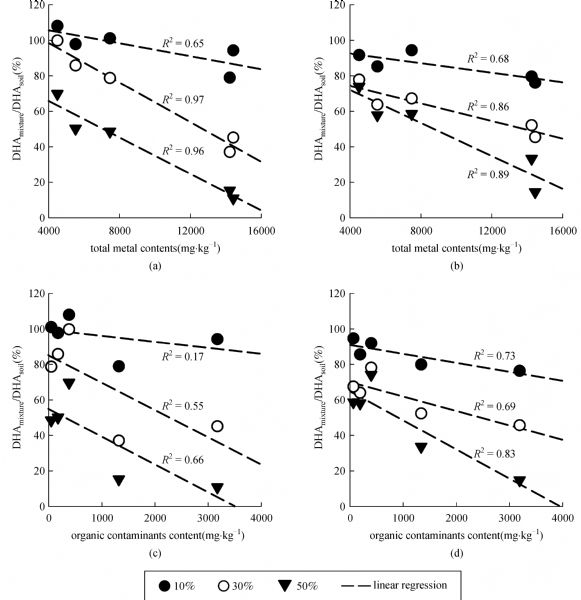
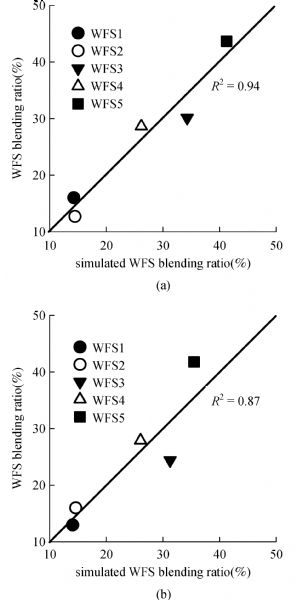
The relationship between the chemical contaminants and soil microbial toxicity of waste foundry sand (WFS) was investigated. Five different types of WFS from typical ferrous, aluminum, and steel foundries in China were examined for total metals, leachable metals, and organic contaminants. The soil microbial toxicity of each WFS was evaluated by measuring the dehydrogenase activity (DHA) of a blended soil and WFS mixture and then comparing it to that of unblended soil. The results show that the five WFSs had very different compositions of metal and organic contaminants and thus exhibited very different levels of soil microbial inhibition when blended with soil. For a given WFS blended with soil in the range of 10 wt.%–50 wt.% WFS, the DHA decreased almost linearly with increased blending ratio. Furthermore, for a given blending ratio, the WFSs with higher concentrations of metal and organic contaminants exhibited greater microbial toxicity. Correlation analysis shows that the relationship between ecotoxicity and metal and organic contaminants of WFSs can be described by an empirical logarithmic linear model. This model may be used to control WFS blending ratios in soil-related applications based on chemical analysis results to prevent significant inhibition of soil microbial activity.
USEPA. EPA Office of Compliance Sector Notebook Project: Profile of the Metal Casting Industry. EPA/310-R-97–004. Wasington, DC: USEPA, 1998
2
USEPA and USDT. Foundry Sand Facts for Civil Engineers. FHWA-IF-04–004. Wasington, DC: USEPA and USDT, 2004
3
USEPA. Beneficial Reuse of Foundry Sand: A Review of State Practices and Regulations. Washington, DC: USEPA, 2002
4
G Owens. CRC CARE Technical Report 7: Development of policies for the handling, disposal and/or beneficial reuse of used foundry sand-a literature review, 2008.
5
Y Wang, F S Cannon, M Salama, J Goudzwaard, J C Furness. Characterization of hydrocarbon emissions from green sand foundry core binders by analytical pyrolysis. Environmental Science & Technology, 2007, 41(22): 7922−7927 https://doi.org/10.1021/es071657o
pmid: 18075109
6
Y Wang, H Huang, F S Cannon, R C Voigt, S Komarneni, J C Furness. Evaluation of volatile hydrocarbon emission characteristics of carbonaceous additives in green sand foundries. Environmental Science & Technology, 2007, 41(8): 2957−2963 https://doi.org/10.1021/es0628295
pmid: 17533864
7
Y Wang, Y Zhang, L Su, X Li, L Duan, C Wang, T Huang. Hazardous air pollutant formation from pyrolysis of typical Chinese casting materials. Environmental Science & Technology, 2011, 45(15): 6539−6544 https://doi.org/10.1021/es200310p
pmid: 21714543
8
Y Wang, F S Cannon, X Li. Comparative analysis of hazardous air pollutant emissions of casting materials measured in analytical pyrolysis and conventional metal pouring emission tests. Environmental Science & Technology, 2011, 45(19): 8529−8535 https://doi.org/10.1021/es2023048
pmid: 21866938
9
R S Dungan. Polycyclic aromatic hydrocarbons and phenolics in ferrous and non-ferrous waste foundry sands. Journal of Residuals Science & Technology, 2006, 3(4): 203−209
10
S Ji, L Wan, Z Fan. The toxic compounds and leaching characteristics of spent foundry sands. Water, Air, and Soil Pollution, 2001, 132(3): 347−364 https://doi.org/10.1023/A:1013207000046
R S Dungan, N H Dees. The characterization of total and leachable metals in foundry molding sands. Journal of Environmental Management, 2009, 90(1): 539−548 https://doi.org/10.1016/j.jenvman.2007.12.004
pmid: 18194836
M G A van der Heijden, R D Bardgett, N M van Straalen. The unseen majority: soil microbes as drivers of plant diversity and productivity in terrestrial ecosystems. Ecology Letters, 2008, 11(3): 296−310 https://doi.org/10.1111/j.1461-0248.2007.01139.x
pmid: 18047587
17
K C Bastian, J E Alleman. Microtox (TM) characterization of foundry sand residuals. Waste Management (New York, N.Y.), 1998, 18(4): 227−234 https://doi.org/10.1016/S0956-053X(98)00030-0
18
USEPA.Acid Digestion of Sediments, Sludges, and Soils. Method 3050B. Washington, DC: USEPA, 1996
19
USEPA. USEPA Contract Laboratory Program. Statement of Work for Inorganics Analysis, Multi-Media Multi-Concentration. Document ILMO 4.0. EPA/540/R95/121 PB95−963545.Washington, DC: USEPA, 1999
20
T Ma, Y Teng, P Christie, Y Luo, Y Chen, M Ye, Y Huang. A new procedure combining GC-MS with accelerated solvent extraction for the analysis of phthalic acid esters in contaminated soils. Frontiers of Environmental Science & Engineering, 2013, 7(1): 31−42 https://doi.org/10.1007/s11783-012-0463-2
21
P Popp, P Keil, M Moder, A Paschke, U Thuss. Application of accelerated solvent extraction followed by gas chromatography, high-performance liquid chromatography and gas chromatography-mass spectrometry for the determination of polycyclic aromatic hydrocarbons, chlorinated pesticides and polychlorinated dibenzo-p-dioxins and dibenzofurans in solid wastes. Journal of Chromatography. A, 1997, 774(1−2): 203−211 https://doi.org/10.1016/S0021-9673(97)00337-3
22
F Wei, J Chen, Y Wu, C Zheng. Study on the soil background value in China. Environmental Sciences, 1991, 12(4): 12−19
23
Ministry of Environmental Protection, General Administration of Quality Supervision, Inspection and Quarantine. GB5085. 3−2007. Identification Standards for Hazardous Wastes-Identification for Extraction Toxicity. Beijing: Ministry of Environmental Protection of the People’s Republic of China, General Administration of Quality Supervision, Inspection and uarantine of the People’s Republic of China, 2007 (in Chinese)
24
D Fahnline, R Sr Regan. Leaching of metals from beneficially used foundry residuals into soils. In: Proceedings of the 50th Industrial Waste Conference, 1995, West Lafayette. Chelsea: Ann Arbor Press, 1996, 5: 339−347
25
E Winkler, A Bol’shakov. Characterization of Foundry Sand Waste. MA: Chelsea Center for Recycling and Economic Development, University of Massachusetts at Lowell, USA, 2000
26
R S Dungan. Headspace solid−phase microextraction (HS‐SPME) for the determination of benzene, toluene, ethylbenzene, and xylenes (BTEX) in foundry molding sand. Analytical Letters, 2005, 38(14): 2393−2405 https://doi.org/10.1080/00032710500318007
27
Y Wang, F S Cannon, M Salama, D A Fonseca, S Giese. Characterization of pyrolysis products from a biodiesel phenolic urethane binder. Environmental Science & Technology, 2009, 43(5): 1559−1564 https://doi.org/10.1021/es8024929
pmid: 19350935
28
R S Dungan, J B Reeves. Pyrolysis of carbonaceous foundry sand additives: seacoal and gilsonite. Thermochimica Acta, 2007, 460(1): 60−66 https://doi.org/10.1016/j.tca.2007.05.020
29
Ministry of Environmental Protection, General Administration of Quality Supervision, Inspection and Quarantine. GB5085.6−2007. Identification Standards for Hazardous Wastes−Identification for Toxic Substance Content. Beijing: Ministry of Environmental Protection of the People’s Republic of China, General Administration of Quality Supervision, Inspection and Quarantine of the People’s Republic of China, 2007 (in Chinese)
30
J P Obbard. Measurement of dehydrogenase activity using 2-p-iodophenyl-3-p-nitrophenyl-5-phenyltetrazolium chloride (INT) in the presence of copper. Biology and Fertility of Soils, 2001, 33(4): 328−330 https://doi.org/10.1007/s003740000332
31
Q Shan, Y Yu, J Yu, J Zhang. Soil enzyme activities and their indication for fertility of urban forest soil. Frontiers of Environmental Science & Engineering in China, 2008, 2(2): 218−223 https://doi.org/10.1007/s11783-008-0037-5
32
A Coz, A Andrés, Á Irabien. Ecotoxicity assessment of stabilized/solidified foundry sludge. Environmental Science & Technology, 2004, 38(6): 1897−1900 https://doi.org/10.1021/es034913f
pmid: 15074704
33
D G Heijerick, C R Janssen, C Karlèn, I Odnevall Wallinder, C Leygraf. Bioavailability of zinc in runoff water from roofing materials. Chemosphere, 2002, 47(10): 1073−1080 https://doi.org/10.1016/S0045-6535(02)00014-0
pmid: 12137040
34
S Ren, P D Frymier. Kinetics of the toxicity of metals to luminescent bacteria. Advances in Environmental Research, 2003, 7(2): 537−547 https://doi.org/10.1016/S1093-0191(02)00022-9
35
J C Dearden, M T D Cronin, A J Dobbs. Quantitative structure-activity relationships as a tool to assess the comparative toxicity of organic chemicals. Chemosphere, 1995, 31(1): 2521−2528 https://doi.org/10.1016/0045-6535(95)00121-N
pmid: 7670864