1. Shaanxi Key Laboratory of Earth Surface System and Environmental Carrying Capacity, College of Urban and Environmental Sciences, Northwest University, Xi’an 710127, China 2. Department of Environment Science, Shaanxi Normal University, Xi’an 710062, China
● A machine learning path for predicting biochar adsorption efficiency was constructed.
● Stacking model has exhibited better prediction accuracy and generalization ability.
● The proposed method could be used to optimize the preparation conditions of biochars.
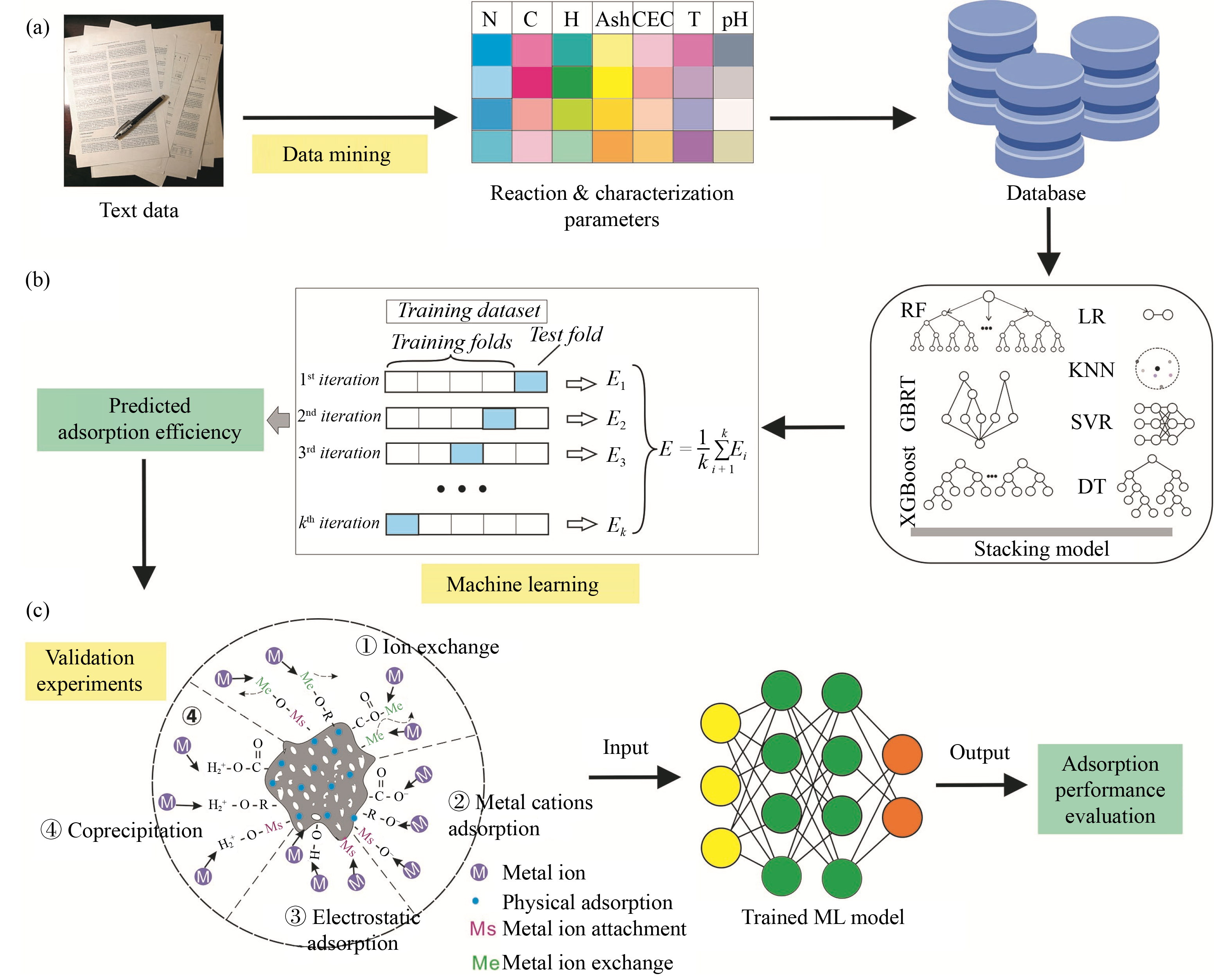
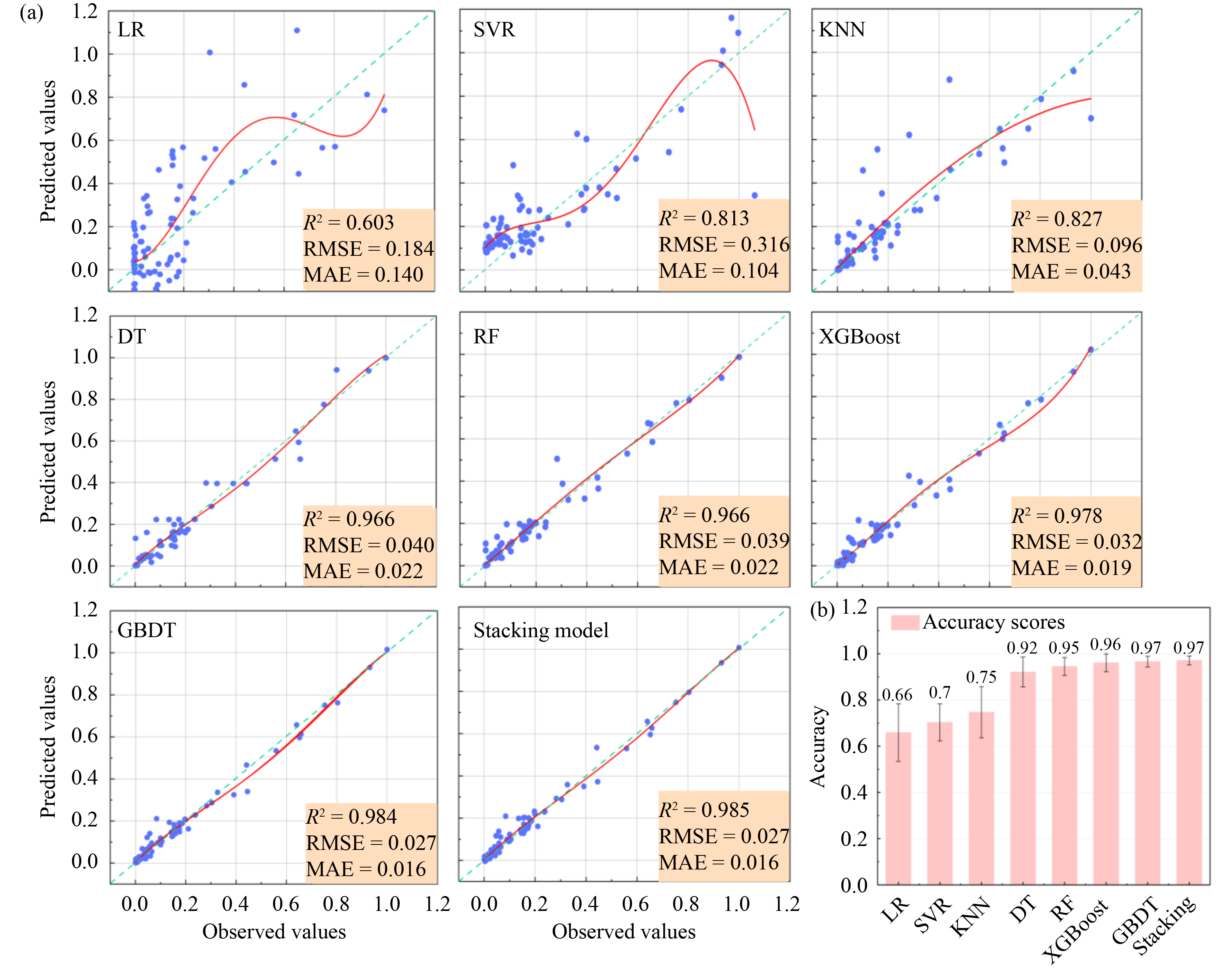
Heavy metals (HMs) represent pervasive and highly toxic environmental pollutants, known for their long latency periods and high toxicity levels, which pose significant challenges for their removal and degradation. Therefore, the removal of heavy metals from the environment is crucial to ensure the water safety. Biochar materials, known for their intricate pore structures and abundant oxygen-containing functional groups, are frequently harnessed for their effectiveness in mitigating heavy metal contamination. However, conventional tests for optimizing biochar synthesis and assessing their heavy metal adsorption capabilities can be both costly and tedious. To address this challenge, this paper proposes a data-driven machine learning (ML) approach to identify the optimal biochar preparation and adsorption reaction conditions, with the ultimate goal of maximizing their adsorption capacity. By utilizing a data set comprising 476 instances of heavy metal absorption by biochar, seven classical integrated models and one stacking model were trained to rapidly predict the efficiency of heavy metal adsorption by biochar. These predictions were based on diverse physicochemical properties of biochar and the specific adsorption reaction conditions. The results demonstrate that the stacking model, which integrates multiple algorithms, allows for training with fewer samples to achieve higher prediction accuracy and improved generalization ability.
D T Ahneman , J G Estrada , S Lin , S D Dreher , A G Doyle . (2018). Predicting reaction performance in C–N cross-coupling using machine learning. Science, 360(6385): 186–190 https://doi.org/10.1126/science.aar5169
R M Balabin , E I Lomakina . (2011). Support vector machine regression (SVR/LS-SVM): an alternative to neural networks (ANN) for analytical chemistry? Comparison of nonlinear methods on near infrared (NIR) spectroscopy data. Analyst (London), 136(8): 1703–1712 https://doi.org/10.1039/c0an00387e
A Chen , X Zhang , Z Zhou . (2020). Machine learning: accelerating materials development for energy storage and conversion. InfoMat, 2(3): 553–576 https://doi.org/10.1002/inf2.12094
6
T Chen , T He , M Benesty , V Khotilovich , Y Tang , H Cho , K Chen , R Mitchell , I Cano , T Zhou . (2015). Xgboost: extreme gradient boosting. R package version 0.4–2, 1(4): 1–4
7
J G Greener , S M Kandathil , L Moffat , D T Jones . (2022). A guide to machine learning for biologists. Nature Reviews. Molecular Cell Biology, 23(1): 40–55 https://doi.org/10.1038/s41580-021-00407-0
8
G GuoH WangD BellY BiK (2003) Greer. KNN model-based approach in classification. In: Robert M, Zahir T, eds. On The Move to Meaningful Internet Systems 2003: CoopIS, DOA, and ODBASE. Berlin: Springer
9
M I Jordan , T M Mitchell . (2015). Machine learning: Trends, perspectives, and prospects. Science, 349(6245): 255–260 https://doi.org/10.1126/science.aaa8415
10
Kingsford C, Salzberg S L (2008). What are decision trees? Nature Biotechnology, 26(9): 1011–1013
11
D Lakshmi , D Akhil , A Kartik , K P Gopinath , J Arun , A Bhatnagar , J Rinklebe , W Kim , G Muthusamy . (2021). Artificial intelligence (AI) applications in adsorption of heavy metals using modified biochar. Science of the Total Environment, 801: 149623 https://doi.org/10.1016/j.scitotenv.2021.149623
12
K Liu , X Guan , C Li , K Zhao , X Yang , R Fu , Y Li , F Yu . (2022). Global perspectives and future research directions for the phytoremediation of heavy metal-contaminated soil: a knowledge mapping analysis from 2001 to 2020. Frontiers of Environmental Science & Engineering, 16(6): 73 https://doi.org/10.1007/s11783-021-1507-2
13
B Mahesh . (2020). Machine learning algorithms: a review. International Journal of Scientific Research, 9: 381–386
14
M Mao , T Yan , J Shen , J Zhang , D Zhang . (2021). Capacitive removal of heavy metal Ions from wastewater via an electro-adsorption and electro-reaction coupling process. Environmental Science & Technology, 55(5): 3333–3340 https://doi.org/10.1021/acs.est.0c07849
B J Ni , Q S Huang , C Wang , T Y Ni , J Sun , W Wei . (2019). Competitive adsorption of heavy metals in aqueous solution onto biochar derived from anaerobically digested sludge. Chemosphere, 219: 351–357 https://doi.org/10.1016/j.chemosphere.2018.12.053
17
B (2018) Pavlyshenko. Using Stacking Approaches for Machine Learning Models. IEEE International Conference on Data Stream Mining & Processing. New York: IEEE
18
H Qiao , Y Qiao , C Sun , X Ma , J Shang , X Li , F Li , H Zheng . (2023). Biochars derived from carp residues: characteristics and copper immobilization performance in water environments. Frontiers of Environmental Science & Engineering, 17(6): 72 https://doi.org/10.1007/s11783-023-1672-6
19
H Qin , T Hu , Y Zhai , N Lu , J Aliyeva . (2020). The improved methods of heavy metals removal by biosorbents: a review. Environmental Pollution, 258: 113777 https://doi.org/10.1016/j.envpol.2019.113777
20
B Qiu , X Tao , H Wang , W Li , X Ding , H Chu . (2021). Biochar as a low-cost adsorbent for aqueous heavy metal removal: a review. Journal of Analytical and Applied Pyrolysis, 155: 105081 https://doi.org/10.1016/j.jaap.2021.105081
21
M Rahimi , M H Abbaspour-Fard , A Rohani . (2021). Machine learning approaches to rediscovery and optimization of hydrogen storage on porous bio-derived carbon. Journal of Cleaner Production, 329: 129714 https://doi.org/10.1016/j.jclepro.2021.129714
22
S A Rebuffi , S Gowal , D A Calian , F Stimberg , O Wiles , T A Mann . (2021). Data augmentation can improve robustness. Advances in Neural Information Processing Systems, 34: 29935–29948
23
J L Santos , P Mäki-Arvela , A Monzón , D Y Murzin , M Á Centeno . (2020). Metal catalysts supported on biochars: Part I. Synthesis and characterization. Applied Catalysis B: Environmental, 268: 118423 https://doi.org/10.1016/j.apcatb.2019.118423
24
G A SeberA J (2003) Lee. Linear Regression Analysis. New York: John Wiley & Sons
25
T ToyaoZ MaenoS TakakusagiT KamachiI TakigawaK I (2020 ) Shimizu. Machine learning for catalysis informatics: recent applications and prospects. ACS Catalysis, 10(3): 2260−2297
26
X Wang , Y Sheng , J Ning , J Xi , L Xi , D Qiu , J Yang , X Ke . (2023). A critical review of machine learning techniques on thermoelectric materials. Journal of Physical Chemistry Letters, 14(7): 1808–1822 https://doi.org/10.1021/acs.jpclett.2c03073
27
J H (2005) Zar. Sepearman Rank Correlation. New York: John Wiley & Sons
28
M Zhang , G Song , D L Gelardi , L Huang , E Khan , O Masek , S J Parikh , Y S Ok . (2020). Evaluating biochar and its modifications for the removal of ammonium, nitrate, and phosphate in water. Water Research, 186: 116303 https://doi.org/10.1016/j.watres.2020.116303
29
Z H (2021) Zhou. Machine Learning. Berlin: Springer Nature