Keratin 5-Cre-driven deletion of Ncstn in an acne inversa-like mouse model leads to a markedly increased IL-36a and Sprr2 expression
Jun Yang1, Lianqing Wang1,2, Yingzhi Huang1, Keqiang Liu1, Chaoxia Lu1, Nuo Si1, Rongrong Wang1, Yaping Liu1(), Xue Zhang1()
1. McKusick-Zhang Center for Genetic Medicine, State Key Laboratory of Medical Molecular Biology, Institute of Basic Medical Sciences Chinese Academy of Medical Sciences, School of Basic Medicine Peking Union Medical College, Beijing 100005, China 2. Center of Translational Medicine, Central Hospital of Zibo, Shandong University, Zibo 255036, China
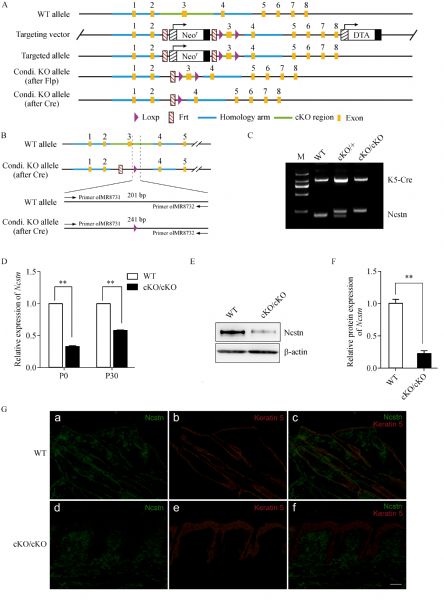
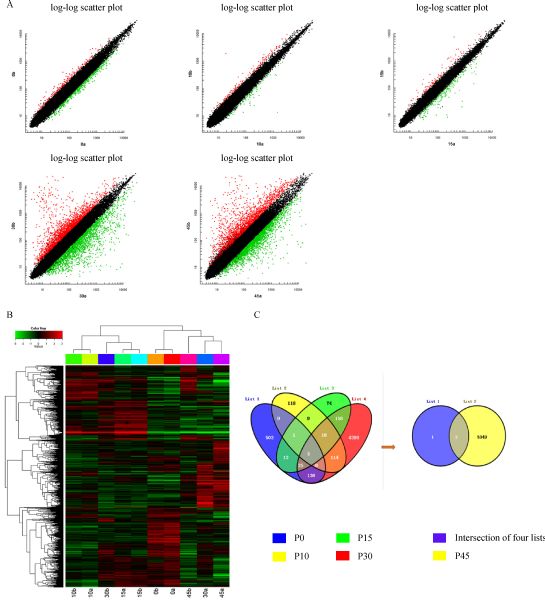
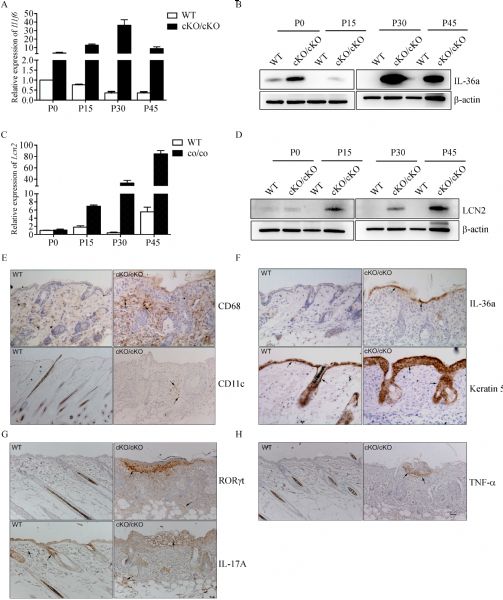
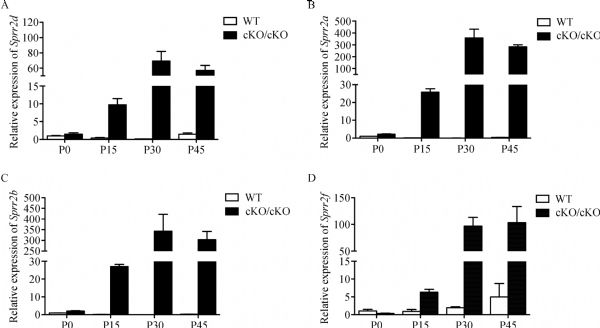
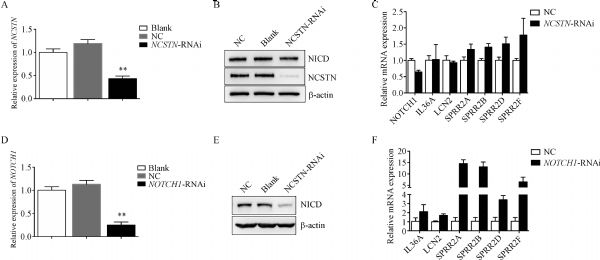
Familial acne inversa (AI) is an autoinflammatory disorder that affects hair follicles and is caused by loss-of-function mutations in g-secretase component genes. We and other researchers showed that nicastrin (NCSTN) is the most frequently mutated gene in familial AI. In this study, we generated a keratin 5-Cre-driven epidermis-specific Ncstn conditional knockout mutant in mice. We determined that this mutant recapitulated the major phenotypes of AI, including hyperkeratosis of hair follicles and inflammation. In Ncstnflox/flox;K5-Cre mice, the IL-36a expression level markedly increased starting from postnatal day 0 (P0), and this increase occurred much earlier than those of TNF-α, IL-23A, IL-1b, and TLR4. RNA-Seq analysis indicated that Sprr2d, a member of the small proline-rich protein 2 family, in the skin tissues of the Ncstnflox/flox;K5-Cre mice was also upregulated on P0. Quantitative reverse-transcription polymerase chain reaction showed that other Sprr2 genes had a similar expression pattern. Our findings suggested that IL-36a might be a key inflammatory cytokine in the pathophysiology of AI and implicate malfunction of the skin barrier in the pathogenesis of AI.
A Garg, JS Kirby, J Lavian, G Lin, A Strunk. Sex- and age-adjusted population analysis of prevalence estimates for hidradenitis suppurativa in the United States. JAMA Dermatol 2017; 153(8): 760–764 https://doi.org/10.1001/jamadermatol.2017.0201
pmid: 28492923
3
JE Revuz, F Canoui-Poitrine, P Wolkenstein, C Viallette, G Gabison, F Pouget, F Poli, O Faye, JC Roujeau, G Bonnelye, JJ Grob, S Bastuji-Garin. Prevalence and factors associated with hidradenitis suppurativa: results from two case-control studies. J Am Acad Dermatol 2008; 59(4): 596–601 https://doi.org/10.1016/j.jaad.2008.06.020
pmid: 18674845
4
C Coughlan, W Ledger, Q Wang, F Liu, A Demirol, T Gurgan, R Cutting, K Ong, H Sallam, TC Li. Recurrent implantation failure: definition and management. Reprod Biomed Online 2014; 28(1): 14–38 https://doi.org/10.1016/j.rbmo.2013.08.011
pmid: 24269084
5
GB Jemec, M Heidenheim, NH Nielsen. The prevalence of hidradenitis suppurativa and its potential precursor lesions. J Am Acad Dermatol 1996; 35(2 Pt 1): 191–194 https://doi.org/10.1016/S0190-9622(96)90321-7
pmid: 8708018
M Gao, PG Wang, Y Cui, S Yang, YH Zhang, D Lin, KY Zhang, YH Liang, LD Sun, KL Yan, FL Xiao, W Huang, XJ Zhang. Inversa acne (hidradenitis suppurativa): a case report and identification of the locus at chromosome 1p21.1-1q25.3. J Invest Dermatol 2006; 126(6): 1302–1306 https://doi.org/10.1038/sj.jid.5700272
pmid: 16543891
Y Nomura, T Nomura, S Suzuki, M Takeda, O Mizuno, Y Ohguchi, R Abe, Y Murata, H Shimizu. A novel NCSTN mutation alone may be insufficient for the development of familial hidradenitis suppurativa. J Dermatol Sci 2014; 74(2): 180–182 https://doi.org/10.1016/j.jdermsci.2014.01.013
pmid: 24581508
13
B Wang, W Yang, W Wen, J Sun, B Su, B Liu, D Ma, D Lv, Y Wen, T Qu, M Chen, M Sun, Y Shen, X Zhang. γ-Secretase gene mutations in familial acne inversa. Science 2010; 330(6007): 1065 https://doi.org/10.1126/science.1196284
pmid: 20929727
EJ Giamarellos-Bourboulis, A Antonopoulou, C Petropoulou, M Mouktaroudi, E Spyridaki, F Baziaka, A Pelekanou, H Giamarellou, NG Stavrianeas. Altered innate and adaptive immune responses in patients with hidradenitis suppurativa. Br J Dermatol 2007; 156(1): 51–56 https://doi.org/10.1111/j.1365-2133.2006.07556.x
pmid: 17199566
19
Q Chen, H Bao, H Wu, S Zhao, S Huang, F Zhao. Diagnosis of cobalamin C deficiency with renal abnormality from onset in a Chinese child by next generation sequencing: a case report. Exp Ther Med 2017; 14(4): 3637–3643 https://doi.org/10.3892/etm.2017.4970
pmid: 29042959
A Kurayev, H Ashkar, A Saraiya, AB Gottlieb. Hidradenitis suppurativa: review of the pathogenesis and treatment. J Drugs Dermatol 2016; 15(8): 1017–1022
pmid: 27538005
22
G Kelly, R Hughes, T McGarry, M van den Born, K Adamzik, R Fitzgerald, C Lawlor, AM Tobin, CM Sweeney, B Kirby. Dysregulated cytokine expression in lesional and nonlesional skin in hidradenitis suppurativa. Br J Dermatol 2015; 173(6): 1431–1439 https://doi.org/10.1111/bjd.14075
pmid: 26282467
23
L Tong, RM Corrales, Z Chen, AL Villarreal, CS De Paiva, R Beuerman, DQ Li, SC Pflugfelder. Expression and regulation of cornified envelope proteins in human corneal epithelium. Invest Ophthalmol Vis Sci 2006; 47(5): 1938–1946 https://doi.org/10.1167/iovs.05-1129
pmid: 16639001
24
Affymetrix. GeneChip® Expression Analysis. Data Analysis Fundamentals. 2004
25
S Anders, W Huber. Differential expression of RNA-Seq data at the gene level — the DESeq package. DESeq version 1.38.0. European Molecular Biology Laboratory (EMBL). 2013
26
L Wang, Z Feng, X Wang, X Wang, X Zhang. DEGseq: an R package for identifying differentially expressed genes from RNA-seq data. Bioinformatics 2010; 26(1): 136–138 https://doi.org/10.1093/bioinformatics/btp612
pmid: 19855105
27
Y Nomura, T Nomura, S Suzuki, M Takeda, O Mizuno, Y Ohguchi, R Abe, Y Murata, H Shimizu. A novel NCSTN mutation alone may be insufficient for the development of familial hidradenitis suppurativa. J Dermatol Sci 2014; 74(2): 180–182 https://doi.org/10.1016/j.jdermsci.2014.01.013
pmid: 24581508
28
X Zhang, SS Sisodia. Acne inversa caused by missense mutations in NCSTN is not fully compatible with impairments in Notch signaling. J Invest Dermatol 2015; 135(2): 618–620 https://doi.org/10.1038/jid.2014.399
pmid: 25211177
29
X Xiao, Y He, C Li, X Zhang, H Xu, B Wang. Nicastrin mutations in familial acne inversa impact keratinocyte proliferation and differentiation through the Notch and phosphoinositide 3-kinase/AKT signalling pathways. Br J Dermatol 2016; 174(3): 522–532 https://doi.org/10.1111/bjd.14223
pmid: 26473517
30
L Yang, C Mao, Y Teng, W Li, J Zhang, X Cheng, X Li, X Han, Z Xia, H Deng, X Yang. Targeted disruption of Smad4 in mouse epidermis results in failure of hair follicle cycling and formation of skin tumors. Cancer Res 2005; 65(19): 8671–8678 https://doi.org/10.1158/0008-5472.CAN-05-0800
pmid: 16204035
31
A Ramirez, A Page, A Gandarillas, J Zanet, S Pibre, M Vidal, L Tusell, A Genesca, DA Whitaker, DW Melton, JL Jorcano. A keratin K5Cre transgenic line appropriate for tissue-specific or generalized Cre-mediated recombination. Genesis 2004; 39(1): 52–57 https://doi.org/10.1002/gene.20025
pmid: 15124227
32
B Wang, W Yang, W Wen, J Sun, B Su, B Liu, D Ma, D Lv, Y Wen, T Qu, M Chen, M Sun, Y Shen, X Zhang. γ-Secretase gene mutations in familial acne inversa. Science 2010; 330(6007): 1065 https://doi.org/10.1126/science.1196284
pmid: 20929727
33
AE Pink, MA Simpson, N Desai, RC Trembath, JNW Barker. γ-Secretase mutations in hidradenitis suppurativa: new insights into disease pathogenesis. J Invest Dermatol 2013; 133(3): 601–607 https://doi.org/10.1038/jid.2012.372
pmid: 23096707
34
MA Boutet, G Bart, M Penhoat, J Amiaud, B Brulin, C Charrier, F Morel, JC Lecron, M Rolli-Derkinderen, A Bourreille, S Vigne, C Gabay, G Palmer, B Le Goff, F Blanchard. Distinct expression of interleukin (IL)-36a, b and g, their antagonist IL-36Ra and IL-38 in psoriasis, rheumatoid arthritis and Crohn’s disease. Clin Exp Immunol 2016; 184(2): 159–173 https://doi.org/10.1111/cei.12761
pmid: 26701127
35
AE Pink, MA Simpson, GW Brice, CH Smith, N Desai, PS Mortimer, JN Barker, RC Trembath. PSENEN and NCSTN mutations in familial hidradenitis suppurativa (acne inversa). J Invest Dermatol 2011; 131(7): 1568–1570 https://doi.org/10.1038/jid.2011.42
pmid: 21412258
36
H Xu, X Xiao, Y Hui, X Zhang, Y He, C Li, B Wang. Phenotype of 53 Chinese individuals with nicastrin gene mutations in association with familial hidradenitis suppurativa (acne inversa). Br J Dermatol 2016; 174(4): 927–929 https://doi.org/10.1111/bjd.14268
pmid: 26522179
37
HH van der Zee, JD Laman, J Boer, EP Prens. Hidradenitis suppurativa: viewpoint on clinical phenotyping, pathogenesis and novel treatments. Exp Dermatol 2012; 21(10): 735–739 https://doi.org/10.1111/j.1600-0625.2012.01552.x
pmid: 22882284
38
JW van der Meer, A Simon. The challenge of autoinflammatory syndromes: with an emphasis on hyper-IgD syndrome. Rheumatology (Oxford) 2016; 55(suppl 2): ii23–ii29 https://doi.org/10.1093/rheumatology/kew351
pmid: 27856657
39
S Hessam, M Sand, T Gambichler, M Skrygan, I Rüddel, FG Bechara. Interleukin-36 in hidradenitis suppurativa: evidence for a distinctive proinflammatory role and a key factor in the development of an inflammatory loop. Br J Dermatol 2018; 178(3): 761–767 https://doi.org/10.1111/bjd.16019
pmid: 28975626
40
E Witte-Händel, K Wolk, A Tsaousi, ML Irmer, R Mößner, O Shomroni, T Lingner, K Witte, D Kunkel, G Salinas, S Jodl, N Schmidt, W Sterry, HD Volk, EJ Giamarellos-Bourboulis, A Pokrywka, WD Döcke, S Schneider-Burrus, R Sabat. The IL-1 pathway is hyperactive in hidradenitis suppurativa and contributes to skin infiltration and destruction. J Invest Dermatol 2019; 139(6): 1294–1305 https://doi.org/10.1016/j.jid.2018.11.018
pmid: 30528824
41
R Thomi, M Kakeda, N Yawalkar C Schlapbach, RE Hunger. Increased expression of the interleukin-36 cytokines in lesions of hidradenitis suppurativa. J Eur Acad Dermatol Venereol 2017; 31(12): 2091–2096 https://doi.org/10.1111/jdv.14389
42
R Di Caprio, A Balato, G Caiazzo, S Lembo, A Raimondo, G Fabbrocini, G Monfrecola. IL-36 cytokines are increased in acne and hidradenitis suppurativa. Arch Dermatol Res 2017; 309(8): 673–678 https://doi.org/10.1007/s00403-017-1769-5
pmid: 28852851
43
DE Smith, BR Renshaw, RR Ketchem, M Kubin, KE Garka, JE Sims. Four new members expand the interleukin-1 superfamily. J Biol Chem 2000; 275(2): 1169–1175 https://doi.org/10.1074/jbc.275.2.1169
pmid: 10625660
44
Y Carrier, HL Ma, HE Ramon, L Napierata, C Small, M O’Toole, DA Young, LA Fouser, C Nickerson-Nutter, M Collins, K Dunussi-Joannopoulos, QG Medley. Inter-regulation of Th17 cytokines and the IL-36 cytokines in vitro and in vivo: implications in psoriasis pathogenesis. J Invest Dermatol 2011; 131(12): 2428–2437 https://doi.org/10.1038/jid.2011.234
pmid: 21881584
45
H Blumberg, H Dinh, ES Trueblood, J Pretorius, D Kugler, N Weng, ST Kanaly, JE Towne, CR Willis, MK Kuechle, JE Sims, JJ Peschon. Opposing activities of two novel members of the IL-1 ligand family regulate skin inflammation. J Exp Med 2007; 204(11): 2603–2614 https://doi.org/10.1084/jem.20070157
pmid: 17908936
46
JE Towne, KE Garka, BR Renshaw, GD Virca, JE Sims. Interleukin (IL)-1F6, IL-1F8, and IL-1F9 signal through IL-1Rrp2 and IL-1RAcP to activate the pathway leading to NF-κB and MAPKs. J Biol Chem 2004; 279(14): 13677–13688 https://doi.org/10.1074/jbc.M400117200
pmid: 14734551
47
S Vigne, G Palmer, P Martin, C Lamacchia, D Strebel, E Rodriguez, ML Olleros, D Vesin, I Garcia, F Ronchi, F Sallusto, JE Sims, C Gabay. IL-36 signaling amplifies Th1 responses by enhancing proliferation and Th1 polarization of naive CD4+ T cells. Blood 2012; 120(17): 3478–3487 https://doi.org/10.1182/blood-2012-06-439026
pmid: 22968459
48
BC Melnik, G Plewig. Impaired Notch-MKP-1 signalling in hidradenitis suppurativa: an approach to pathogenesis by evidence from translational biology. Exp Dermatol 2013; 22(3): 172–177 https://doi.org/10.1111/exd.12098
pmid: 23489419
49
K Wolk, J Wenzel, A Tsaousi, E Witte-Händel, N Babel, C Zelenak, HD Volk, W Sterry, S Schneider-Burrus, R Sabat. Lipocalin-2 is expressed by activated granulocytes and keratinocytes in affected skin and reflects disease activity in acne inversa/hidradenitis suppurativa. Br J Dermatol 2017; 177(5): 1385–1393 https://doi.org/10.1111/bjd.15424
pmid: 28256718
50
PM Steinert, E Candi, T Kartasova, L Marekov. Small proline-rich proteins are cross-bridging proteins in the cornified cell envelopes of stratified squamous epithelia. J Struct Biol 1998; 122(1-2): 76–85 https://doi.org/10.1006/jsbi.1998.3957
pmid: 9724607
51
N Wakabayashi, S Shin, SL Slocum, ES Agoston, J Wakabayashi, MK Kwak, V Misra, S Biswal, M Yamamoto, TW Kensler. Regulation of notch1 signaling by nrf2: implications for tissue regeneration. Sci Signal 2010; 3(130): ra52 https://doi.org/10.1126/scisignal.2000762
pmid: 20628156
52
M Schfer, H Farwanah, AH Willrodt, AJ Huebner, K Sandhoff, D Roop, D Hohl, W Bloch, S Werner. Nrf2 links epidermal barrier function with antioxidant defense. EMBO Mol Med 2012(4): 364–379 https://doi.org/10.1002/emmm.201200219
N Wakabayashi, JJ Skoko, DV Chartoumpekis, S Kimura, SL Slocum, K Noda, DL Palliyaguru, M Fujimuro, PA Boley, Y Tanaka, N Shigemura, S Biswal, M Yamamoto, TW Kensler. Notch-Nrf2 axis: regulation of Nrf2 gene expression and cytoprotection by Notch signaling. Mol Cell Biol 2014; 34(4): 653–663 https://doi.org/10.1128/MCB.01408-13
pmid: 24298019