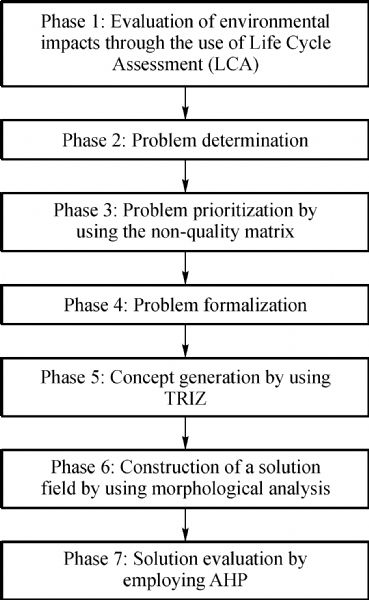
This study proposes an eco-innovative design process taking into consideration quality and environmental aspects in prioritizing and solving technical engineering problems. This approach provides a synergy between the Life Cycle Assessment (LCA), the non-quality matrix, the Theory of Inventive Problem Solving (TRIZ), morphological analysis and the Analytical Hierarchy Process (AHP). In the sequence of these tools, LCA assesses the environmental impacts generated by the system. Then, for a better consideration of environmental aspects, a new tool is developed, the non-quality matrix, which defines the problem to be solved first from an environmental point of view. The TRIZ method allows the generation of new concepts and contradiction resolution. Then, the morphological analysis offers the possibility of extending the search space of solutions in a design problem in a systematic way. Finally, the AHP identifies the promising solution(s) by providing a clear logic for the choice made. Their usefulness has been demonstrated through their application to a case study involving a centrifugal spreader with spinning discs.
Leakage (the product falls without going through spreading equipment)
1
1
1
1
Poor border spreading
1
1
1
Presence of big clods
5
Tab.5
Identified problems k
Environmental impacts j
Flow rate variation during time of discharge
Low quality of the spread pattern
Leakage
Poor border spreading
Presence of big clods
Abiotic depletion
0
0
0
0
0
Global warming
0
0
0
0
0
Ozone layer depletion
0
0
0
0
0
Human toxicity
27
24
9
6
0
Fresh water aquatic ecotoxicity
27
24
9
6
0
Marine aquatic ecotoxicity
9
8
3
2
0
Terrestrial ecotoxicity
45
40
15
10
0
Photochemical oxidation
0
0
0
0
0
Acidification
9
8
3
2
0
Eutrophication
45
40
15
10
5
Sum
162
144
54
36
5
Relative weighting /%
34.7
30.8
11.6
7.7
1.1
Tab.6
Fig.7
Fig.8
Subsystems
Characteristics
Configuration 1
Configuration 2
Air
Departure
The air exits on each side
The air exits in the middle of the hopper
Sequence
One by one
Two by two
Tube
Location
On a portion of the hopper
Through the hopper
Height
At the top of the slope
In the middle of the slope
Tab.7
Fig.9
Intensity of importance
Definition
1
Equal importance
2
Equal to moderate importance
3
Moderate importance
4
Moderate to strong importance
5
Strong importance
6
Strong to very strong importance
7
Very strong importance
8
Very to extremely strong importance
9
Extreme importance
Tab.8
Main criteria
Sub-criteria
Weighting
A
B
C
D
E
CR
Environment
Mass of the system
0.021
0.138
0.092
0.032
0.441
0.297
0.0508
Energy consumption
0.043
0.077
0.282
0.453
0.145
0.043
0.0485
Economic
Cost
0.276
0.449
0.297
0.137
0.058
0.058
0.0212
Maintenance load
0.092
0.154
0.308
0.308
0.154
0.077
0.0000
Technique
Adaptability
0.026
0.273
0.091
0.091
0.273
0.273
0.0000
Aggression resistance
0.048
0.250
0.125
0.125
0.250
0.250
0.0000
Manufacturability
0.048
0.260
0.138
0.082
0.260
0.260
0.0022
Pertinence
0.090
0.271
0.271
0.057
0.130
0.271
0.0013
Ergonomics and security
Ease of use
0.089
0.141
0.141
0.248
0.141
0.330
0.0132
Ease of maintenance
0.034
0.250
0.125
0.125
0.250
0.250
0.0000
Safety
0.156
0.100
0.246
0.143
0.266
0.246
0.0125
Marketing
Originality
0.032
0.158
0.158
0.298
0.089
0.298
0.0030
Patentability
0.011
0.273
0.273
0.273
0.091
0.091
0.0000
Reputational value
0.032
0.235
0.235
0.100
0.089
0.340
0.0326
Global priorities
0.253
0.235
0.168
0.158
0.185
Rank
1
2
4
5
3
Tab.9
Fig.10
Fig.11
Fig.12
Fig.13
1
W F Hoffman. A tiered approach to design for environment. In: International Conference on Clean Electronics Products and Technology. Edimbourg, 1995
2
C Fussler, P James. Driving Eco-innovation: A Breakthrough Discipline for Innovation and Sustainability. London: Pitman Publishing, 1996
3
T E Graedel, B R Allenby. Design for Environment. London: Prentice Hall, 1996
4
Volvo. Corporate standards for materials. 2012
5
Bombardier. Prohibited and restricted substances for transportation. 2005
6
J L Chen, C C Liu. Green innovation design of products by TRIZ inventive principles and green evolution rules. In: International CIRP Design Seminar. Hong Kong, 2002
7
J L Chen, C C Liu. An eco-innovative design approach incorporating the TRIZ method without contradiction analysis. The Journal of Sustainable Product Design, 2001, 1(4): 263–272 https://doi.org/10.1023/A:1024621524160
8
H Kobayashi. Strategic evolution of eco-products: A product life cycle planning methodology. Research in Engineering Design, 2005, 16(1–2): 1–16 https://doi.org/10.1007/s00163-005-0001-3
9
H Kobayashi. A systematic approach to eco-innovative product design based on life cycle planning. Advanced Engineering Informatics, 2006, 20(2): 113–125 https://doi.org/10.1016/j.aei.2005.11.002
10
S B Yen, T Chen. An eco-innovative tool by integrating FMEA and TRIZ methods. In: Fourth International Symposium on Environmentally Conscious Design and Inverse Manufacturing. Tokyo: IEEE, 2005, 678–683
11
J Fresner, J Jantschgi, S Birkel, J Bärnthaler, C Krenn. The theory of inventive problem solving (TRIZ) as option generation tool within cleaner production projects. Journal of Cleaner Production, 2010, 18(2): 128–136 https://doi.org/10.1016/j.jclepro.2009.08.012
12
C J Yang, J L Chen. Accelerating preliminary eco-innovation design for products that integrates case-based reasoning and TRIZ method. Journal of Cleaner Production, 2011, 19(9–10): 998–1006 https://doi.org/10.1016/j.jclepro.2011.01.014
13
E Jones, D Harisson, J McLaren. Managing Creative Eco-innovation. The Journal of Sustainable Product Design, 2001, 1(1): 27–39 https://doi.org/10.1023/A:1014494005565
14
C Vezzoli, E Manzini. Design for Environmental Sustainability. London: Springer, 2008
15
J Terninko, A Zusman, B Zlotin. Systematic Innovation: An Introduction to TRIZ. Boca Raton: CRC Press, 1998
16
B Portwood, L Reising. Root cause analysis and quantitative methods–Yin and Yang? In: Proceedings of the 25th International System Safety Conference. Baltimore: System Safety Organization, 2007
17
G S Altshuller. Creativity as an Exact Science. New York: Gordon & Breach, 1988
18
G S Altshuller. And Suddenly the Inventor Appeared: TRIZ, the Theory of Inventive Problem Solving. 2nd ed. Worcester: Technical Innovation Center, Inc., 1994
19
Y Salamatov. TRIZ: The Right Solution at the Right Time. Enschede: Insytec B V, 1999
20
S Savransky. Engineering of Creativity: Introduction to TRIZ Methodology of Inventive Problem Solving. Boca Raton: CRC Press, 2000
21
M W Maier, E Rechtin. The Art of Systems Architecting. 2nd ed. Boca Raton: CRC Press, 2000
22
F Zwicky. Discovery, Invention, Research—Through the Morphological Approach. Toronto: The Macmillan Company, 1969
23
F Zwicky, A G Wilson. New Methods of Thought and Procedure. Contributions to the Symposium on Methodologies. Berlin: Springer, 1967
24
J C Pomerol, S Barba-Romero. Choix Multicritère Dans L’Entreprise. Paris: Hermes Science Publications, 1993