Efficient, high-resolution topology optimization method based on convolutional neural networks
Liang XUE1,2, Jie LIU2, Guilin WEN1,2(), Hongxin WANG1
1. State Key Laboratory of Advanced Design and Manufacturing for Vehicle Body, Hunan University, Changsha 410082, China 2. Center for Research on Leading Technology of Special Equipment, School of Mechanical and Electric Engineering, Guangzhou University, Guangzhou 510006, China
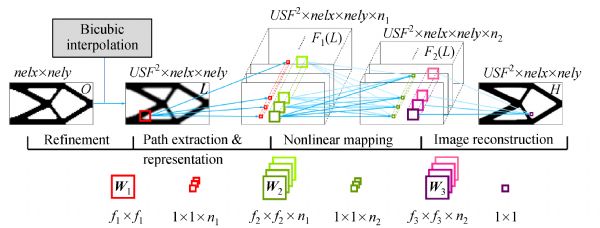
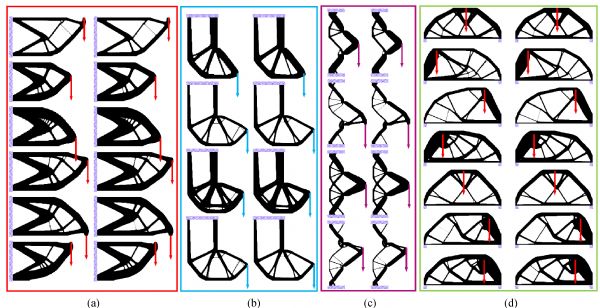
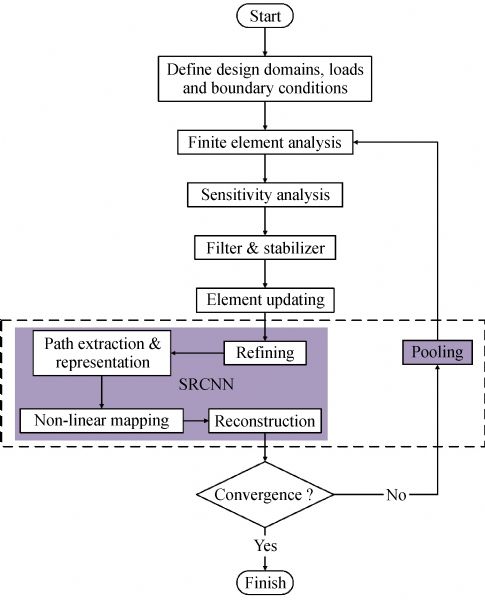
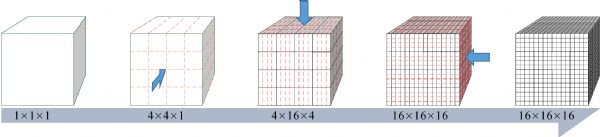
Topology optimization is a pioneer design method that can provide various candidates with high mechanical properties. However, high resolution is desired for optimum structures, but it normally leads to a computationally intractable puzzle, especially for the solid isotropic material with penalization (SIMP) method. In this study, an efficient, high-resolution topology optimization method is developed based on the super-resolution convolutional neural network (SRCNN) technique in the framework of SIMP. SRCNN involves four processes, namely, refinement, path extraction and representation, nonlinear mapping, and image reconstruction. High computational efficiency is achieved with a pooling strategy that can balance the number of finite element analyses and the output mesh in the optimization process. A combined treatment method that uses 2D SRCNN is built as another speed-up strategy to reduce the high computational cost and memory requirements for 3D topology optimization problems. Typical examples show that the high-resolution topology optimization method using SRCNN demonstrates excellent applicability and high efficiency when used for 2D and 3D problems with arbitrary boundary conditions, any design domain shape, and varied load.
M P Bendsøe, N Kikuchi. Generating optimal topologies in structural design using a homogenization method. Computer Methods in Applied Mechanics and Engineering, 1988, 71(2): 197–224 https://doi.org/10.1016/0045-7825(88)90086-2
2
M P Bendsøe. Optimal shape design as a material distribution problem. Structural Optimization, 1989, 1(4): 193–202 https://doi.org/10.1007/BF01650949
3
O A Sigmund. 99 line topology optimization code written in Matlab. Structural and Multidisciplinary Optimization, 2001, 21(2): 120–127 https://doi.org/10.1007/s001580050176
4
G I N Rozvany, M Zhou, T Birker. Generalized shape optimization without homogenization. Structural Optimization, 1992, 4(3–4): 250–252 https://doi.org/10.1007/BF01742754
O M Querin, G P Steven, Y M Xie. Evolutionary structural optimisation (ESO) using a bidirectional algorithm. Engineering Computations, 1998, 15(8): 1031–1048 https://doi.org/10.1108/02644409810244129
7
X Huang, Y M Xie. Convergent and mesh-independent solutions for the bi-directional evolutionary structural optimization method. Finite Elements in Analysis and Design, 2007, 43(14): 1039–1049 https://doi.org/10.1016/j.finel.2007.06.006
8
G I N Rozvany. A critical review of established methods of structural topology optimization. Structural and Multidisciplinary Optimization, 2009, 37(3): 217–237 https://doi.org/10.1007/s00158-007-0217-0
9
L Xia, L Zhang, Q Xia, et al. Stress-based topology optimization using bi-directional evolutionary structural optimization method. Computer Methods in Applied Mechanics and Engineering, 2018, 333: 356–370 https://doi.org/10.1016/j.cma.2018.01.035
10
M Y Wang, X Wang, D Guo. A level set method for structural topology optimization. Computer Methods in Applied Mechanics and Engineering, 2003, 192(1–2): 227–246 https://doi.org/10.1016/S0045-7825(02)00559-5
11
P Wei, Z Li, X Li, et al. An 88-line MATLAB code for the parameterized level set method based topology optimization using radial basis functions. Structural and Multidisciplinary Optimization, 2018, 58(2): 831–849 https://doi.org/10.1007/s00158-018-1904-8
12
Q Xia, T Shi, L Xia. Stable hole nucleation in level set based topology optimization by using the material removal scheme of BESO. Computer Methods in Applied Mechanics and Engineering, 2019, 343: 438–452 https://doi.org/10.1016/j.cma.2018.09.002
13
Q Xia, T Shi. Generalized hole nucleation through BESO for the level set based topology optimization of multi-material structures. Computer Methods in Applied Mechanics and Engineering, 2019, 355: 216–233 https://doi.org/10.1016/j.cma.2019.06.028
14
H Liu, H Zong, T Shi, et al. M-VCUT level set method for optimizing cellular structures. Computer Methods in Applied Mechanics and Engineering, 2020, 367: 113154 https://doi.org/10.1016/j.cma.2020.113154
15
X Guo, W Zhang, W Zhong. Doing topology optimization explicitly and geometrically—A new moving morphable components based framework. Journal of Applied Mechanics, 2014, 81(8): 081009 https://doi.org/10.1115/1.4027609
16
W Zhang, J Chen, X Zhu, et al. Explicit three dimensional topology optimization via moving morphable void (MMV) approach. Computer Methods in Applied Mechanics and Engineering, 2017, 322: 590–614 https://doi.org/10.1016/j.cma.2017.05.002
17
X Lei, C Liu, Z Du, et al. Machine learning-driven real-time topology optimization under moving morphable component-based framework. Journal of Applied Mechanics, 2019, 86(1): 011004 https://doi.org/10.1115/1.4041319
18
S Cai, W Zhang. An adaptive bubble method for structural shape and topology optimization. Computer Methods in Applied Mechanics and Engineering, 2020, 360: 112778 https://doi.org/10.1016/j.cma.2019.112778
19
J H Zhu, W H Zhang, L Xia. Topology optimization in aircraft and aerospace structures design. Archives of Computational Methods in Engineering, 2016, 23(4): 595–622 https://doi.org/10.1007/s11831-015-9151-2
20
Y F Fu, B Rolfe, L N S Chiu, et al. Design and experimental validation of self-supporting topologies for additive manufacturing. Virtual and Physical Prototyping, 2019, 14(4): 382–394 https://doi.org/10.1080/17452759.2019.1637023
21
L Meng, W Zhang, D Quan, et al. From topology optimization design to additive manufacturing: Today’s success and tomorrow’s roadmap. Archives of Computational Methods in Engineering, 2020, 27(3): 805–830 https://doi.org/10.1007/s11831-019-09331-1
22
T W Chin, G J Kennedy. Large-scale compliance-minimization and buckling topology optimization of the undeformed common research model wing. In: Proceedings of the 57th AIAA/ASCE/AHS/ASC Structures, Structural Dynamics, and Materials Conference. San Diego: AIAA, 2016 https://doi.org/10.2514/6.2016-0939
23
J Liu, H Ou, J He, et al. Topological design of a lightweight sandwich aircraft spoiler. Materials, 2019, 12(19): 3225 https://doi.org/10.3390/ma12193225
24
A Sutradhar, J Park, D Carrau, et al. Designing patient-specific 3D printed craniofacial implants using a novel topology optimization method. Medical & Biological Engineering & Computing, 2016, 54(7): 1123–1135 https://doi.org/10.1007/s11517-015-1418-0
25
J Alexandersen, O Sigmund, N Aage. Large scale three-dimensional topology optimisation of heat sinks cooled by natural convection. International Journal of Heat and Mass Transfer, 2016, 100: 876–891 https://doi.org/10.1016/j.ijheatmasstransfer.2016.05.013
26
M Ye, L Gao, H Li. A design framework for gradually stiffer mechanical metamaterial induced by negative Poisson’s ratio property. Materials & Design, 2020, 192: 108751 https://doi.org/10.1016/j.matdes.2020.108751
27
J P Groen, O Sigmund. Homogenization-based topology optimization for high-resolution manufacturable microstructures. International Journal for Numerical Methods in Engineering, 2018, 113(8): 1148–1163 https://doi.org/10.1002/nme.5575
28
Z Wu, L Xia, S Wang, et al. Topology optimization of hierarchical lattice structures with substructuring. Computer Methods in Applied Mechanics and Engineering, 2019, 345: 602–617 https://doi.org/10.1016/j.cma.2018.11.003
29
B Zhu, M Skouras, D Chen, et al. Two-scale topology optimization with microstructures. ACM Transactions on Graphics, 2017, 36(4): 120b https://doi.org/10.1145/3072959.3095815
30
Y Wang, H Xu, D Pasini. Multiscale isogeometric topology optimization for lattice materials. Computer Methods in Applied Mechanics and Engineering, 2017, 316: 568–585 https://doi.org/10.1016/j.cma.2016.08.015
31
H Li, Z Luo, L Gao, et al. Topology optimization for concurrent design of structures with multi-patch microstructures by level sets. Computer Methods in Applied Mechanics and Engineering, 2018, 331: 536–561 https://doi.org/10.1016/j.cma.2017.11.033
32
H Li, Z Luo, M Xiao, et al. A new multiscale topology optimization method for multiphase composite structures of frequency response with level sets. Computer Methods in Applied Mechanics and Engineering, 2019, 356: 116–144 https://doi.org/10.1016/j.cma.2019.07.020
33
A N Christiansen, J A Bærentzen, M Nobel-Jørgensen, et al.Combined shape and topology optimization of 3D structures. Computers & Graphics, 2015, 46: 25–35 https://doi.org/10.1016/j.cag.2014.09.021
34
H Wang, J Liu, G Wen. An efficient evolutionary structural optimization method with smooth edges based on the game of building blocks. Engineering Optimization, 2019, 51(12): 2089–2018 https://doi.org/10.1080/0305215X.2018.1562550
35
T H Nguyen, G H Paulino, J Song, et al. A computational paradigm for multiresolution topology optimization (MTOP). Structural and Multidisciplinary Optimization, 2010, 41(4): 525–539 https://doi.org/10.1007/s00158-009-0443-8
36
H Nguyen-Xuan. A polytree-based adaptive polygonal finite element method for topology optimization. International Journal for Numerical Methods in Engineering, 2017, 110(10): 972–1000 https://doi.org/10.1002/nme.5448
37
M K Leader, T W Chin, G J Kennedy. High-resolution topology optimization with stress and natural frequency constraints. AIAA Journal, 2019, 57(8): 3562–3578 https://doi.org/10.2514/1.J057777
38
T W Chin, M K Leader, G J Kennedy. A scalable framework for large-scale 3D multimaterial topology optimization with octree-based mesh adaptation. Advances in Engineering Software, 2019, 135: 102682 https://doi.org/10.1016/j.advengsoft.2019.05.004
39
J P Groen, M Langelaar, O Sigmund, et al. Higher-order multi-resolution topology optimization using the finite cell method. International Journal for Numerical Methods in Engineering, 2017, 110(10): 903–920 https://doi.org/10.1002/nme.5432
40
D K Gupta, F van Keulen, M Langelaar. Design and analysis adaptivity in multi-resolution topology optimization. 2018, arXiv:1811.09821v1
41
M Xiao, D Lu, P Breitkopf, et al. Multi-grid reduced-order topology optimization. Structural and Multidisciplinary Optimization, 2020, 61: 2319–2341 https://doi.org/10.1007/s00158-020-02570-y
42
Q X Lieu, J Lee. Multiresolution topology optimization using isogeometric analysis. International Journal for Numerical Methods in Engineering, 2017, 112(13): 2025–2047 https://doi.org/10.1002/nme.5593
43
M Xu, L Xia, S Wang, et al. An isogeometric approach to topology optimization of spatially graded hierarchical structures. Composite Structures, 2019, 225: 111171 https://doi.org/10.1016/j.compstruct.2019.111171
44
Y Wang, Z Liao, M Ye, et al. An efficient isogeometric topology optimization using multilevel mesh, MGCG and local-update strategy. Advances in Engineering Software, 2020, 139: 102733 https://doi.org/10.1016/j.advengsoft.2019.102733
45
H Wang, J Liu, G Wen. Achieving large-scale or high-resolution topology optimization based on modified BESO and XEFM. 2019, arXiv:1908.07157
46
Y Y Kim, G H Yoon. Multi-resolution multi-scale topology optimization—A new paradigm. International Journal of Solids and Structures, 2000, 37(39): 5529–5559 https://doi.org/10.1016/S0020-7683(99)00251-6
47
R Stainko. An adaptive multilevel approach to the minimal compliance problem in topology optimization. Communications in Numerical Methods in Engineering, 2006, 22(2): 109–118 https://doi.org/10.1002/cnm.800
48
Z Liao, Y Zhang, Y Wang, et al. A triple acceleration method for topology optimization. Structural and Multidisciplinary Optimization, 2019, 60(2): 727–744 https://doi.org/10.1007/s00158-019-02234-6
49
K Suresh. Generating 3D topologies with multiple constraints on the GPU. In: Proceedings of the 10th World Congress on Structural and Multidisciplinary Optimization. Orlando, 2013, 1–9
50
V J Challis, A P Roberts, J F Grotowski. High resolution topology optimization using graphics processing units (GPUs). Structural and Multidisciplinary Optimization, 2014, 49(2): 315–325 https://doi.org/10.1007/s00158-013-0980-z
51
N Aage, E Andreassen, B S Lazarov, et al. Giga-voxel computational morphogenesis for structural design. Nature, 2017, 550(7674): 84–86 https://doi.org/10.1038/nature23911
52
K Long, C Gu, X Wang, et al. A novel minimum weight formulation of topology optimization implemented with reanalysis approach. International Journal for Numerical Methods in Engineering, 2019, 120(5): 567–579 https://doi.org/10.1002/nme.6148
53
Y Wang, Z Liao, S Shi, et al. Data-driven structural design optimization for petal-shaped auxetics using isogeometric analysis. Computer Modeling in Engineering & Sciences, 2020, 122(2): 433–458 https://doi.org/10.32604/cmes.2020.08680
54
Y Zhou, H Zhan, W Zhang, et al. A new data-driven topology optimization framework for structural optimization. Computers & Structures, 2020, 239: 106310 https://doi.org/10.1016/j.compstruc.2020.106310
55
I Sosnovik, I Oseledets. Neural networks for topology optimization. Russian Journal of Numerical Analysis and Mathematical Modelling, 2019, 34(4): 215–223 https://doi.org/10.1515/rnam-2019-0018
56
S Banga, H Gehani, S Bhilare, et al. 3D topology optimization using convolutional neural networks. 2018, arXiv:1808.07440v1
57
Y Zhang, A Chen, B Peng, et al. A deep convolutional neural network for topology optimization with strong generalization ability. 2019, arXiv:1901.07761v1
58
B Li, C Huang, X Li, et al. Non-iterative structural topology optimization using deep learning. Computer-Aided Design, 2019, 115: 172–180 https://doi.org/10.1016/j.cad.2019.05.038
59
C Dong, C C Loy, K He, et al. Image super-resolution using deep convolutional networks. IEEE Transactions on Pattern Analysis and Machine Intelligence, 2016, 38(2): 295–307 https://doi.org/10.1109/TPAMI.2015.2439281
60
M P Bendsøe, O Sigmund. Topology Optimization: Theory, Methods, and Applications. Berlin: Springer, 2013, 37–40
61
E Andreassen, A Clausen, M Schevenels, et al. Efficient topology optimization in MATLAB using 88 lines of code. Structural and Multidisciplinary Optimization, 2011, 43(1): 1–16 https://doi.org/10.1007/s00158-010-0594-7
62
H Liu, Y Wang, H Zong, et al. Efficient structure topology optimization by using the multiscale finite element method. Structural and Multidisciplinary Optimization, 2018, 58(4): 1411–1430 https://doi.org/10.1007/s00158-018-1972-9