1. State Key Laboratory of Tribology, Tsinghua University, Beijing 100084, China; Department of Mechanical Engineering, Tsinghua University, Beijing 100084, China 2. High-Tech Research Institute of Xi’an, Xi’an 710025, China
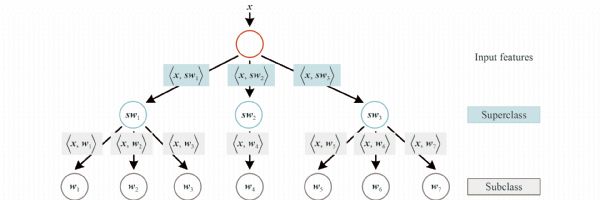
The fault diagnosis of bearings is crucial in ensuring the reliability of rotating machinery. Deep neural networks have provided unprecedented opportunities to condition monitoring from a new perspective due to the powerful ability in learning fault-related knowledge. However, the inexplicability and low generalization ability of fault diagnosis models still bar them from the application. To address this issue, this paper explores a decision-tree-structured neural network, that is, the deep convolutional tree-inspired network (DCTN), for the hierarchical fault diagnosis of bearings. The proposed model effectively integrates the advantages of convolutional neural network (CNN) and decision tree methods by rebuilding the output decision layer of CNN according to the hierarchical structural characteristics of the decision tree, which is by no means a simple combination of the two models. The proposed DCTN model has unique advantages in 1) the hierarchical structure that can support more accuracy and comprehensive fault diagnosis, 2) the better interpretability of the model output with hierarchical decision making, and 3) more powerful generalization capabilities for the samples across fault severities. The multiclass fault diagnosis case and cross-severity fault diagnosis case are executed on a multicondition aeronautical bearing test rig. Experimental results can fully demonstrate the feasibility and superiority of the proposed method.
Distance between the feature and each classification hyperplane
H(p, q)
Cross-entropy loss function
Loss function of the tree-structured decision layer
K
Number of sample categories
Overall prediction
L
Feature dimension of the fully-connected layer
N
Number of samples
p(·)
Probability distribution of the predicted output
True labels of the pre-trained network
True labels of the tree-structured decision layer
Path probabilities of the tree-structured decision layer
P (subclass)
Probability of correct prediction for seed nodes
P (superclass)
Probability of correct prediction of leaf nodes
q(·)
Probability distribution of the actual output
Predicted probabilities of the pre-trained network
Predicted probabilities of the tree-structured decision layer
R
Dimension of the TFD matrix
s(t)
Signal in time t
swj
Weight vector of the jth leaf note
wj
Weight vector of the jth vector in weight matrix W of the fully-connected layer
Weight vector of the jth tree-structured decision layer after fine-tuning
W
Weight matrix
x
Input features of the Softmax classifier in the cross-entropy loss
x
Input feature vector of the tree-structured decision layer
Prediction probabilities by the Softmax classifier
Predicted probability for the jth category
Prediction scope corresponding to K categories
Weight adjusting the pre-trained decision and tree-structured decision
Mother wavelet
1
X F Chen, S B Wang, B J Qiao. Basic research on machinery fault diagnostics: past, present, and future trends. Frontiers of Mechanical Engineering, 2018, 13( 2): 264– 291 https://doi.org/10.1007/s11465-018-0472-3
2
P Zheng, H Wang, Z Sang. Smart manufacturing systems for Industry 4.0: conceptual framework, scenarios, and future perspectives. Frontiers of Mechanical Engineering, 2018, 13( 2): 137– 150 https://doi.org/10.1007/s11465-018-0499-5
Y G Lei, B Yang, X Jiang. Applications of machine learning to machine fault diagnosis: a review and roadmap. Mechanical Systems and Signal Processing, 2020, 138 : 106587– https://doi.org/10.1016/j.ymssp.2019.106587
5
D H Zhou, Y H Zhao, Z D Wang. Review on diagnosis techniques for intermittent faults in dynamic systems. IEEE Transactions on Industrial Electronics, 2020, 67( 3): 2337– 2347 https://doi.org/10.1109/TIE.2019.2907500
6
X Y Wu, Y Zhang, C M Cheng. A hybrid classification autoencoder for semi-supervised fault diagnosis in rotating machinery. Mechanical Systems and Signal Processing, 2021, 149 : 107327– https://doi.org/10.1016/j.ymssp.2020.107327
7
P F Liang, C Deng, J Wu. Single and simultaneous fault diagnosis of gearbox via a semi-supervised and high-accuracy adversarial learning framework. Knowledge-Based Systems, 2020, 198 : 105895– https://doi.org/10.1016/j.knosys.2020.105895
8
Z H An, S M Li, J R Wang. A novel bearing intelligent fault diagnosis framework under time-varying working conditions using recurrent neural network. ISA Transactions, 2020, 100 : 155– 170 https://doi.org/10.1016/j.isatra.2019.11.010
9
T Zhong, J F Qu, X Y Fang. The intermittent fault diagnosis of analog circuits based on EEMD-DBN. Neurocomputing, 2021, 436 : 74– 91 https://doi.org/10.1016/j.neucom.2021.01.001
10
D Z Zhao, T Y Wang, F L Chu. Deep convolutional neural network based planet bearing fault classification. Computers in Industry, 2019, 107 : 59– 66 https://doi.org/10.1016/j.compind.2019.02.001
11
S L Lu, R Q Yan, Y B Liu. Tacholess speed estimation in order tracking: a review with application to rotating machine fault diagnosis. IEEE Transactions on Instrumentation and Measurement, 2019, 68( 7): 2315– 2332 https://doi.org/10.1109/TIM.2019.2902806
12
Y W Cheng, M X Lin, J Wu. Intelligent fault diagnosis of rotating machinery based on continuous wavelet transform-local binary convolutional neural network. Knowledge-Based Systems, 2021, 216 : 106796– https://doi.org/10.1016/j.knosys.2021.106796
13
M F Li, T Y Wang, Y Kong. Synchro-reassigning transform for instantaneous frequency estimation and signal reconstruction. IEEE Transactions on Industrial Electronics, 2021 (in press)
14
M F Li, T Y Wang, F L Chu. Scaling-basis Chirplet transform. IEEE Transactions on Industrial Electronics, 2020, 68( 9): 8777– 8788 https://doi.org/10.1109/TIE.2020.3013537
15
M F Li, T Y Wang, F L Chu. Component matching chirplet transform via frequency-dependent chirp rate for wind turbine planetary gearbox fault diagnostics under variable speed condition. Mechanical Systems and Signal Processing, 2021, 161 : 107997– https://doi.org/10.1016/j.ymssp.2021.107997
16
M Cerrada, R V Sánchez, C Li. A review on data-driven fault severity assessment in rolling bearings. Mechanical Systems and Signal Processing, 2018, 99 : 169– 196 https://doi.org/10.1016/j.ymssp.2017.06.012
17
J Zhao, S P Yang, Q Li. A new bearing fault diagnosis method based on signal-to-image mapping and convolutional neural network. Measurement, 2021, 176 : 109088– https://doi.org/10.1016/j.measurement.2021.109088
18
A S Minhas, P K Kankar, N Kumar. Bearing fault detection and recognition methodology based on weighted multiscale entropy approach. Mechanical Systems and Signal Processing, 2021, 147 : 107073– https://doi.org/10.1016/j.ymssp.2020.107073
19
H Y Pan, Y Yang, J D Zheng. A fault diagnosis approach for roller bearing based on symplectic geometry matrix machine. Mechanism and Machine Theory, 2019, 140 : 31– 43 https://doi.org/10.1016/j.mechmachtheory.2019.05.019
20
L Wen, X Li, L Gao. A new two-level hierarchical diagnosis network based on convolutional neural network. IEEE Transactions on Instrumentation and Measurement, 2020, 69( 2): 330– 338 https://doi.org/10.1109/TIM.2019.2896370
21
J P Amorim, Abreu P H, Reyes M, et al. Interpretability vs. complexity: the friction in deep neural networks. In: Proceedings of 2020 International Joint Conference on Neural Networks (IJCNN). Glasgow: IEEE, 2020, 20006226
22
Z B Yang, J P Zhang, Z B Zhao. Interpreting network knowledge with attention mechanism for bearing fault diagnosis. Applied Soft Computing, 2020, 97 : 106829– https://doi.org/10.1016/j.asoc.2020.106829
23
T W Rauber, A L da Silva Loca, A Boldt F de. An experimental methodology to evaluate machine learning methods for fault diagnosis based on vibration signals. Expert Systems with Applications, 2021, 167 : 114022– https://doi.org/10.1016/j.eswa.2020.114022
M Stock, B Nguyen, W Courtens. Otolith identification using a deep hierarchical classification model. Computers and Electronics in Agriculture, 2021, 180 : 105883– https://doi.org/10.1016/j.compag.2020.105883
26
C Lu, Z Y Wang, B Zhou. Intelligent fault diagnosis of rolling bearing using hierarchical convolutional network based health state classification. Advanced Engineering Informatics, 2017, 32 : 139– 151 https://doi.org/10.1016/j.aei.2017.02.005
27
P Liu, Y Zhang, X Y Zhang. Evaluation of measurement uncertainty of oxygen in titanium alloys based on Monte Carlo method. Journal of Physics: Conference Series, 2020, 1605 : 012135– https://doi.org/10.1088/1742-6596/1605/1/012135
28
M Kraus, S Feuerriegel. Forecasting remaining useful life: interpretable deep learning approach via variational Bayesian inferences. Decision Support Systems, 2019, 125 : 113100– https://doi.org/10.1016/j.dss.2019.113100
29
P Gangsar, R Tiwari. Signal based condition monitoring techniques for fault detection and diagnosis of induction motors: a state-of-the-art review. Mechanical Systems and Signal Processing, 2020, 144 : 106908– https://doi.org/10.1016/j.ymssp.2020.106908
30
X Wang, T Y Wang, A B Ming. Semi-supervised hierarchical attribute representation learning via multi-layer matrix factorization for machinery fault diagnosis. Mechanism and Machine Theory, 2022, 167 : 104445– https://doi.org/10.1016/j.mechmachtheory.2021.104445
31
A Blanco-Justicia, J Domingo-Ferrer, S Martínez. Machine learning explainability via microaggregation and shallow decision trees. Knowledge-Based Systems, 2020, 194 : 105532– https://doi.org/10.1016/j.knosys.2020.105532
32
O Sagi, L Rokach. Explainable decision forest: transforming a decision forest into an interpretable tree. Information Fusion, 2020, 61 : 124– 138 https://doi.org/10.1016/j.inffus.2020.03.013
33
I Vamsi, G R Sabareesh, P K Penumakala. Comparison of condition monitoring techniques in assessing fault severity for a wind turbine gearbox under non-stationary loading. Mechanical Systems and Signal Processing, 2019, 124 : 1– 20 https://doi.org/10.1016/j.ymssp.2019.01.038
34
D Cabrera, F Sancho, R V Sánchez. Fault diagnosis of spur gearbox based on random forest and wavelet packet decomposition. Frontiers of Mechanical Engineering, 2015, 10( 3): 277– 286 https://doi.org/10.1007/s11465-015-0348-8
35
Z H Zhou, J Feng. Deep forest: towards an alternative to deep neural networks. In: Proceedings of the Twenty-Sixth International Joint Conference on Artificial Intelligence (IJCAI 2017). 2017, 3553– 3559
36
K D Humbird, J L Peterson, R G McClarren. Deep neural network initialization with decision trees. IEEE Transactions on Neural Networks and Learning Systems, 2019, 30( 5): 1286– 1295 https://doi.org/10.1109/TNNLS.2018.2869694
37
S H Jiang, H Y Mao, Z M Ding. Deep decision tree transfer boosting. IEEE Transactions on Neural Networks and Learning Systems, 2020, 31( 2): 383– 395 https://doi.org/10.1109/TNNLS.2019.2901273
38
P Kontschieder, M Fiterau, A Criminisi. Deep neural decision forests. In: Proceedings of 2015 IEEE International Conference on Computer Vision (ICCV). Santiago: IEEE, 2015, 1467– 1475
39
Q S Zhang, Y Yang, H T Ma. Interpreting CNNs via decision trees. In: Proceedings of the IEEE Computer Society Conference on Computer Vision and Pattern Recognition (CVPR). Long Beach: IEEE, 2019, 6254– 6263
40
D Roy, P Panda, K Roy. Tree-CNN: a hierarchical deep convolutional neural network for incremental learning. Neural Networks, 2020, 121 : 148– 160 https://doi.org/10.1016/j.neunet.2019.09.010
41
A P Daga, A Fasana, S Marchesiello. The Politecnico di Torino rolling bearing test rig: description and analysis of open access data. Mechanical Systems and Signal Processing, 2019, 120 : 252– 273 https://doi.org/10.1016/j.ymssp.2018.10.010
42
P Zhou, Z K Peng, S Q Chen. Non-stationary signal analysis based on general parameterized time–frequency transform and its application in the feature extraction of a rotary machine. Frontiers of Mechanical Engineering, 2018, 13( 2): 292– 300 https://doi.org/10.1007/s11465-017-0443-0
43
W Zhang, G Peng, C Li. A new deep learning model for fault diagnosis with good anti-noise and domain adaptation ability on raw vibration signals. Sensors (Basel), 2017, 17( 2): 425– https://doi.org/10.3390/s17020425
44
Y Jiang, C Feng, B He. Actuator fault diagnosis in autonomous underwater vehicle based on neural network. Sensors and Actuators. A, Physical, 2021, 324 : 112668– https://doi.org/10.1016/j.sna.2021.112668