1. School of Architecture and Planning, Tsinghua University, Beijing 100084, China; 2. Faculty of Architecture, Building and Planning, The University of Melbourne, Parkville VIC 3010, Australia
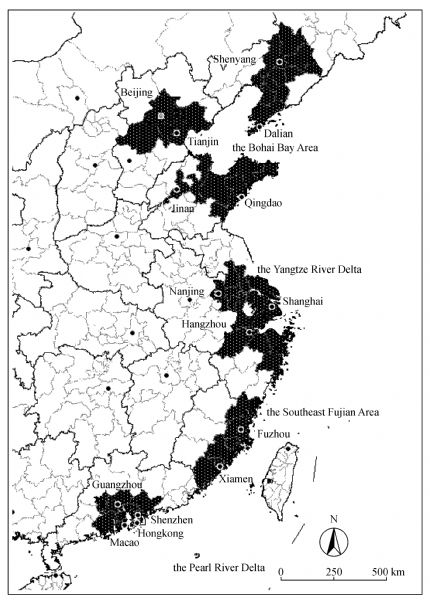
China’s mega urban regions are focal points of economic development and environmental concerns. This paper positions four mega urban regions (i.e., the Yangtze River Delta, the Pearl River Delta, the Bohai Bay Area, and the South-eastern Fujian Province) along China’s coast into the national economy and elaborates their development challenges and planning innovations. Mega urban regions in China are spatial consequences of rapid economic transition. They deserve close scrutiny and demands for innovative planning responses in order to maintain their key role in driving economic growth but limiting their greenhouse gas emission.
. Climate change and China’s mega urban regions[J]. Frontiers of Architecture and Civil Engineering in China, 0, (): 418-430.
Chaolin GU, Sunsheng HAN. Climate change and China’s mega urban regions. Front Arch Civil Eng Chin, 0, (): 418-430.
Earth Policy Institute. Carbon dioxide emissions accelerating rapidly. 2008. http://www.enn.com/press_releases/2435
2
NBSC. China Statistical Abstract. Beijing: China Statistics Press, 2008
3
Qu J S, Wang Q, Zeng J J. Regional analysis of CO2 emissions in China. Scientific Research Monitoring Express of the National Science Library of Chinese Academy , 2008, 12, 1–7
4
Gottmann J. Megalopolis, or the urbanization of the northeastern seaboard. Economic Geography , 1957, (3): 191
5
Friedman J. Miller J. The urban field. Journal of the American Institute of Planners , 1965, (31): 312–320 doi: 10.1080/01944366508978185
6
Doxiadis C A. Building Entopia. New York: Norton, 1975
7
Liangyong W. Introduction to Habitat Environmental Science. Beijing: China Building Industry Press, 2001, 48–49 (in Chinese)
8
Hall P. The World Cities. New York: McGraw-Hill, 1966
Sassen S. The Global City: New York, London, Tokyo. Princeton: Princeton University Press, 1991
11
Castells M. The Rise of the Network Society. Society and Culture Vol I . UK: Blackwell, 1996
12
Scott A. Global City-Regions: Trends, Theory, Policy. Oxford: Oxford University Press, 2001
13
Hall P. Global City-Region in the 21st Century. In: Scott, A, Global City-Regions: Trends, Theory, Policy . Oxford: Oxford University Press, 2001, 59–77
14
Dicken P. Global Shift, 3rd Edition. London: Paul Chapman, 1998
15
Zhou Y X, Hu D P. The economic impact of City with county system: questionnaire survey. Economic Geography , 1991, 8(1): 8–14 (in Chinese)
16
Yao S M. China Urban Agglomerations. Hefei: China University of Technology Press, 1992
17
Yao S M, Chen Z G, Zhu Y M. Urban Agglomerations in China. Beijing: China Science and Technology Press, 2001
18
Zhang J X. The Spatial Combination of City Group. Nanjing: Southeast University Press, 2000
19
Wu L Y. To create a 21st century “new world paradise” — in Shanghai and its surrounding areas of space research to develop insights. Port Economy , 2002 (6): 6 (in Chinese)
20
Li H W. Global region in China: A case study of regional spatial development in Pearl River Delta area. Post-doctoral Research Report. Shanghai: Tongji University , 2005
21
Sit V, Cai J. Evolution of three metropolitan economic regions in China and their development strategy. Geographical Studies , 2003, 22(5): 532–533 (in Chinese)
22
Zou D C. China's major cities in mountain areas of planning and building research. The Chinese Academy of Engineering “Mountain City Area” Project Synthesis Report , 2008
23
Hu X W, Zhou Y X, Gu C L. Spatial Agglomeration and Diffusion of in China's Coastal Urbanized Area. Beijing: Science Press, 2000 (in Chinese)
24
Gu C L, Yu T F, Kam W C. Extended metropolitan area: new features of China’s metropolitan areas in the era of globalization. Planners , 2002, (2): 16–20 (in Chinese)
25
Gu C L, Chen L, Ding R. Globalization and the reconstruction of national urban systems. Geographical Science , 2005, 25(6): 641–654
26
Han S S. Shanghai: Between state and market in urban transformation. Urban Studies , 2000, 37(11): 2091–2112 doi: 10.1080/713707226