1. Central Research Institute of Building and Construction Co., Ltd., MCC, Beijing 100088, China 2. Department of Civil Engineering, Tsinghua University, Beijing 100086, China 3. Zhuhai Institute of Civil Construction-Safety Research Co., Ltd., Zhuhai 519000, China 4. Department of Civil and Environmental Engineering, University of Houston, Houston, TX 77054, US
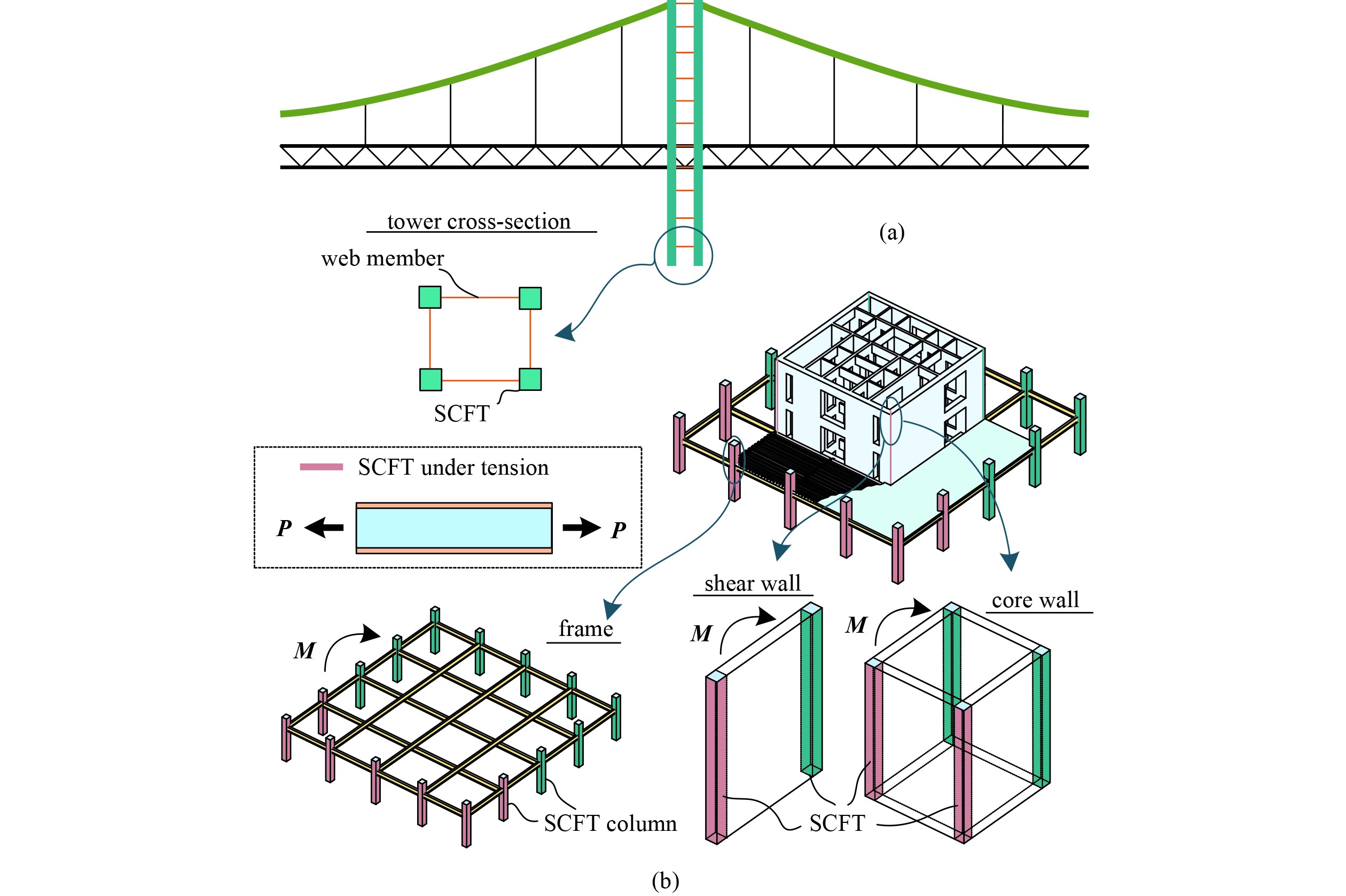
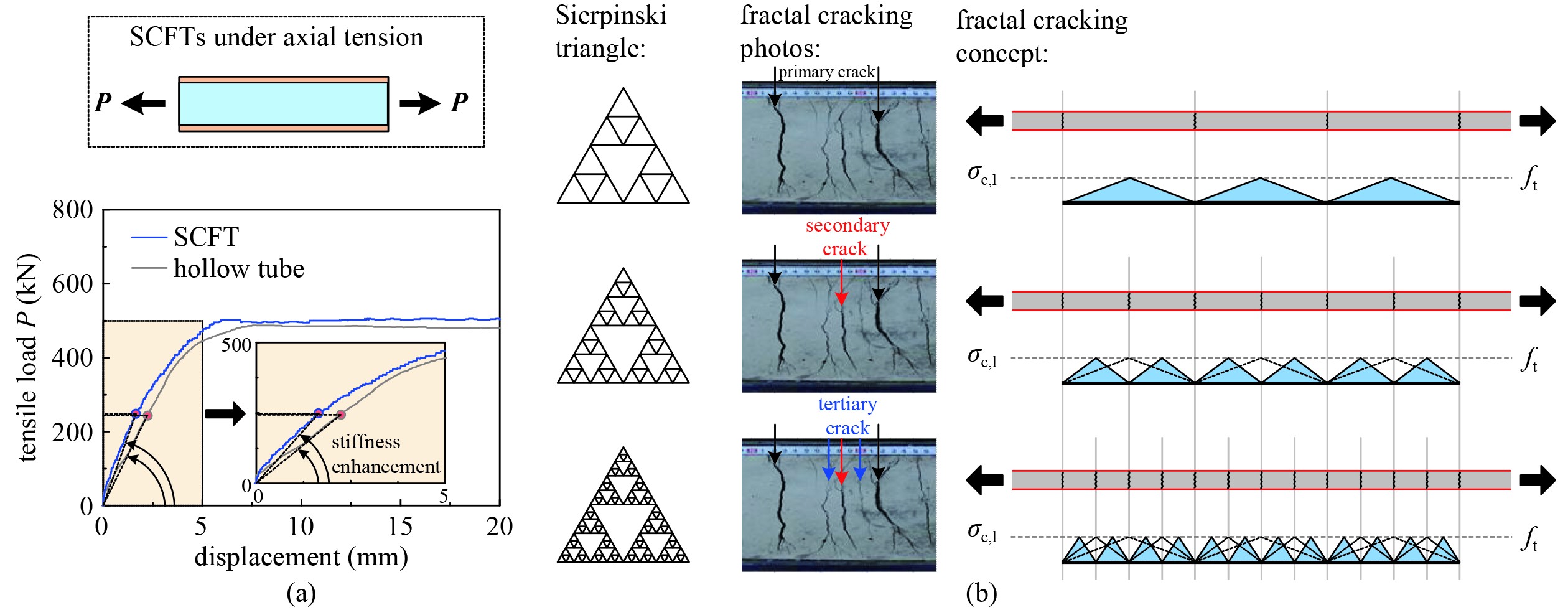
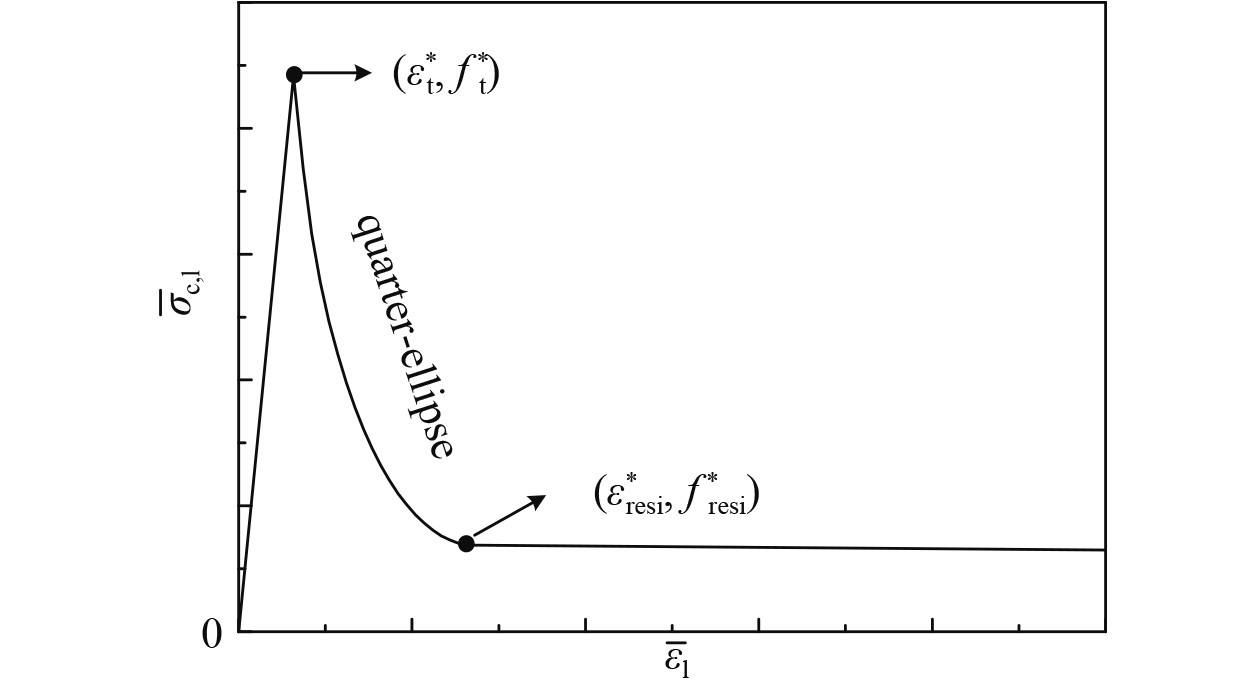
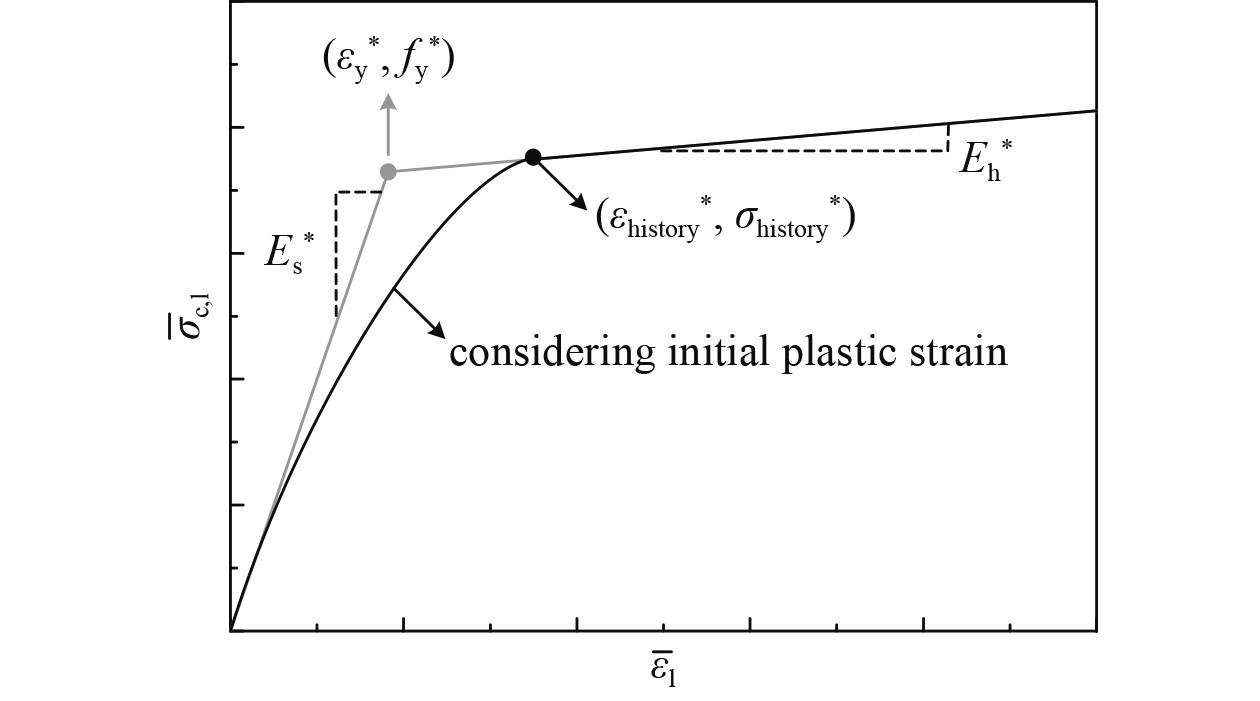
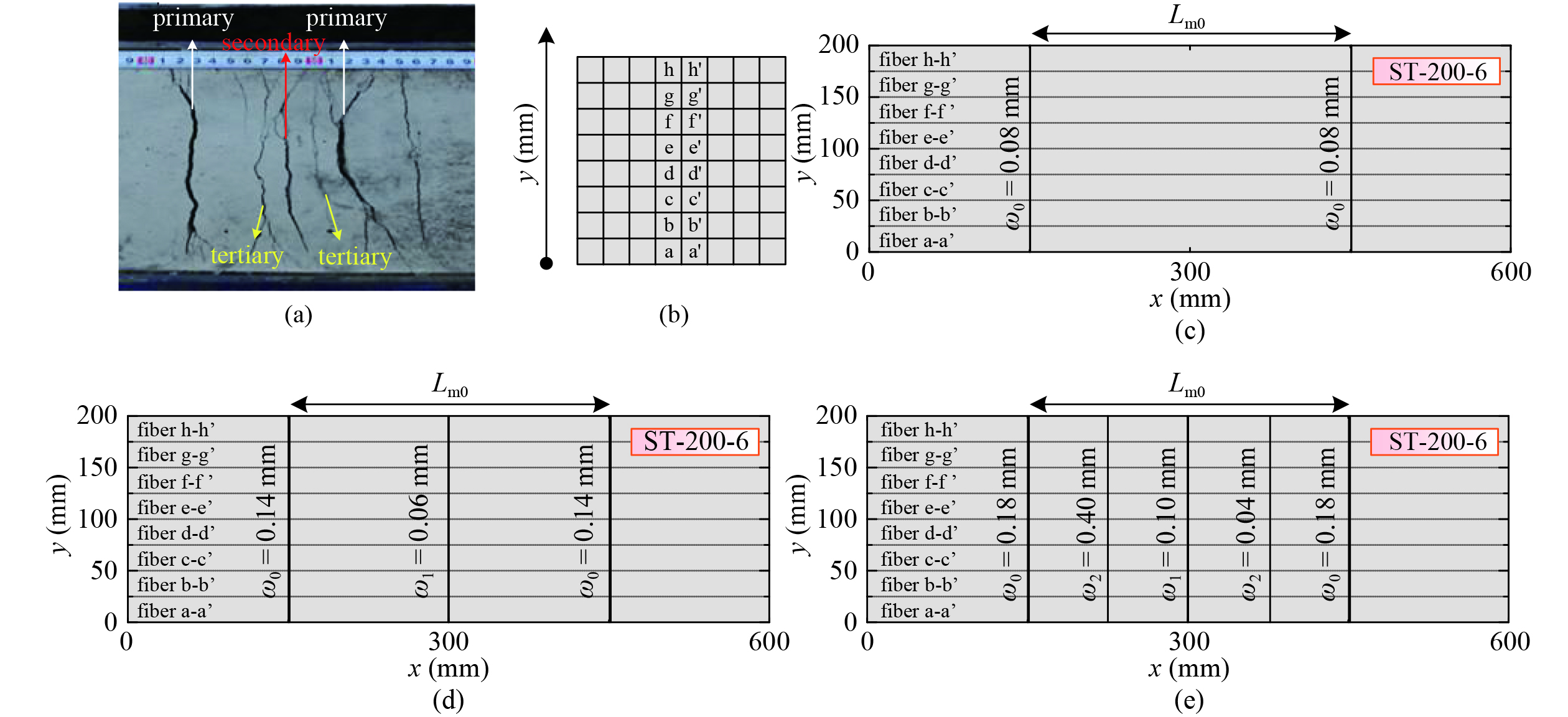
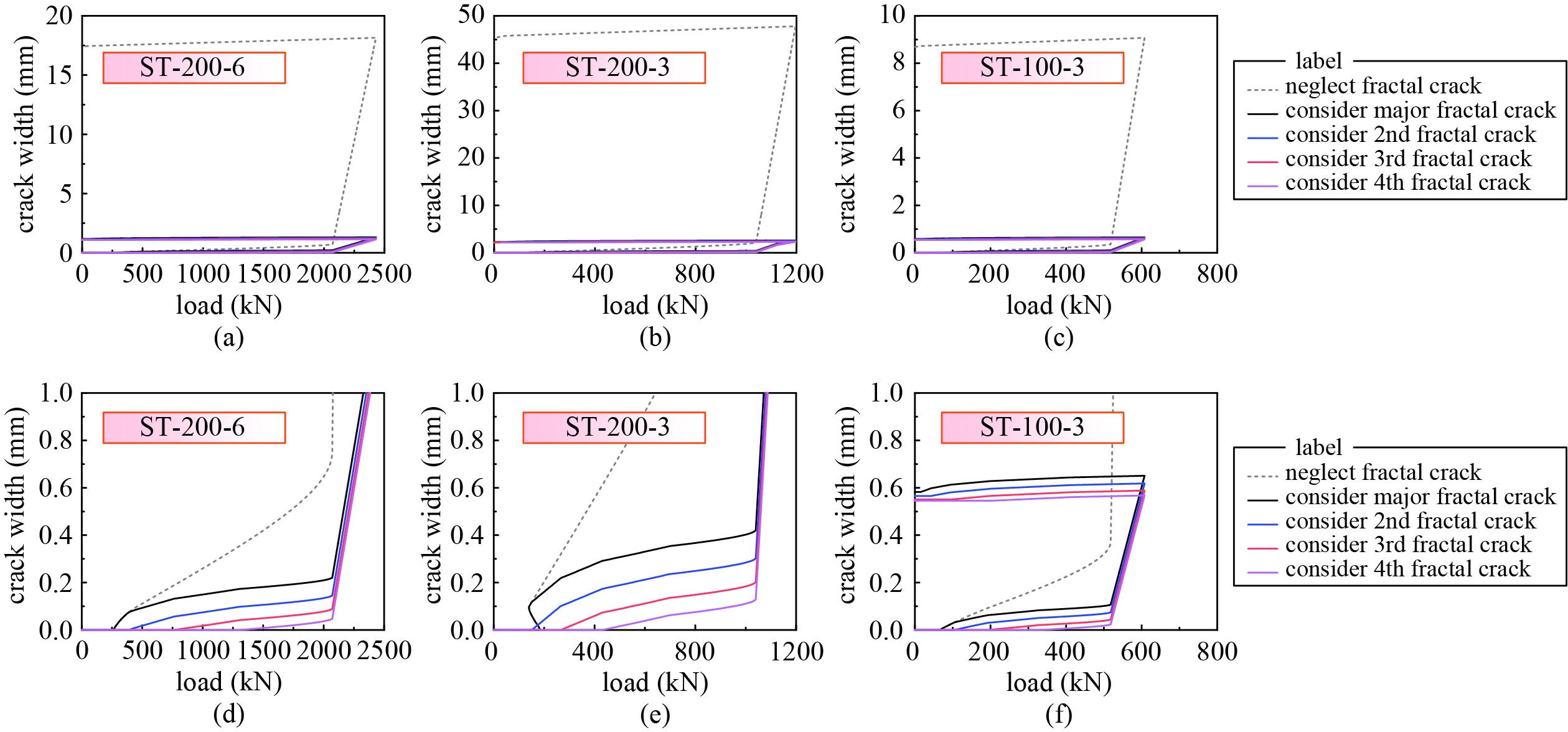
Tension stress in steel-concrete composite is widely observed in engineering design. Based on an experimental program on tension performance of three square concrete-filled tubes (SCFT), the tension theory of SCFT is proposed using a mechanics-based approach. The tension stiffening effect, the confining strengthening effect and the confining stiffening effect, observed in tests of SCFTs are included in the developed tension theory model. Subsequently, simplified constitutive models of steel and concrete are proposed for the axial tension performance of SCFT. Based on the MSC.MARC software, a special fiber beam-column element is proposed to include the confining effect of SCFTs under tension and verified. The proposed analytical theory, effective formulas, and equivalent constitutive laws are extensively verified against three available tests reported in the literature on both global level (e.g., load-displacement curves) and strain level. The experimental verification proves the accuracy of the proposed theory and formulations in simulating the performance of SCFT members under tension with the capability to accurately predict the tensile strength and stiffness enhancements and realistically simulate the fractal cracking phenomenon.
. [J]. Frontiers of Structural and Civil Engineering, 2021, 15(6): 1317-1336.
Meng ZHOU, Jiaji WANG, Jianguo NIE, Qingrui YUE. Theoretical study on the confine-stiffening effect and fractal cracking of square concrete filled steel tubes in tension loads. Front. Struct. Civ. Eng., 2021, 15(6): 1317-1336.
J G Nie, J J Wang, S K Gou, Y Y Zhu, J S Fan. Technological development and engineering applications of novel steel-concrete composite structures. Frontiers of Structural and Civil Engineering, 2019, 13( 1): 1– 14 https://doi.org/10.1007/s11709-019-0514-x
2
X D Shao, L Deng, J H Cao. Innovative steel-UHPC composite bridge girders for long-span bridges. Frontiers of Structural and Civil Engineering, 2019, 13( 4): 981– 989 https://doi.org/10.1007/s11709-019-0531-9
3
1994-1-1: 2004 EN. Eurocode 4: Design of Composite Steel and Concrete Structures. Part1-1: General Rules and Rules for Buildings. Brussels: European Committee for Standardization (CEN), 2004
4
R T Leon, Y Gao. Resiliency of steel and composite structures. Frontiers of Structural and Civil Engineering, 2016, 10( 3): 239– 253 https://doi.org/10.1007/s11709-016-0349-7
5
S W Deng, X D Shao, X D Zhao, Y Wang, Y Wang. Precast steel–UHPC lightweight composite bridge foraccelerated bridge construction. Frontiers of Structural and Civl Engieering, 2021, 15( 2): 364– 377
6
M Zhou, J S Fan, M X Tao, J G Nie. Experimental study on the tensile behaviour of square concrete-filled steel tubes. Journal of Constructional Steel Research, 2016, 121 : 202– 215 https://doi.org/10.1016/j.jcsr.2016.02.002
7
W Li, L H Han, T M Chan. Tensile behaviour of concrete-filled double-skin steel tubular members. Journal of Constructional Steel Research, 2014, 99 : 35– 46 https://doi.org/10.1016/j.jcsr.2014.03.011
8
W Li, L H Han, T M Chan. Numerical investigation on the performance of concrete-filled double-skin steel tubular members under tension. Thin-walled Structures, 2014, 79 : 108– 118 https://doi.org/10.1016/j.tws.2014.02.001
9
A Silva, Y Jiang, L Macedo, J M Castro, R Monteiro, N Silvestre. Seismic performance of composite moment-resisting frames achieved with sustainable CFST members. Frontiers of Structural and Civil Engineering, 2016, 10( 3): 312– 332 https://doi.org/10.1007/s11709-016-0345-y
10
M Shams, M A Saadeghvaziri. Nonlinear response of concrete-filled steel tubular columns under axial loading. ACI Structural Journal, 1999, 96( 6): 1009– 1017
11
K A S Susantha, H Ge, T Usami. Uniaxial stress-strain relationship of concrete confined by various shaped steel tubes. Engineering Structures, 2001, 23( 10): 1331– 1347 https://doi.org/10.1016/S0141-0296(01)00020-7
E Inai, A Mukai, M Kai, H Tokinoya, T Fukumoto, K Mori. Behavior of concrete-filled steel tube beam columns. Journal of Structural Engineering, 2004, 130( 2): 189– 202
14
F J Vecchio, M P Collins. The modified compression field theory for reinforced concrete elements subjected to shear. ACI Structural Journal, 1986, 83( 2): 219– 231
15
Institute of Japan (AIJ) Architectural. Recommendations for design and construction of concrete filled steel tubular structures. Study on Concrete Properties Subjected Impact Loading, 2008, 12: 3– 10 (in Japanese)
16
360-05 ANSI/AISC. Specification for Structural Steel Buildings. Chicago: American Institute of Steel Construction (AISC), 2005
17
138-2016 JGJ. Code for Design of Composite Structures. Beijing: Ministry of Housing and Urban-Rural Development (MOHURD), 2016 (in Chinese)
18
M Zhou, L Y Xu, M X Tao, J S Fan, J F Hajjar, J G Nie. Experimental study on confining-strengthening, confining-stiffening, and fractal cracking of circular concrete filled steel tubes under axial tension. Engineering Structures, 2017, 133 : 186– 199 https://doi.org/10.1016/j.engstruct.2016.12.008
19
L Y Xu, M X Tao, M Zhou. Analytical model and design formulae of circular CFSTs under axial tension. Journal of Constructional Steel Research, 2017, 133 : 214– 230 https://doi.org/10.1016/j.jcsr.2017.02.004
20
T Rabczuk, G Zi, A Gerstenberger, W A Wall. A new crack tip element for the phantom-node method with arbitrary cohesive cracks. International Journal for Numerical Methods in Engineering, 2008, 75( 5): 577– 599 https://doi.org/10.1002/nme.2273
21
T Rabczuk, T Belytschko. Cracking particles: A simplified meshfree method for arbitrary evolving cracks. International Journal for Numerical Methods in Engineering, 2004, 61( 13): 2316– 2343 https://doi.org/10.1002/nme.1151
22
Y M Zhang, R Lackner, M Zeiml, H A Mang. Strong discontinuity embedded approach with standard SOS formulation: Element formulation, energy-based crack-tracking strategy, and validations. Computer Methods in Applied Mechanics and Engineering, 2015, 287 : 335– 366 https://doi.org/10.1016/j.cma.2015.02.001
23
Y M Zhang, X Y Zhuang. Cracking elements: A self-propagating strong discontinuity embedded Approach for quasi-brittle fracture. Finite Elements in Analysis and Design, 2018, 144 : 84– 100 https://doi.org/10.1016/j.finel.2017.10.007
24
Y M Zhang, X Y Zhuang. Cracking elements method for dynamic brittle fracture. Theoretical and Applied Fracture Mechanics, 2019, 102 : 1– 9 https://doi.org/10.1016/j.tafmec.2018.09.015
25
Y M Zhang, H A Mang. Global cracking elements: A novel tool for Garlerkin-based approaches simulating quasi-brittle fracture. International Journal for Numerical Methods in Engineering, 2020, 121( 11): 2462– 2480 https://doi.org/10.1002/nme.6315
26
Y M Zhang, Z R Gao, Y Y Li, X Y Zhuang. On the crack opening and energy dissipation in a continuum based disconnected crack model. Finite Elements in Analysis and Design, 2020, 170 : 103333– https://doi.org/10.1016/j.finel.2019.103333
27
Y M Zhang, J G Huang, Y Yuan, H A Mang. Cracking elements method with a dissipation-based arc-length approach. Finite Elements in Analysis and Design, 2021, 195 : 103573– https://doi.org/10.1016/j.finel.2021.103573
28
H L Ren, X Y Zhuang, C Anitescu, T Rabczuk. An explicit phase field method for brittle dynamic fracture. Computers & Structures, 2019, 217 : 45– 56 https://doi.org/10.1016/j.compstruc.2019.03.005
29
T Rabczuk, H L Ren, X Y Zhuang. A nonlocal operator method for partial differential equations with application to electromagnetic waveguide problem. CMC, 2019, 59( 1): 31– 55 https://doi.org/10.32604/cmc.2019.04567
30
H L Ren, X Y Zhuang, T Rabczuk. A nonlocal operator method for solving partial differential equations. Computer Methods in Applied Mechanics and Engineering, 2020, 358 : 112621– https://doi.org/10.1016/j.cma.2019.112621
31
E Hognestad. High strength bars as concrete reinforcement—Part 2: Control of cracking. Journal of the PCA Research and Development Laboratories, 1962, 4( 1): 46– 62
32
LY Xu, X Nie, M Zhou, MX Tao. Whole-process crack width prediction of reinforced concrete structures considering bonding deterioration. Engineering Structures, 2017, 142: 240–254
33
A Belarbi, T T C Hsu. Constitutive laws of concrete intension and reinforcing bars stiffened by concrete. ACI Structural Journal, 1994, 91( 4): 465– 474
34
J G Nie, M X Tao, C S Cai, S J Li. Deformation analysis of prestressed continuous steel-concrete composite beams. Journal of Structural Engineering, 2009, 135( 11): 1377– 1389 https://doi.org/10.1061/(ASCE)ST.1943-541X.0000067
35
M X Tao, J G Nie. Fiber beam-column model considering slab spatial composite effect for nonlinear analysis of composite frame systems. Journal of Structural Engineering, 2015, 140( 1): 04013039– https://doi.org/10.1061/(ASCE)ST.1943-541X.0000815
36
M X Tao, J G Nie. Element mesh, section discretization and material hysteretic laws for fiber beam-column elements of composite structural members. Materials and Structures, 2014, 48( 8): 2521– 2544 https://doi.org/10.1617/s11527-014-0335-2
37
Y H Wang, J G Nie, C S Cai. Numerical modeling on concrete structures and steel-concrete composite frames structures. Composite: Part B, 2013, 51( 1): 58– 67 https://doi.org/10.1016/j.compositesb.2013.02.035
38
M D Denavit, J F Hajjar. Nonlinear seismic analysis of circular concrete-filled steel tube members and frames. NSEL Report No. NSEL-023. 2010
39
C Tort, J F Hajjar. Reliability-based performance-based design of rectangular concrete-filled steel tube (SCFT) members and frames. Structural Engineering Report No. ST-07-1. 2007
40
J F Hajjar, A Molodan, P H Schiller. A distributed plasticity model for cyclic analysis of concrete-filled steel tube beam-columns and composite frames. Engineering Journal (New York), 1998, 20( 4−6): 398– 412 https://doi.org/10.1016/S0141-0296(97)00020-5
41
F Legeron, P Paultre, J Mazars. Damage mechanics modeling of nonlinear seismic behavior of concrete structures. Journal of Structural Engineering, 2005, 131( 6): 946– 955 https://doi.org/10.1061/(ASCE)0733-9445(2005)131:6(946
42
M Zhou. Study on basic theory and method of steel-concrete composite tension problem. Dissertation for the Doctoral Degree. Beijing: Tsinghua University, 2016 (in Chinese)