Destructive and non-destructive evaluation of concrete for optimum sand to aggregate volume ratio
Tarek Uddin MOHAMMED1, Aziz Hasan MAHMOOD2(), Mohammad Zunaied-Bin-HARUN1, Jamil Ahmed JOY1, Md. Asif AHMED3
1. Department of Civil and Environmental Engineering, Islamic University of Technology (IUT), Organization of Islamic Cooperation (OIC), Board Bazar, Gazipur 1704, Bangladesh 2. Centre for Infrastructure Engineering and Safety, School of Civil and Environmental Engineering, The University of New South Wales, Sydney, NSW 2052, Australia 3. Department of Civil Engineering, European University of Bangladesh, Mirpur, Dhaka 1216, Bangladesh
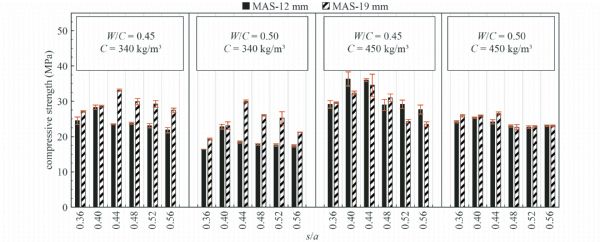
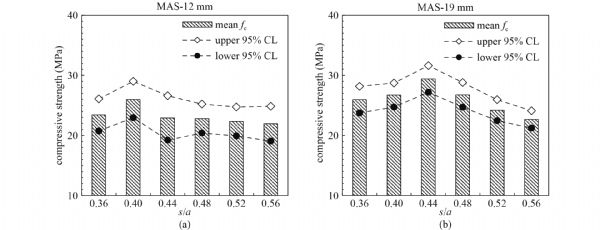
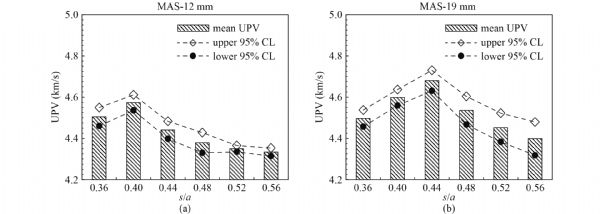
Aggregates are the biggest contributor to concrete volume and are a crucial parameter in dictating its mechanical properties. As such, a detailed experimental investigation was carried out to evaluate the effect of sand-to-aggregate volume ratio (s/a) on the mechanical properties of concrete utilizing both destructive and non-destructive testing (employing UPV (ultrasonic pulse velocity) measurements). For investigation, standard cylindrical concrete samples were made with different s/a (0.36, 0.40, 0.44, 0.48, 0.52, and 0.56), cement content (340 and 450 kg/m3), water-to-cement ratio (0.45 and 0.50), and maximum aggregate size (12 and 19 mm). The effect of these design parameters on the 7, 14, and 28 d compressive strength, tensile strength, elastic modulus, and UPV of concrete were assessed. The careful analysis demonstrates that aggregate proportions and size need to be optimized for formulating mix designs; optimum ratios of s/a were found to be 0.40 and 0.44 for the maximum aggregate size of 12 and 19 mm, respectively, irrespective of the W/C (water-to-cement) and cement content.
. [J]. Frontiers of Structural and Civil Engineering, 2021, 15(6): 1400-1414.
Tarek Uddin MOHAMMED, Aziz Hasan MAHMOOD, Mohammad Zunaied-Bin-HARUN, Jamil Ahmed JOY, Md. Asif AHMED. Destructive and non-destructive evaluation of concrete for optimum sand to aggregate volume ratio. Front. Struct. Civ. Eng., 2021, 15(6): 1400-1414.
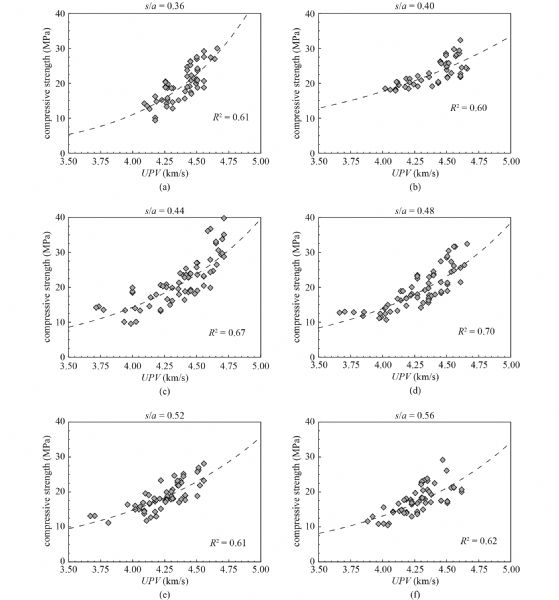
proposed relationship between compressive strength and UPV
level of agreement (R2)
equation no.
0.36
0.61
(15)
0.40
0.60
(16)
0.44
0.67
(17)
0.48
0.70
(18)
0.52
0.61
(19)
0.56
0.62
(20)
Tab.5
Fig.12
Fig.13
Fig.14
1
K K Sagoe-Crentsil, T Brown, A H Taylor. Performance of concrete made with commercially produced coarse recycled concrete aggregate. Cement and concrete research, 2001, 31( 5): 707– 712
2
V Okonkwo, E Emmanuel. A study of the effect of aggregate proportioning on concrete properties. American Journal of Engineering Research, 2018, 7 : 61– 67
3
C Deepa, K Sathiya Kumari, V P Sudha. Prediction of the compressive strength of high performance concrete mix using tree based modeling. International Journal of Computers and Applications, 2010, 6( 5): 18– 24 https://doi.org/10.5120/1076-1406
4
JSCE Concrete Committee of. No. 16: Standard Specifications for Concrete Structures–2007. Materials and Construction. Tokyo: Japan Society of Civil Engineers (JSCE), 2007
5
D L Bloem, R D Gaynor. Effects of aggregate properties on strength of concrete. Journal Proceedings, 1963, 60( 10): 1429– 1456
6
M T Uddin, A H Mahmood, M R I Kamal, S M Yashin, Z U A Zihan. Effects of maximum size of brick aggregate on properties of concrete. Construction & Building Materials, 2017, 134 : 713– 726 https://doi.org/10.1016/j.conbuildmat.2016.12.164
7
S Yan, J Z Li, H Q Yang, Y Q Lin. Effect of the maximum aggregate size on mechanical properties of four-grade RCC. In: 2011 International Conference on Electric Technology and Civil Engineering (ICETCE). Lushan: IEEE, 2011
8
A Mardani-Aghabaglou, A E Son, B Felekoglu, K Ramyar. Effect of cement fineness on properties of cementitious materials containing high range water reducing admixture. Journal of Green Building, 2017, 12( 1): 142– 167
9
W Shen, Z G Yang, L H Cao, L Cao, Y Liu, H Yang, Z L Lu, J Bai. Characterization of manufactured sand: Particle shape, surface texture and behavior in concrete. Construction & Building Materials, 2016, 114 : 595– 601
10
S Jamkar, C J C Rao, C Research. Index of aggregate particle shape and texture of coarse aggregate as a parameter for concrete mix proportioning. Cement and Concrete Research, 2004, 34( 11): 2021– 2027
11
A A Bashandy, N M Soliman. Influence of fine to coarse aggregate ratio and curing temperatures on the behavior of concrete. Engineering Research Journal, 2013, 138 : 30– 41
12
W T Lin. Effects of sand/aggregate ratio on strength, durability, and microstructure of self-compacting concrete. Construction & Building Materials, 2020, 242 : 118046– https://doi.org/10.1016/j.conbuildmat.2020.118046
13
W M Ruiz. Effect of Volume of Aggregate on the Elastic and Inelastic Properties of Concrete. Cornell University, 1966
14
J Carrillo, J Ramirez, J Lizarazo-Marriaga. Modulus of elasticity and Poisson’s ratio of fiber-reinforced concrete in Colombia from ultrasonic pulse velocities. Journal of Building Engineering, 2019, 23 : 18– 26 https://doi.org/10.1016/j.jobe.2019.01.016
15
S E S Mendes, R L N Oliveira, C Cremonez, E Pereira, E Pereira, R A Medeiros-Junior. Electrical resistivity as a durability parameter for concrete design: Experimental data versus estimation by mathematical model. Construction & Building Materials, 2018, 192 : 610– 620
16
R A Medeiros-Junior, P S Gans, E Pereira, E Pereira. Electrical resistivity of concrete exposed to chlorides and sulfates. ACI Materials Journal, 2019, 116(3)
17
W Mazer, M G Lima, R A Medeiros-Junior. Fuzzy logic for estimating chloride diffusion in concrete. Proceedings of the Institution of Civil Engineers-Structures and Buildings, 2018, 171( 7): 542– 551
18
D H de Bem, D P B Lima, R A Medeiros-Junior. Effect of chemical admixtures on concrete’s electrical resistivity. International Journal of Building Pathology and Adaptation, 2018, 36( 2): 174– 187 https://doi.org/10.1108/IJBPA-11-2017-0058
19
D A Anderson, R K Seals. Pulse velocity as a predictor of 28- and 90-day strength. Journal Proceedings. 1981, 78(2): 116– 122
20
M Kaplan. The effects of age and water/cement ratio upon the relation between ultrasonic pulse velocity and compressive strength of concrete. Magazine of Concrete Research, 1959, 11( 32): 85– 92 https://doi.org/10.1680/macr.1959.11.32.85
21
S Popovics, J L Rose, J S Popovics. The behaviour of ultrasonic pulses in concrete. Cement and Concrete Research, 1990, 20( 2): 259– 270
22
P Turgut. Evaluation of the ultrasonic pulse velocity data coming on the field. In: 4th International Conference on NDE in Relation to Structural Integrity for Nuclear and Pressurized Components. London, 2004
23
G Kheder. A two stage procedure for assessment of in situ concrete strength using combined non-destructive testing. Materials and Structures, 1999, 32( 6): 410– 417 https://doi.org/10.1007/BF02482712
24
R H Elvery, L A M Ibrahim. Ultrasonic assessment of concrete strength at early ages. Magazine of Concrete Research, 1976, 28( 97): 181– 190
G Trtnik, F Kavčič, G Turk. Prediction of concrete strength using ultrasonic pulse velocity and artificial neural networks. Ultrasonics, 2009, 49( 1): 53– 60 https://doi.org/10.1016/j.ultras.2008.05.001
S A Abo-Qudais. Effect of concrete mixing parameters on propagation of ultrasonic waves. Construction & Building Materials, 2005, 19( 4): 257– 263 https://doi.org/10.1016/j.conbuildmat.2004.07.022
29
Y Tanigawa, K Baba, H Mori. Estimation of concrete strength by combined nondestructive testing method. Special Publication, 1984, 82 : 57– 76
A E Ben-Zeitun. Use of pulse velocity to predict compressive strength of concrete. International Journal of Cement Composites and Lightweight Concrete, 1986, 8( 1): 51– 59 https://doi.org/10.1016/0262-5075(86)90024-2
32
Rıo L M Del, A Jimenez, F Lopez, F J Rosa, M M Rufo, J M Paniagua. Characterization and hardening of concrete with ultrasonic testing. Ultrasonics, 2004, 42( 1– 9): 1– 9
33
E Ohdaira, N Masuzawa. Water content and its effect on ultrasound propagation in concrete—The possibility of NDE. Ultrasonics, 2000, 38( 1−8): 546– 552 https://doi.org/10.1016/S0041-624X(99)00158-4
34
T U Mohammed, M N Rahman. Effect of types of aggregate and sand-to-aggregate volume ratio on UPV in concrete. Construction & Building Materials, 2016, 125 : 832– 841 https://doi.org/10.1016/j.conbuildmat.2016.08.102
35
ASTM. Standard Specification for Concrete Aggregates, ASTM C33 / C33M–16. West Conshohocken, PA: ASTM, 2016
36
EN 197–1: 2000 Cement BDS. Composition, specifications and conformity criteria for common cements. London: British Standards Institution, 2000
37
ASTM. Standard Test Method for Relative Density (Specific Gravity) and Absorption of Coarse Aggregate, ASTM C127-15. West Conshohocken, PA: ASTM, 2015
38
ASTM. Standard Test Method for Relative Density (Specific Gravity) and Absorption of Fine Aggregate, ASTM C128-15. West Conshohocken, PA: ASTM, 2015
39
ASTM. Standard Test Method for Bulk Density (“Unit Weight”) and Voids in Aggregate. ASTM C29/C29M-17a. West Conshohocken, PA: ASTM, 2017
40
ASTM. Standard Test Method for Resistance to Degradation of Small-size Coarse Aggregate by Abrasion Resistance and Impact in the Los Angeles Machine, ASTM C131. West Conshohocken, PA: ASTM, 2006
41
ASTM. Standard Test Method for Sieve Analysis of Fine and Coarse Aggregates, ASTM C136/C136M-19. West Conshohocken, PA: ASTM, 2019
42
ASTM. Standard Practice for Making and Curing Concrete Test Specimens in the Laboratory, ASTM C192. West Conshohocken, PA: ASTM, 2018
43
ASTM. Standard Test Method for Compressive Strength of Cylindrical Concrete Specimens, ASTM C39/C39M-16. West Conshohocken, PA: ASTM, 2016
44
ASTM. Standard test method for splitting tensile strength of cylindrical concrete specimen, ASTM C496/C496M-11. West Conshohocken, PA: ASTM, 2011
45
ASTM. Standard Test Method for Pulse Velocity Through Concrete, ASTM C597-16. West Conshohocken, PA: ASTM, 2016
46
T H Panzera, A L Christoforo, F P Cota, P R Borges, C R Bowen. Ultrasonic pulse velocity evaluation of cementitious materials. Advances in Composite Materials − Analysis of Natural and Man-Made Materials, 2011, 17 : 411– 436
47
H O Shin, D Y Yoo, J H Lee, S H Lee, Y S Yoon. Optimized mix design for 180 MPa ultra-high-strength concrete. Journal of Materials Research and Technology, 2019, 8( 5): 4182– 4197 https://doi.org/10.1016/j.jmrt.2019.07.027
48
ACI 318–14 Building Code Requirements for Structural Concrete. Farmington Hills, MI: American Concrete Institute, 2014
49
S E S Mendes, R L N Oliveira, C Cremonez, E Pereira, E Pereira, R A Medeiros-Junior. Mixture Design of Concrete Using Ultrasonic Pulse Velocity. International Journal of Civil Engineering, 2020, 18( 1): 113– 122
50
I H Nash’t, S H A’bour, A A Sadoon. Finding an unified relationship between crushing strength of concrete and non-destructive tests. In: Middle East Nondestructive Testing Conference & Exhibition. Manama: Citeseer, 2005
51
P Turgut. Research into the correlation between concrete strength and UPV values. e-Journal of NDT, 2004, 12( 12): 1– 9
52
S Hedjazi, D Castillo. Relationships among compressive strength and UPV of concrete reinforced with different types of fibers. Heliyon, 2020, 6( 3): e03646–
53
Nash’t I H, A’bour S H, Sadoon A A. Finding an unified relationship between crushing strength of concrete and non-destructive tests. In: Middle East Nondestructive Testing Conference & Exhibition. 2005, 27– 30
54
R Solís-Carcaño, E I Moreno. Evaluation of concrete made with crushed limestone aggregate based on ultrasonic pulse velocity. Construction & Building Materials, 2008, 22( 6): 1225– 1231 https://doi.org/10.1016/j.conbuildmat.2007.01.014
55
Y Lin, K Shih-Fang, C Hsiao, L Chao-Peng. Investigation of pulse velocity-strength relationship of hardened concrete. ACI Materials Journal, 2007, 104( 4): 344–
56
J A Bogas, M G Gomes, A Gomes. Compressive strength evaluation of structural lightweight concrete by non-destructive ultrasonic pulse velocity method. Ultrasonics, 2013, 53( 5): 962– 972 https://doi.org/10.1016/j.ultras.2012.12.012
57
R Ghosh, S P Sagar, A Kumar, S K Gupta, S Kumar. Estimation of geopolymer concrete strength from ultrasonic pulse velocity (UPV) using high power pulser. Journal of building engineering, 2018, 16 : 39– 44
58
N Mahure, G K Vijh, P Sharma, N Sivakumar, M Ratnam. Correlation between pulse velocity and compressive strength of concrete. International Journal of Earth Sciences and Engineering, 2011, 4( 6): 871– 874
59
T H Panzera, J C Rubio, C R Bowen, W L Vasconcelos, K Strecker. Correlation between structure and pulse velocity of cementitious composites. Advances in cement research, 2008, 20( 3): 101– 108
60
F Gameiro, J De Brito, D Correia da Silva. Durability performance of structural concrete containing fine aggregates from waste generated by marble quarrying industry. Engineering Structures, 2014, 59 : 654– 662 https://doi.org/10.1016/j.engstruct.2013.11.026