Computational modeling of fracture in capsule-based self-healing concrete: A 3D study
Luthfi Muhammad MAULUDIN1, Timon RABCZUK2()
1. Civil Engineering Department, Gegerkalong Hilir Ds.Ciwaruga, Bandung 40012, Indonesia 2. Institute of Structural Mechanics, Bauhaus University of Weimar, Weimar 99425, Germany
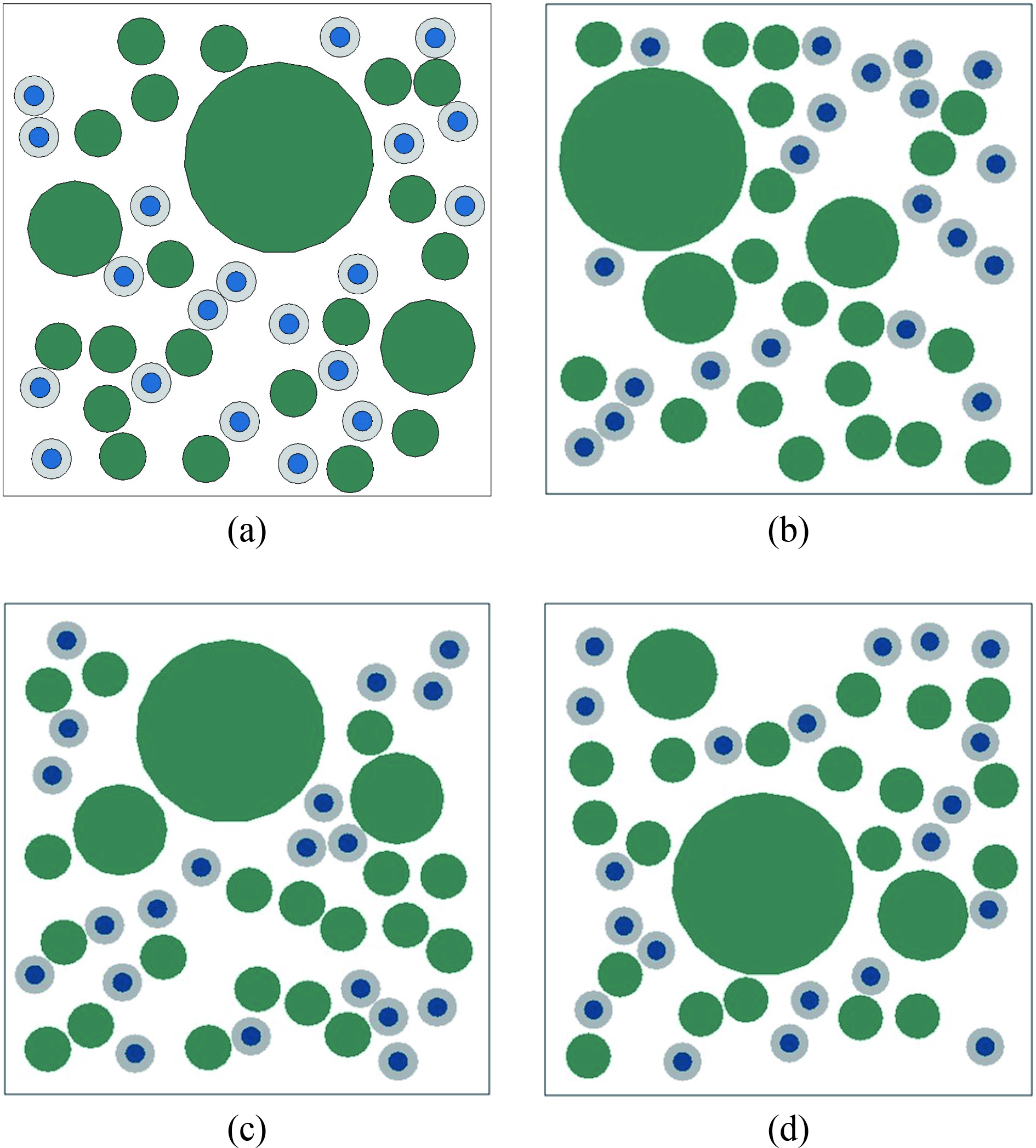
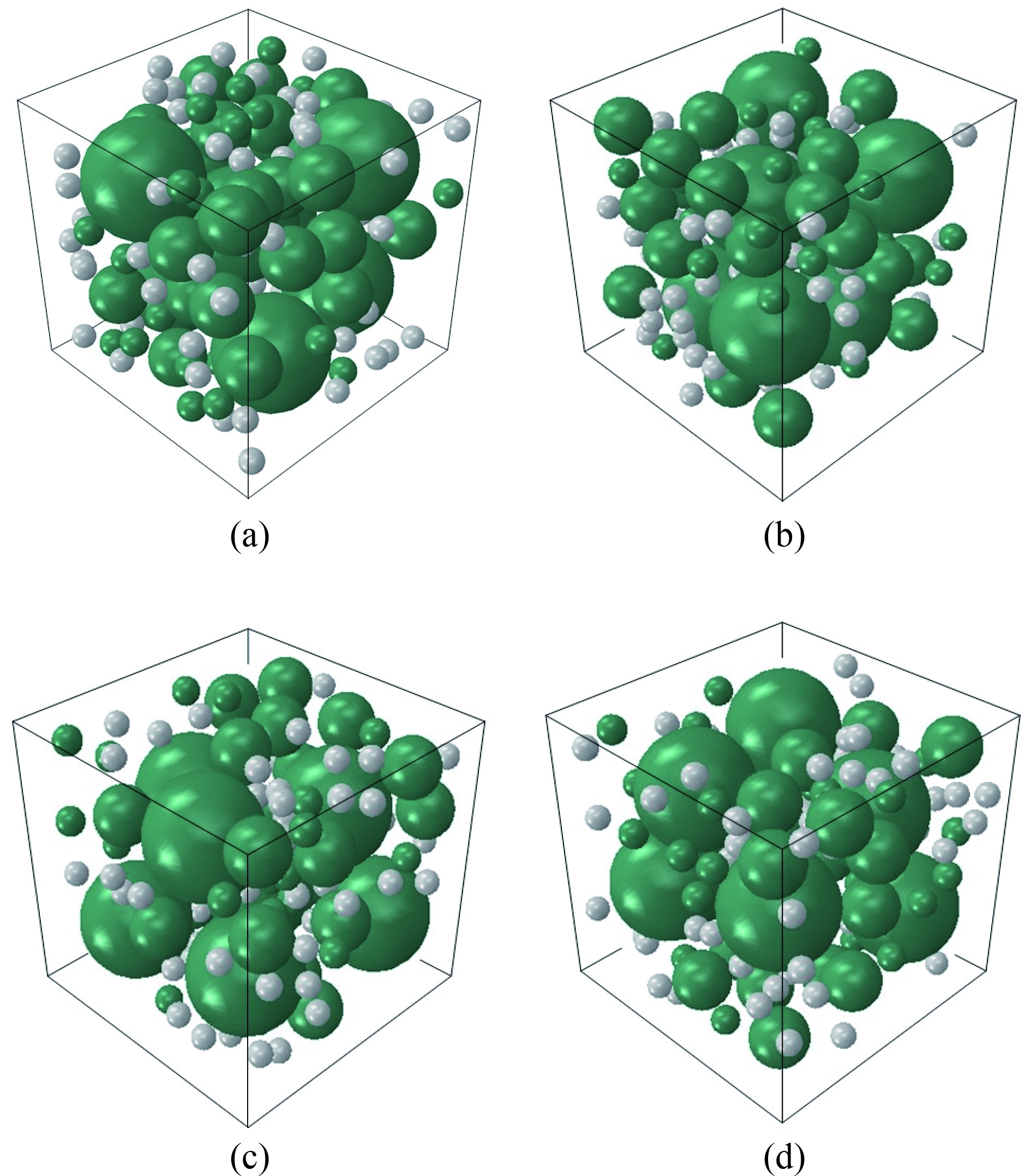
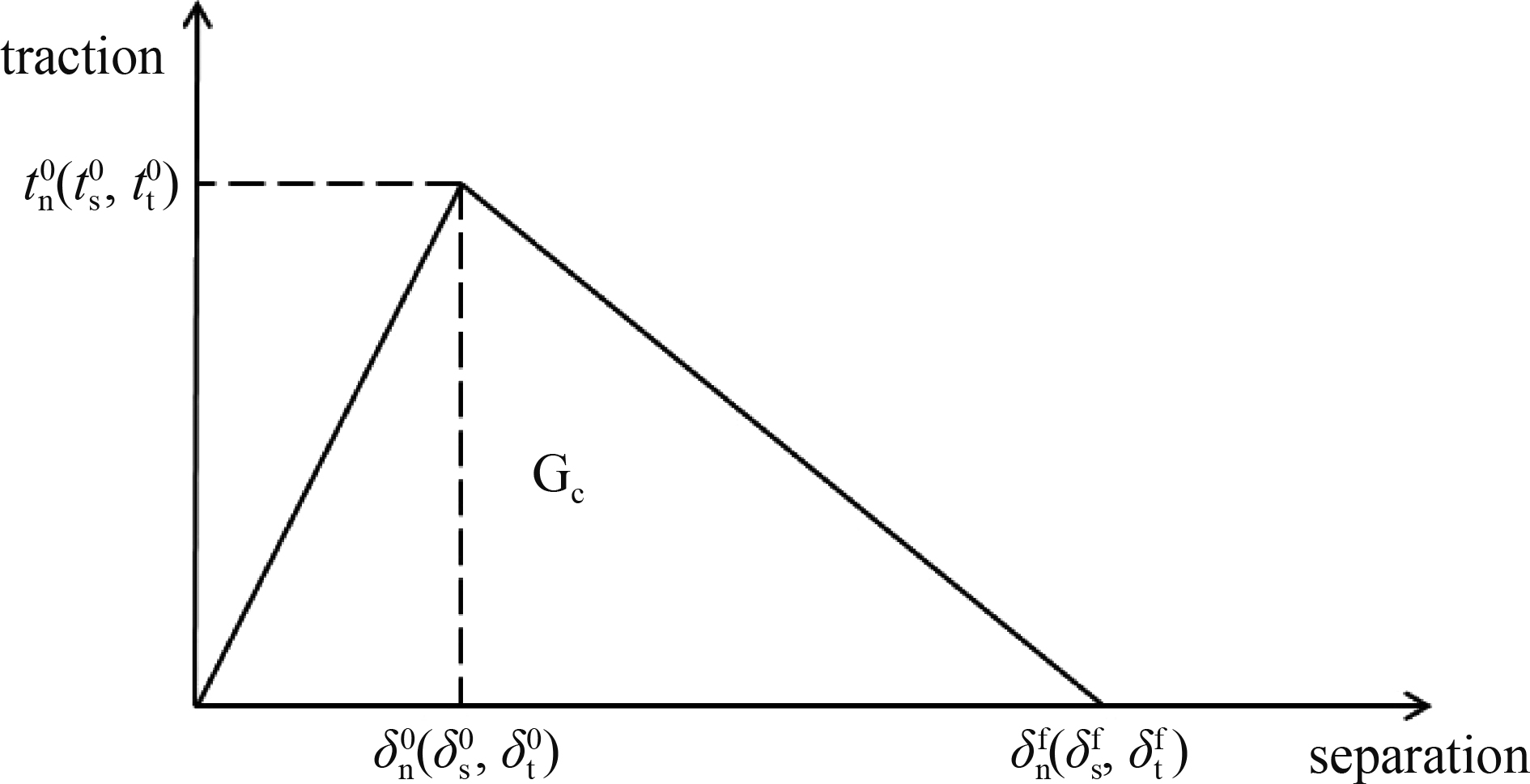
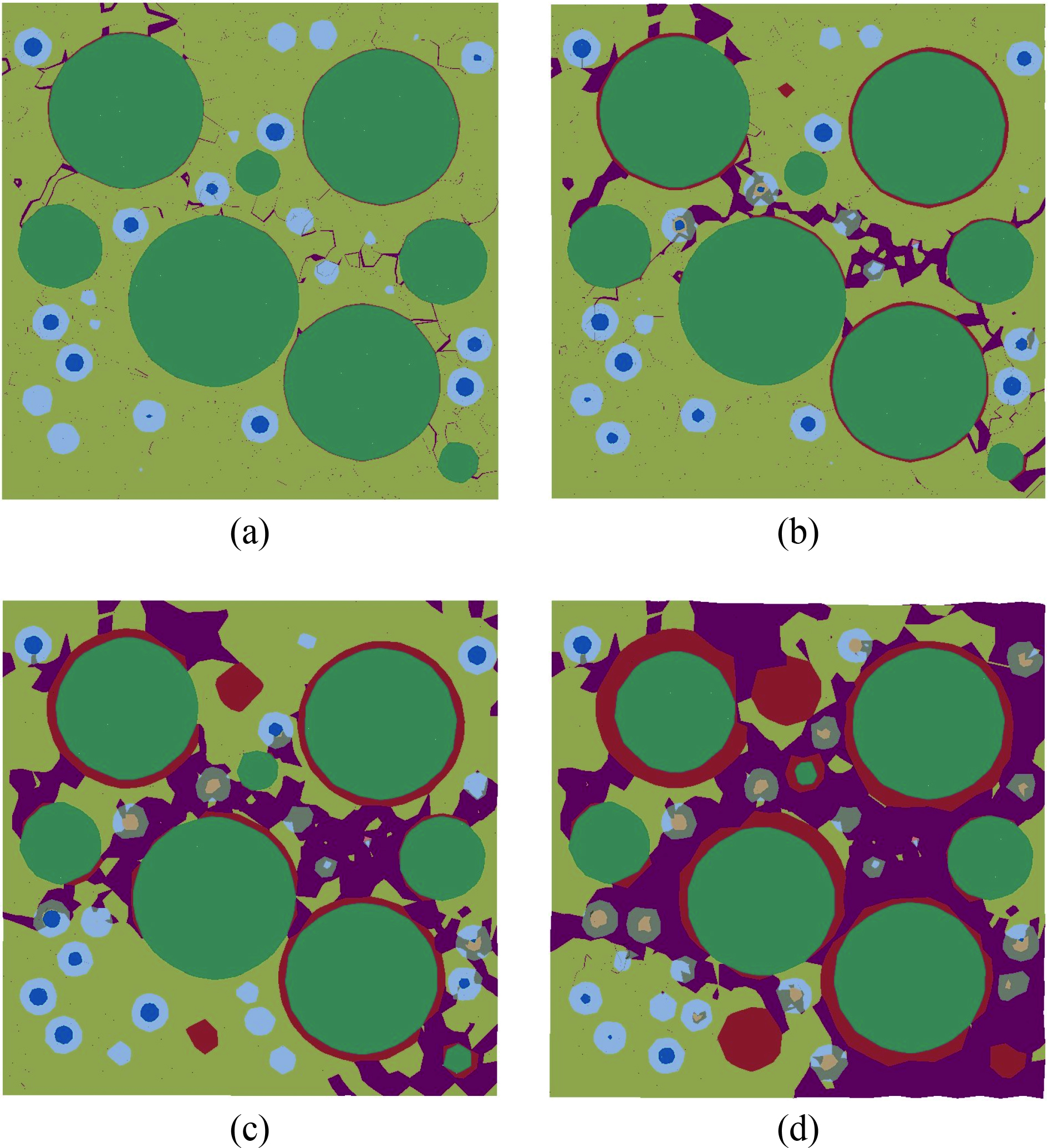
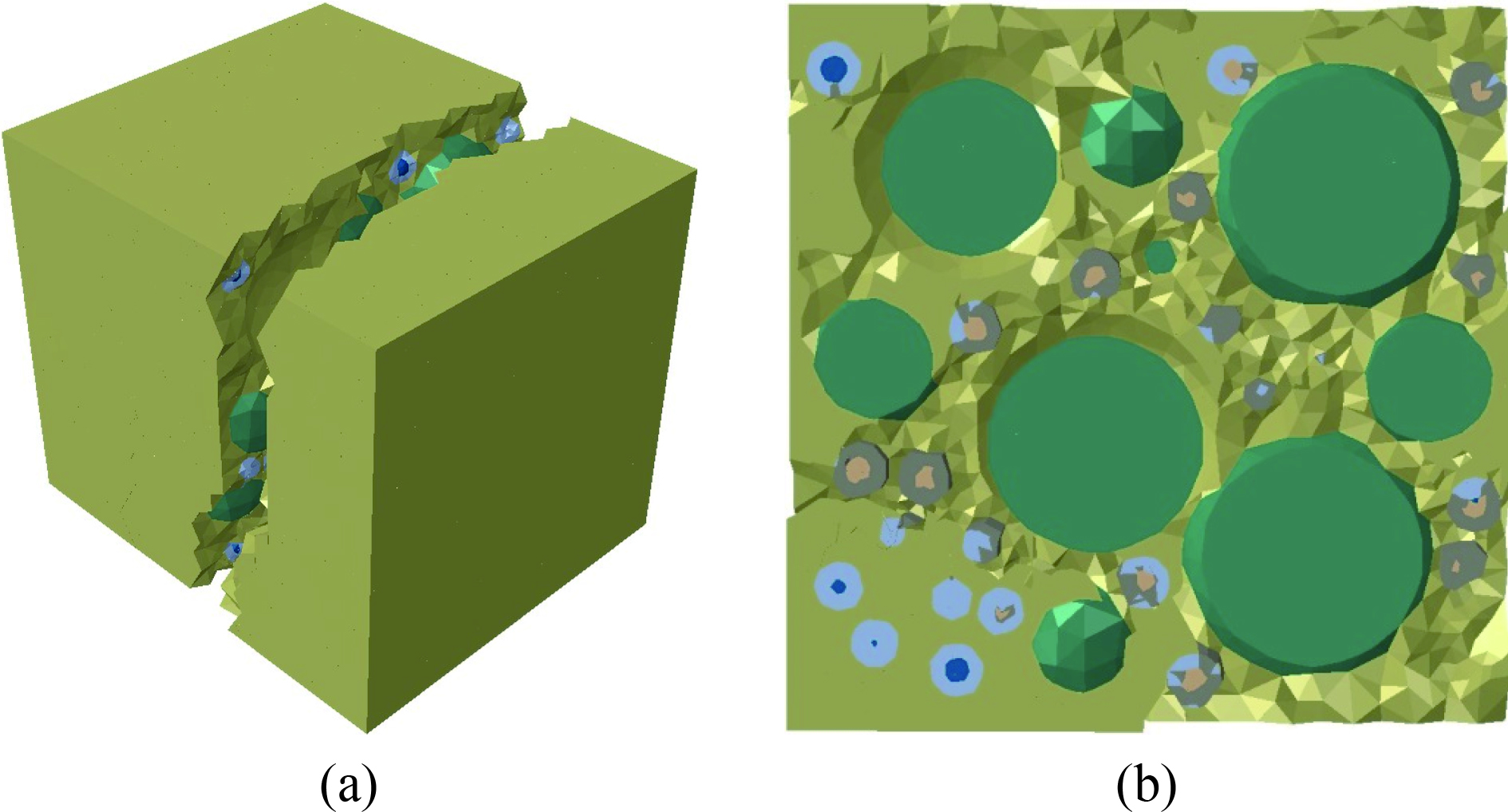
We present a three-dimensional (3D) numerical model to investigate complex fracture behavior using cohesive elements. An efficient packing algorithm is employed to create the mesoscale model of heterogeneous capsule-based self-healing concrete. Spherical aggregates are used and directly generated from specified size distributions with different volume fractions. Spherical capsules are also used and created based on a particular diameter, and wall thickness. Bilinear traction-separation laws of cohesive elements along the boundaries of the mortar matrix, aggregates, capsules, and their interfaces are pre-inserted to simulate crack initiation and propagation. These pre-inserted cohesive elements are also applied into the initial meshes of solid elements to account for fracture in the mortar matrix. Different realizations are carried out and statistically analyzed. The proposed model provides an effective tool for predicting the complex fracture response of capsule-based self-healing concrete at the meso-scale.
. [J]. Frontiers of Structural and Civil Engineering, 2021, 15(6): 1337-1346.
Luthfi Muhammad MAULUDIN, Timon RABCZUK. Computational modeling of fracture in capsule-based self-healing concrete: A 3D study. Front. Struct. Civ. Eng., 2021, 15(6): 1337-1346.
E Cailleux, V Pollet. Investigations on the development of self-healing properties in protective coatings for concrete and repair mortars. In: Proceedings of the 2nd International Conference on Self-Healing Materials. Chicago, IL, 2009
2
C Dry. Matrix cracking repair and filling using active and passive modes for smart timed release of chemicals from fibers into cement matrices. Smart Materials and Structures, 1994, 3( 2): 118– 123 https://doi.org/10.1088/0964-1726/3/2/006
3
S White, S Maiti, A Jones, E Brown, N Sottos, P Geubelle. Fatigue of self-healing polymers: Multiscale analysis and experiments. In: 11th International Conference on Fracture. Turin, 2005
4
R de Borst. Some recent developments in computational modelling of concrete fracture. International Journal of Fracture, 1997, 86( 1): 5– 36 https://doi.org/10.1023/A:1007360521465
5
A R C Murthy, G Palani, N R Iyer. State-of-the-art review on fracture analysis of concrete structural components. Sadhana, 2009, 34( 2): 345– 367 https://doi.org/10.1007/s12046-009-0014-0
6
M Wu, B Johannesson, M Geiker. A review: Self-healing in cementitious materials and engineered cementitious composite as a self-healing material. Construction & Building Materials, 2012, 28( 1): 571– 583 https://doi.org/10.1016/j.conbuildmat.2011.08.086
7
K Van Tittelboom, N deBelie. Self-healing in cementitious materialsa review. Materials (Basel), 2013, 6( 6): 2182– 2217 https://doi.org/10.3390/ma6062182
8
A Talaiekhozan, M Z Abd Majid. A review of self-healing concrete research development. Journal of Environmental Treatment Techniques, 2014, 2( 1): 1– 11
9
L M Mauludin, C Oucif. Modeling of self-healing concrete: A review. Journal of Applied and Computational Mechanics, 2019, 5 : 526– 539
10
C Oucif, L Mauludin. Continuum damage-healing and super healing mechanics in brittle materials: A state-of-the-art review. Applied Sciences (Basel, Switzerland), 2018, 8( 12): 2350– https://doi.org/10.3390/app8122350
11
L M Mauludin, B A Budiman, S P Santosa, X Zhuang, T Rabczuk. Numerical modeling of microcrack behavior in encapsulation-based self-healing concrete under uniaxial tension. Journal of Mechanical Science and Technology, 2020, 34( 5): 1847– 1853 https://doi.org/10.1007/s12206-020-0405-z
12
S R White, N Sottos, P Geubelle, J Moore, M Kessler, S Sriram, E Brown, S Viswanathan. Autonomic healing of polymer composites. Nature, 2001, 409( 6822): 794– 797 https://doi.org/10.1038/35057232
13
S V Zemskov, H M Jonkers, F J Vermolen. Two analytical models for the probability characteristics of a crack hitting encapsulated particles: Application to self-healing materials. Computational Materials Science, 2011, 50( 12): 3323– 3333 https://doi.org/10.1016/j.commatsci.2011.06.024
14
S D Mookhoek, H R Fischer, S van der Zwaag. A numerical study into the effects of elongated capsules on the healing efficiency of liquid-based systems. Computational Materials Science, 2009, 47( 2): 506– 511 https://doi.org/10.1016/j.commatsci.2009.09.017
15
Z Lv, H Chen. Analytical models for determining the dosage of capsules embedded in self-healing materials. Computational Materials Science, 2013, 68 : 81– 89 https://doi.org/10.1016/j.commatsci.2012.09.032
16
F Gilabert, D Garoz, W Van Paepegem. Stress concentrations and bonding strength in encapsulation-based self-healing materials. Materials & Design, 2015, 67 : 28– 41 https://doi.org/10.1016/j.matdes.2014.11.012
17
Z Lv, H Chen, H Yuan. Analytical solution on dosage of self-healing agents in cementitious materials: long capsule 229 model. Journal of Intelligent Material Systems and Structures, 2014, 25( 1): 47– 57 https://doi.org/10.1177/1045389X12457250
18
E Kaltzakorta, I Erkizia. Silica microcapsules encapsulating epoxy compounds for self-healing cementitiousmaterials. In: Proceedings of 3rd International Conference on Self Healing Materials. Bath, 2011
19
B Hilloulin, K Van Tittelboom, E Gruyaert, N de Belie, A Loukili. Design of polymeric capsules for self-healing concrete. Cement and Concrete Composites, 2015, 55 : 298– 307 https://doi.org/10.1016/j.cemconcomp.2014.09.022
20
A Alexeev, R Verberg, A C Balazs. Patterned surfaces segregate compliant microcapsules. Langmuir, 2007, 23( 3): 983– 987 https://doi.org/10.1021/la062914q
21
L M Mauludin, C Oucif. The effects of interfacial strength on fractured microcapsule. Frontiers of Structural and Civil Engineering, 2019, 13( 2): 353– 363 https://doi.org/10.1007/s11709-018-0469-3
22
L M Mauludin, C Oucif. Interaction between matrix crack and circular capsule under uniaxial tension in encapsulation based self-healing concrete. Underground Space, 2018, 3( 3): 181– 189 https://doi.org/10.1016/j.undsp.2018.04.004
23
L M Mauludin, X Zhuang, T Rabczuk. Computational modeling of fracture in encapsulation-based self-healing concrete using cohesive elements. Composite Structures, 2018, 196 : 63– 75 https://doi.org/10.1016/j.compstruct.2018.04.066
24
P Wriggers, S Moftah. Mesoscale models for concrete: Homogenisation and damage behaviour. Finite Elements in Analysis and Design, 2006, 42( 7): 623– 636 https://doi.org/10.1016/j.finel.2005.11.008
25
T J Hirsch. Modulus of elasticity of concrete affected by elastic moduli of cement paste matrix and aggregate. Journal Proceedings, 1962, 59 : 427– 452
26
M L Daudeville. Role of coarse aggregates in the triaxial behavior of concrete: experimental and numerical analysis. Dissertation for the Doctoral Degree. Cergy-Pontoise: Cergy-Pontoise University, 2014
27
X Du, L Jin, G Ma. Numerical modeling tensile failure behavior of concrete at mesoscale using extended finite element method. International Journal of Damage Mechanics, 2014, 23( 7): 872– 898 https://doi.org/10.1177/1056789513516028
28
E Gruyaert, K Van Tittelboom, J Sucaet, J Anrijs, S Van Vlierberghe, P Dubruel, B de Geest, J P Remon, N de Belie. Capsules with evolving brittleness to resist the preparation of self-healing concrete. Construction Materials, 2016, 66 (323): e092
29
M S Quayum, X Zhuang, T Rabczuk. Computational model generation and rve design of self-healing concrete. Frontiers of Structural and Civil Engineering, 2015, 9( 4): 383– 396 https://doi.org/10.1007/s11709-015-0320-z
30
Simulia, Abaqus 6.13 Documentation, 2013
31
Y Yang, Y Ning, C Wang, Z Tong. Capsule clusters fabricated by polymerization based on capsule-in-water-in-oil pickering emulsions. Polymer Chemistry, 2013, 4( 21): 5407– 5415 https://doi.org/10.1039/c3py00620d
32
X Wang, A P Jivkov. Combined numerical-statistical analyses of damage and failure of 2d and 3d mesoscale hetero geneous concrete. Mathematical Problems in Engineering, 2015, 1– 12
33
X Wang, F Xing, M Zhang, N Han, Z Qian. Experimental study on cementitious composites embedded with organic microcapsules. Materials (Basel), 2013, 6( 9): 4064– 4081 https://doi.org/10.3390/ma6094064
34
M Keller, N Sottos. Mechanical properties of microcapsules used in a self-healing polymer. Experimental Mechanics. 2006, 46(6): 725– 733
35
Y J You, J H J Kim, K T Park, D W Seo, T H Lee. Modification of rule of mixtures for tensile strength estimation of circular GFRP rebars. Polymers, 2017, 9( 12): 682– https://doi.org/10.3390/polym9120682
36
J Wang, H Soens, W Verstraete, N de Belie. Self-healing concrete by use of microencapsulated bacterial spores. Cement and Concrete Research, 2014, 56 : 139– 152 https://doi.org/10.1016/j.cemconres.2013.11.009
37
A Kanellopoulos, P Giannaros, A Al-Tabbaa. The effect of varying volume fraction of microcapsules on fresh, mechanical and self-healing properties of mortars. Construction & Building Materials, 2016, 122 : 577– 593 https://doi.org/10.1016/j.conbuildmat.2016.06.119
38
L Lv, E Schlangen, Z Yang, F Xing. Micromechanical properties of a new polymeric microcapsule for self-healing cementitious materials. Materials (Basel), 2016, 9( 12): 1025– https://doi.org/10.3390/ma9121025