|
|
|
The German Energiewende and its roll-out of renewable energies: An economic perspective |
Sebastian KREUZ( ), Felix MÜSGENS ), Felix MÜSGENS |
| Faculty of Mechanical Engineering, Electrical and Energy Systems, Brandenburg University of Technology, 03046 Cottbus, Germany |
|
|
|
|
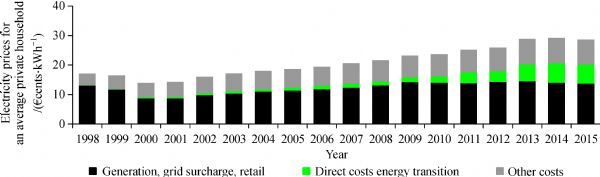
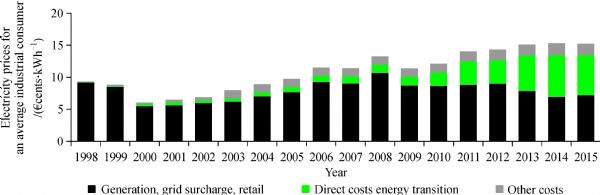
Abstract This paper gives a short overview of the German Energiewende, i.e. the transition of a large and mostly thermal electricity system towards electricity generation from renewable energy source. It discusses both, the motivation of the transitions as future goals and current status. Furthermore, it gives an in-depth view into the changes in economic costs for society as well as electricity price effects, especially for average private households and industrial consumers. It also discusses the benefits of the promotion of renewable energies in Germany.
|
| Keywords
electricity system
renewable energy
cost-benefit analysis
|
|
Corresponding Author(s):
Sebastian KREUZ
|
|
Just Accepted Date: 07 April 2017
Online First Date: 10 May 2017
Issue Date: 01 June 2017
|
|
| 1 |
IRENA (International Renewable Energy Agency). Data and statistics of capacity and generation. 2016
|
| 2 |
Renewable Energy Sources Act (Renewable Energy Sources Act—RES Act 2014). 2014
|
| 3 |
F Joas, M Pahle, C Flachsland, A Joas. Which goals are driving the Energiewende? Making sense of the German Energy Transformation. Energy Policy, 2016, 95: 42–51
https://doi.org/10.1016/j.enpol.2016.04.003
|
| 4 |
Federal Government. German Federal Government’s National Electromobility Development Plan. 2009
|
| 5 |
Federal Ministry for Economic Affairs and Energy (FMEE). Time Series about the Development of Renewable Energies in Germany (in Germany). 2016
|
| 6 |
Federal Ministry for Economic Affairs and Energy (FMEE). The Energy of the Future–5th Monitoring Report of the Energy Transition (long version, in German). 2016
|
| 7 |
Federal Office for Motor Traffic. Annual count of the stock of vehicles. 2016
|
| 8 |
Federal Government. Directory sustainability–outcome and perspectives. 2005
|
| 9 |
Federal Government. Progress report 2008 on the national strategy for sustainable development—for a sustainable German.2008
|
| 10 |
Federal Ministry for Economic Affairs and Energy (FMEE). Compensations, differential costs and EEG-surcharge 2000 until 2017 (in Germany). 2016
|
| 11 |
P L Joskow. Comparing the costs of intermittent and dispatchable electricity generating technologies. American Economic Review, 2010, 101(3):238–241
|
| 12 |
Netztransparenz 2016. Overview for market values and reference market values. 2016
|
| 13 |
C Kost, J N Mayer, J Thomsen, N Hartmann, C Senkpiel, S Philipps, S Nold, S Lude, N Saad, T Schlegl. Levelized cost of electricity renewable energy technologies. 2013
|
| 14 |
I S E Fraunhofer. Current and future cost of photovoltaics: long-term scenarios for market development, system prices and LCOE of utility-scale PV systems. 2015
|
| 15 |
M Dillig, M Jung, J Karl. The impact of renewables on electricity prices in Germany—an estimation based on historic spot prices in the years 2011–2013. Renewable & Sustainable Energy Reviews, 2016, 57: 7–15
https://doi.org/10.1016/j.rser.2015.12.003
|
| 16 |
Federal Network Agency. Approval of scenarios for the electricity grid extension plans 2017–2030 (in Germany). 2016
|
| 17 |
TSOs (Transmission System Operators). 50 Hertz Transmission GmbH, Amprion GmbH, Transnet BW GmbH, TenneT TSO GmbH. 2016
|
| 18 |
BDEW. (Federal Association of the Energy and Water Industry). Net electricity consumption of different customer groups (in Germany). 2016
|
| 19 |
BDEW. (Federal Association of the Energy and Water Industry). BDEW electricity price analysis. 2016
|
| 20 |
Eurostat. Energy price statistics, 2016
|
| 21 |
S Borenstein. The private and public economics of renewable electricity generation. Journal of Economic Perspectives, 2012, 26(1): 67–92
https://doi.org/10.1257/jep.26.1.67
|
| 22 |
R Schmalensee. Evaluating policies to increase electricity generation from renewable energy. Review of Environmental Economics and Policy, 2012, 6(1): 45–64
https://doi.org/10.1093/reep/rer020
|
| 23 |
Öko-Institut. Saved costs for energy imports in 2015 and innovation effects through the usage of renewable energies (in Germany). 2016
|
| 24 |
J Blazejczak, F G Braun, D Edler, W P Schill. Economic effects of renewable energy expansion: a model-based analysis for Germany. Renewable & Sustainable Energy Reviews, 2014, 40: 1070–1080
https://doi.org/10.1016/j.rser.2014.07.134
|
| 25 |
U Lehr, P Ulrich, C Lutz, I Thobe, D Edler, M O’Sullivan, S Simon, T Naegler, U Pfenning, F Peter, F Sakowski, P Bickel. Employment by renewable energies in Germany: development and operation, today and tomorrow (in Germany). Study for the Federal Ministry of Economics and Energy,2015
|
| 26 |
C Lutz, A Großmann, U Lehr, D Lindenberger, A Knaut, R Malischek, S Paulus, C Tode, J Wagner, A Kemmler, A Ley, A Piégsa, M Schlesinger, S Straßburg, S Koziel. Macroeconomic effects of the energy transition (in Germany). Study fort the Federal Ministry of Economics and Energy,2014.
|
| 27 |
M Frondel, N Ritter, C M Schmidt, C Vance. Economic impacts from the promotion of renewable energy technologies: the German experience. Energy Policy, 2010, 38(8): 4048–4056
https://doi.org/10.1016/j.enpol.2010.03.029
|
|
Viewed |
|
|
|
Full text
|
|
|
|
|
Abstract
|
|
|
|
|
Cited |
|
|
|
|
| |
Shared |
|
|
|
|
| |
Discussed |
|
|
|
|