|
|
|
Modeling of unconfined compressive strength of soil-RAP blend stabilized with Portland cement using multivariate adaptive regression spline |
Ali Reza GHANIZADEH1( ), Morteza RAHROVAN2 ), Morteza RAHROVAN2 |
1. Department of Civil Engineering, Sirjan University of Technology, Sirjan 78137-33385, Iran
2. Department of Civil Engineering, Yazd University, Yazd 89195-741, Iran |
|
|
|
|
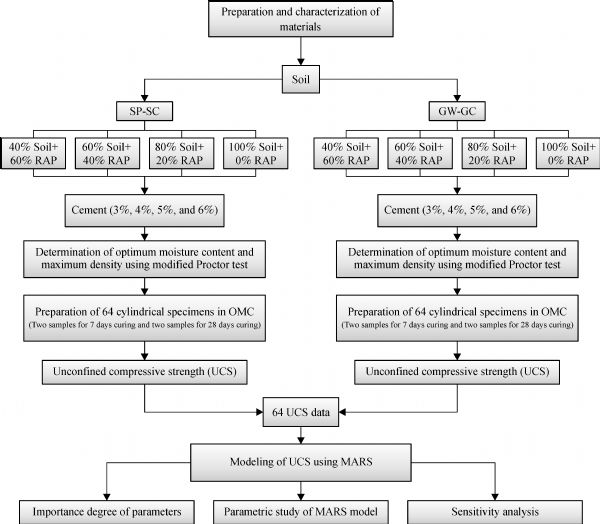
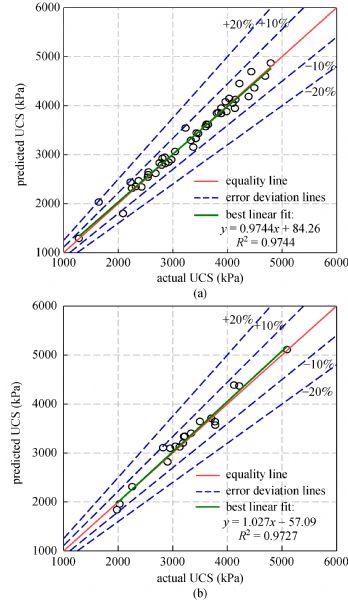
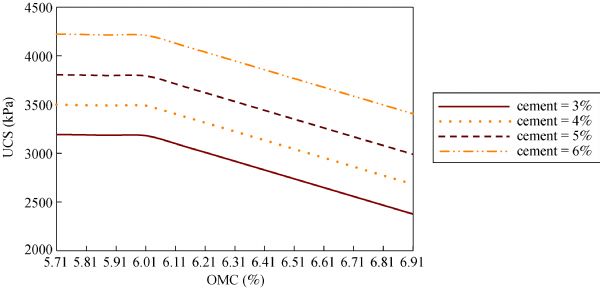
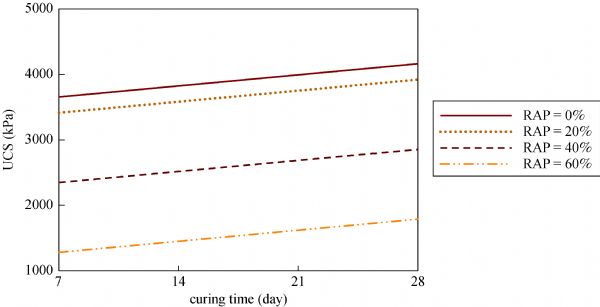
Abstract The recycled layer in full-depth reclamation (FDR) method is a mixture of coarse aggregates and reclaimed asphalt pavement (RAP) which is stabilized by a stabilizer agent. For design and quality control of the final product in FDR method, the unconfined compressive strength of stabilized material should be known. This paper aims to develop a mathematical model for predicting the unconfined compressive strength (UCS) of soil-RAP blend stabilized with Portland cement based on multivariate adaptive regression spline (MARS). To this end, two different aggregate materials were mixed with different percentages of RAP and then stabilized by different percentages of Portland cement. For training and testing of MARS model, total of 64 experimental UCS data were employed. Predictors or independent variables in the developed model are percentage of RAP, percentage of cement, optimum moisture content, percent passing of #200 sieve, and curing time. The results demonstrate that MARS has a great ability for prediction of the UCS in case of soil-RAP blend stabilized with Portland cement (R2 is more than 0.97). Sensitivity analysis of the proposed model showed that the cement, optimum moisture content, and percent passing of #200 sieve are the most influential parameters on the UCS of FDR layer.
|
| Keywords
full-depth reclamation
soil-reclaimed asphalt pavement blend
Portland cement
unconfined compressive strength
multivariate adaptive regression spline
|
|
Corresponding Author(s):
Ali Reza GHANIZADEH
|
|
Just Accepted Date: 07 March 2019
Online First Date: 09 May 2019
Issue Date: 10 July 2019
|
|
| 1 |
Asphalt Recycling and Reclaiming Association (ARRA). Basic asphalt recycling manual, 2001
|
| 2 |
D A Morian, M Solaimanian, B Scheetz, S Jahangirnejad. Developing Standards and Specifications for Full Depth Pavement Reclamation. Harrisburg: Commonwealth of Pennsylvania Department of Transportation, 2012
|
| 3 |
Main DoT. Specification on Cold In-Place Recycled Pavement. Special Provision Section 311, 1993
|
| 4 |
R Mallick, D Bonner, R Bradbury, J Andrews, P Kandhal, E. Kearney Evaluation of performance of full-depth reclamation mixes. Transportation Research Record: Journal of the Transportation Research Board, 2002, 1809(1): 199–208
|
| 5 |
H Wen, M Tharaniyil, B Ramme, S. Krebs Field performance evaluation of class C fly ash in full-depth reclamation: Case history study. Transportation Research Record: Journal of the Transportation Research Board, 2004, 1869: 41–46
|
| 6 |
W Guthrie, A Brown, D Eggett. Cement stabilization of aggregate base material blended with reclaimed asphalt pavement. Transportation Research Record: Journal of the Transportation Research Board, 2007, 2026(1): 47–53
https://doi.org/10.3141/2026-06
|
| 7 |
M Kroge, K McGlumphy, T Besseche. Full-depth reclamation with engineered emulsion in Fairburn, Georgia. Transportation Research Record: Journal of the Transportation Research Board, 2009, 2095(1): 136–143
https://doi.org/10.3141/2095-14
|
| 8 |
J Pappas. Environmental considerations of in-place recycling. In: Virginia Pavement Recycling Conference. Virginia: Virginia tech transportation institute, 2012
|
| 9 |
C Slage. Washington County’s Experience with In-Place Recycling. In: 15th Annual TERRA Pavement Conference. Minnesota: University of Minnesota, 2011, 50–67
|
| 10 |
E C Bartku. In-Situ recycling: Applications, guidelines, and case study for local governments. Thesis for the Master's Degree. Virginia Tech, 2014
|
| 11 |
A J Puppala, L R Hoyos, A K Potturi. Resilient moduli response of moderately cement-treated reclaimed asphalt pavement aggregates. Journal of Materials in Civil Engineering, 2011, 23(7): 990–998
https://doi.org/10.1061/(ASCE)MT.1943-5533.0000268
|
| 12 |
W Guthrie , A Brown , D Eggett. Cement stabilization of aggregate base materials blended with reclaimed asphalt pavement. Transportation Research Record: Journal of the Transportation Research Board, 2007, 2026: 47–53
|
| 13 |
V K Ganne. Long Term Durability Studies On Chemically Treated Reclaimed Asphalt Pavement (RAP) Materials. The Dissertation for the Doctoral Degree. Arlington: University of Texas at Arlington, 2010
|
| 14 |
J Suebsuk, S Deengam, K Chaidachatorn, C Suksiripattanapong. Field strength assessment of recycled base course by dynamic cone penetration (DCP) test. Journal of King Mongkut’s University of Technology North Bangkok, 2017, 27(2): 219–230
|
| 15 |
S Bang, W Lein, B Comes, L Nehl, J Anderson, P Kraft, M deStigter, C Leibrock, L Roberts, P. Sebaaly Quality Base Material Produced Using Full Depth Reclamation on Existing Asphalt Pavement Structure-Task 4: Development of FDR Mix Design Guide. Final Report, No FHWA-HIF-12-015. 2011
|
| 16 |
H J Miller, W S Guthrie, R A Crane, B. Smith Evaluation of Cement-Stabilized Full-depth-recycled Base Materials for Frost and Early Traffic Conditions. Durham: University of New Hampshire, 2006
|
| 17 |
D D Batioja. Evaluation of Cement Stabilization of a Road Base Material in Conjunction with Full-Depth Reclamation in Huaquillas. Thesis for the Master’s Degree. Ecuador: Brigham Young University, 2011
|
| 18 |
S K Das, P Samui, A K Sabat. Application of artificial intelligence to maximum dry density and unconfined compressive strength of cement stabilized soil. Geotechnical and Geological Engineering, 2011, 29(3): 329–342
https://doi.org/10.1007/s10706-010-9379-4
|
| 19 |
A H Alavi, A H Gandomi, A Mollahasani. A Genetic Programming-Based Approach for the Performance Characteristics Assessment of Stabilized Soil. Heidelberg: Springer, 2012, 343–376
|
| 20 |
H Güllü. Function finding via genetic expression programming for strength and elastic properties of clay treated with bottom ash. Engineering Applications of Artificial Intelligence, 2014, 35: 143–157
https://doi.org/10.1016/j.engappai.2014.06.020
|
| 21 |
S Motamedi, S Shamshirband, D Petković, R Hashim. Application of adaptive neuro-fuzzy technique to predict the unconfined compressive strength of PFA-sand-cement mixture. Powder Technology, 2015, 278: 278–285
https://doi.org/10.1016/j.powtec.2015.02.045
|
| 22 |
H MolaAbasi, I Shooshpasha. Prediction of zeolite-cement-sand unconfined compressive strength using polynomial neural network. European Physical Journal Plus, 2016, 131(4): 108–131
https://doi.org/10.1140/epjp/i2016-16108-5
|
| 23 |
R A Mozumder, A I Laskar, M Hussain. Empirical approach for strength prediction of geopolymer stabilized clayey soil using support vector machines. Construction & Building Materials, 2017, 132: 412–424
https://doi.org/10.1016/j.conbuildmat.2016.12.012
|
| 24 |
S Sathyapriya, P Arumairaj, D Ranjini. Prediction of unconfined compressive strength of a stabilised expansive clay soil using ANN and regression analysis (SPSS). Asian Journal of Research in Social Sciences and Humanities, 2017, 7(2): 109–123
https://doi.org/10.5958/2249-7315.2017.00075.2
|
| 25 |
I Taleb Bahmed, K Harichane, M Ghrici, B Boukhatem, R Rebouh, H Gadouri. Prediction of geotechnical properties of clayey soils stabilised with lime using artificial neural networks (ANNs). International Journal of Geotechnical Engineering, 2017, 13(2), 191–203
|
| 26 |
M J Berry, G Linoff. Data Mining Techniques: for Marketing, Sales, and Customer Support. New York: John Wiley & Sons, Inc, 1997
|
| 27 |
V Kecman. Learning and Soft Computing: Support Vector Machines, Neural Networks, and Fuzzy Logic Models. Cambridge: MIT press, 2001
|
| 28 |
N Vu-Bac, T Lahmer, H Keitel, J Zhao, X Zhuang, T Rabczuk. Stochastic predictions of bulk properties of amorphous polyethylene based on molecular dynamics simulations. Mechanics of Materials, 2014, 68: 70–84
https://doi.org/10.1016/j.mechmat.2013.07.021
|
| 29 |
N Vu-Bac, T Lahmer, Y Zhang, X Zhuang, T Rabczuk. Stochastic predictions of interfacial characteristic of polymeric nanocomposites (PNCs). Composites. Part B, Engineering, 2014, 59: 80–95
https://doi.org/10.1016/j.compositesb.2013.11.014
|
| 30 |
N Vu-Bac, M Silani, T Lahmer, X Zhuang, T Rabczuk. A unified framework for stochastic predictions of mechanical properties of polymeric nanocomposites. Computational Materials Science, 2015, 96: 520–535
https://doi.org/10.1016/j.commatsci.2014.04.066
|
| 31 |
N Vu-Bac, R Rafiee, X Zhuang, T Lahmer, T Rabczuk. Uncertainty quantification for multiscale modeling of polymer nanocomposites with correlated parameters. Composites. Part B, Engineering, 2015, 68: 446–464
https://doi.org/10.1016/j.compositesb.2014.09.008
|
| 32 |
N Vu-Bac, T Lahmer, X Zhuang, T Nguyen-Thoi, T Rabczuk. A software framework for probabilistic sensitivity analysis for computationally expensive models. Advances in Engineering Software, 2016, 100: 19–31
https://doi.org/10.1016/j.advengsoft.2016.06.005
|
| 33 |
M F Badawy, M A Msekh, K M Hamdia, M K Steiner, T Lahmer, T Rabczuk. Hybrid nonlinear surrogate models for fracture behavior of polymeric nanocomposites. Probabilistic Engineering Mechanics, 2017, 50: 64–75
https://doi.org/10.1016/j.probengmech.2017.10.003
|
| 34 |
A Parsaie, A H Haghiabi, M Saneie, H Torabi. Predication of discharge coefficient of cylindrical weir-gate using adaptive neuro fuzzy inference systems (ANFIS). Frontiers of Structural and Civil Engineering, 2017, 11(1): 111–122
https://doi.org/10.1007/s11709-016-0354-x
|
| 35 |
P Zakian. An efficient stochastic dynamic analysis of soil media using radial basis function artificial neural network. Frontiers of Structural and Civil Engineering, 2017, 11(4): 470–479
https://doi.org/10.1007/s11709-017-0440-8
|
| 36 |
F Khademi, M Akbari, S M Jamal, M Nikoo. Multiple linear regression, artificial neural network, and fuzzy logic prediction of 28 days compressive strength of concrete. Frontiers of Structural and Civil Engineering, 2017, 11(1): 90–99
https://doi.org/10.1007/s11709-016-0363-9
|
| 37 |
N O Attoh-Okine, K Cooger, S Mensah. Multivariate adaptive regression (MARS) and hinged hyperplanes (HHP) for doweled pavement performance modeling. Construction & Building Materials, 2009, 23(9): 3020–3023
https://doi.org/10.1016/j.conbuildmat.2009.04.010
|
| 38 |
M R Mirzahosseini, A Aghaeifar, A H Alavi, A H Gandomi, R Seyednour. Permanent deformation analysis of asphalt mixtures using soft computing techniques. Expert Systems with Applications, 2011, 38(5): 6081–6100
https://doi.org/10.1016/j.eswa.2010.11.002
|
| 39 |
S Zarnani, M M El-Emam, R J Bathurst. Comparison of numerical and analytical solutions for reinforced soil wall shaking table tests. Geomechanics and Engineering, 2011, 3(4): 291–321
https://doi.org/10.12989/gae.2011.3.4.291
|
| 40 |
P Samui. Determination of ultimate capacity of driven piles in cohesionless soil: a multivariate adaptive regression spline approach. International Journal for Numerical and Analytical Methods in Geomechanics, 2012, 36(11): 1434–1439
https://doi.org/10.1002/nag.1076
|
| 41 |
P Samui, P Kurup. Multivariate adaptive regression spline and least square support vector machine for prediction of undrained shear strength of clay. International Journal of Applied Metaheuristic Computing, 2012, 3(2): 33–42
https://doi.org/10.4018/jamc.2012040103
|
| 42 |
P Samui. Multivariate adaptive regression spline (Mars) for prediction of elastic modulus of jointed rock mass. Geotechnical and Geological Engineering, 2013, 31(1): 249–253
https://doi.org/10.1007/s10706-012-9584-4
|
| 43 |
A R Ghanizadeh, M Fakhri. Prediction of frequency for simulation of asphalt mix fatigue tests using MARS and ANN. The Scientific World Journal , 2014, 2014(34): 515467
https://doi.org/10.1155/2014/515467
|
| 44 |
W Zhang, A T Goh, Y Zhang, Y Chen, Y Xiao. Assessment of soil liquefaction based on capacity energy concept and multivariate adaptive regression splines. Engineering Geology, 2015, 188: 29–37
https://doi.org/10.1016/j.enggeo.2015.01.009
|
| 45 |
W Zhang, A T Goh. Multivariate adaptive regression splines and neural network models for prediction of pile drivability. Geoscience Frontiers, 2016, 7(1): 45–52
https://doi.org/10.1016/j.gsf.2014.10.003
|
| 46 |
L L Liu, Y M Cheng. Efficient system reliability analysis of soil slopes using multivariate adaptive regression splines-based Monte Carlo simulation. Computers and Geotechnics, 2016, 79: 41–54
https://doi.org/10.1016/j.compgeo.2016.05.001
|
| 47 |
W Zhang, A T C Goh. Multivariate adaptive regression splines for analysis of geotechnical engineering systems. Computers and Geotechnics, 2013, 48: 82–95
https://doi.org/10.1016/j.compgeo.2012.09.016
|
| 48 |
S Suman, M Mahamaya, S K Das. Prediction of maximum dry density and unconfined compressive strength of cement stabilised soil using artificial intelligence techniques. International Journal of Geosynthetics and Ground Engineering, 2016, 2(2): 11–22
https://doi.org/10.1007/s40891-016-0051-9
|
| 49 |
Iran Management and Planning Organization. Code 234: Iran Highway Asphaltic Pavements. Tehran: Iran Management and Planniag Organization, 2010
|
| 50 |
J H Friedman. Multivariate adaptive regression splines. Annals of Statistics, 1991, 19(1): 1–67
https://doi.org/10.1214/aos/1176347963
|
| 51 |
O Giustolisi, A Doglioni, D Savic, B Webb. A multi-model approach to analysis of environmental phenomena. Environmental Modelling & Software, 2007, 22(5): 674–682
https://doi.org/10.1016/j.envsoft.2005.12.026
|
| 52 |
K M Hamdia, M Silani, X Zhuang, P He, T Rabczuk. Stochastic analysis of the fracture toughness of polymeric nanoparticle composites using polynomial chaos expansions. International Journal of Fracture, 2017, 206(2): 215–227
https://doi.org/10.1007/s10704-017-0210-6
|
| 53 |
Y Yang, Q Zhang. A hierarchical analysis for rock engineering using artificial neural networks. Rock Mechanics and Rock Engineering, 1997, 30(4): 207–222
https://doi.org/10.1007/BF01045717
|
| 54 |
J Suebsuk, A Suksan, S Horpibulsuk. Strength assessment of cement treated soil/reclaimed asphalt pavement (RAP) mixture. International Journal of GEOMATE, 2014, 6(2): 878–884
https://doi.org/10.21660/2014.12.3262
|
| 55 |
R Taha, A Al-Harthy, K Al-Shamsi, M Al-Zubeidi. Cement stabilization of reclaimed asphalt pavement aggregate for road bases and subbases. Journal of Materials in Civil Engineering, 2002, 14(3): 239–245
https://doi.org/10.1061/(ASCE)0899-1561(2002)14:3(239)
|
|
Viewed |
|
|
|
Full text
|
|
|
|
|
Abstract
|
|
|
|
|
Cited |
|
|
|
|
| |
Shared |
|
|
|
|
| |
Discussed |
|
|
|
|