Please wait a minute...
Frontiers of Structural and Civil Engineering

ISSN 2095-2430

ISSN 2095-2449(Online)

CN 10-1023/X

Postal Subscription Code 80-968

2018 Impact Factor: 1.272

Front. Struct. Civ. Eng.    2014, Vol. 8 Issue (4) : 414-426    https://doi.org/10.1007/s11709-014-0276-4
RESEARCH ARTICLE
Numerical study of the cyclic load behavior of AISI 316L stainless steel shear links for seismic fuse device
Ruipeng LI1,Yunfeng ZHANG1,2,*(),Le-Wei TONG2
1. Department of Civil & Environmental Engineering, University of Maryland, College Park, Maryland 21042, USA
2. State key laboratory for Disaster Reduction in Civil Engineering, College of Civil Engineering, Tongji University, Shanghai 200092, China
 Download: PDF(3161 KB)   HTML
 Export: BibTeX | EndNote | Reference Manager | ProCite | RefWorks
Abstract

This paper presents the results of nonlinear finite element analyses conducted on stainless steel shear links. Stainless steels are attractive materials for seismic fuse device especially for corrosion-aware environment such as coastal regions because they are highly corrosion resistant, have good ductility and toughness properties in combination with low maintenance requirements. This paper discusses the promising use of AISI 316L stainless steel for shear links as seismic fuse devices. Hysteresis behaviors of four stainless steel shear link specimens under reversed cyclic loading were examined to assess their ultimate strength, plastic rotation and failure modes. The nonlinear finite element analysis results show that shear links made of AISI 316L stainless steel exhibit a high level of ductility. However, it is also found that because of large over-strength ratio associated with its strain hardening process, mixed shear and flexural failure modes were observed in stainless steel shear links compared with conventional steel shear links with the same length ratio. This raises the issue that proper design requirements such as length ratio, element compactness and stiffener spacing need to be determined to ensure the full development of the overall plastic rotation of the stainless steel shear links.

Keywords hysteretic damper      eccentrically braced frame      energy dissipation      seismic      stainless steel      shear link     
Corresponding Author(s): Yunfeng ZHANG   
Issue Date: 12 January 2015
 Cite this article:   
Yunfeng ZHANG,Le-Wei TONG,Ruipeng LI. Numerical study of the cyclic load behavior of AISI 316L stainless steel shear links for seismic fuse device[J]. Front. Struct. Civ. Eng., 2014, 8(4): 414-426.
 URL:  
https://academic.hep.com.cn/fsce/EN/10.1007/s11709-014-0276-4
https://academic.hep.com.cn/fsce/EN/Y2014/V8/I4/414
section bf/mm tf/mm tw/mm d/mm L/mm ts/mm web stiffeners
W10×33 202.2 11.0 7.4 247.0 733.2 10.0 4@147 mm
W12×50 205.2 16.3 9.4 309.9 863.3 10.0 3@216 mm
W14×74 256.5 19.9 11.4 360.7 1070.6 11.4 3@268 mm
W16×77 261.6 19.3 11.6 419.1 1090.3 11.6 4@218 mm
Tab.1  Dimensions and section details of the four shear link beams
E0/GPa ν σ 0.01 /MPa σ 0.2 /MPa σ u /MPa ? u
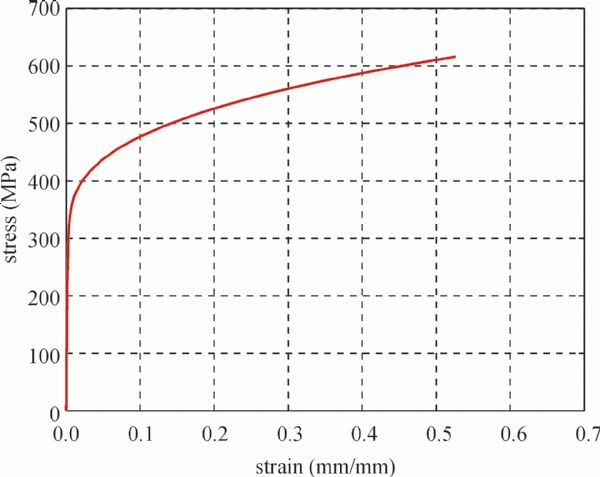
SS316L 190 0.31 190 316 616 0.51
Tab.2  Parameter values of 316L stainless steel material model (adapted from Rasmussen [9])
Fig.1  Stress-strain relationship of AISI 316L stainless steel under monotonic load
C1 γ1 C2 γ2 k R0 R b
A992 5206 62 8400 200 389 3 99 19
AISI 316L 149861 956 608 5 190 173 71 29
Tab.3  Calibrated hardening parameters for ASTM A992 steel and AISI 316L stainless steel
Fig.2  Illustration of combined strain hardening model for AISI 316L stainless steel. (a) Isotropic strain hardening model; (b) kinematic strain hardening model; (c) combined hardening model
Fig.3  Side view of ANSYS finite element model of link beams: (a) W10 × 33 link beam; (b) W12 × 50 link beam; (c) W14 × 74 link beam; (d) W16 × 77 link beam (right side section of the model are fixed)
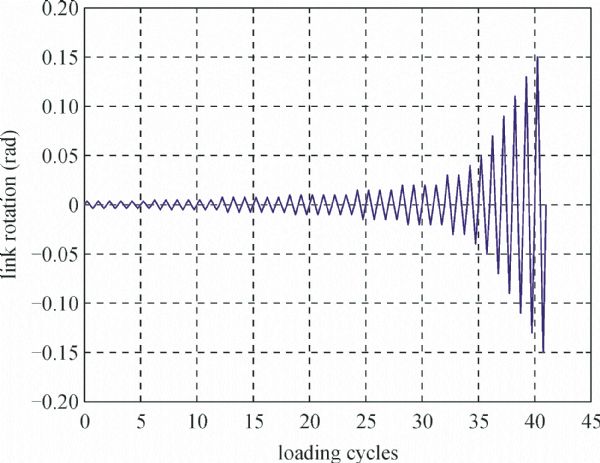
Fig.4  Cyclic load history applied to shear link specimens
sections Vy/kN Vu/kN Ω
W10 × 33 A992 496.9 666.8 1.34
AISI 316L 437.5 698.1 1.60
W12 × 50 A992 777.1 1030 1.33
AISI 316L 671.3 1085 1.62
W14 × 74 A992 1104 1455 1.32
AISI 316L 970.5 1552 1.60
W16 × 77 A992 1295 1722 1.33
AISI 316L 1153 1831 1.59
Tab.4  Yield strength, ultimate strength, and over-strength factor of the link beams
Fig.5  Hysteresis loops of W10 × 33 link beams under cyclic loading
Fig.6  Hysteresis loops of W12 × 50 link beams under cyclic loading
Fig.7  Hysteresis loops of W14 × 74 link beams under cyclic loading
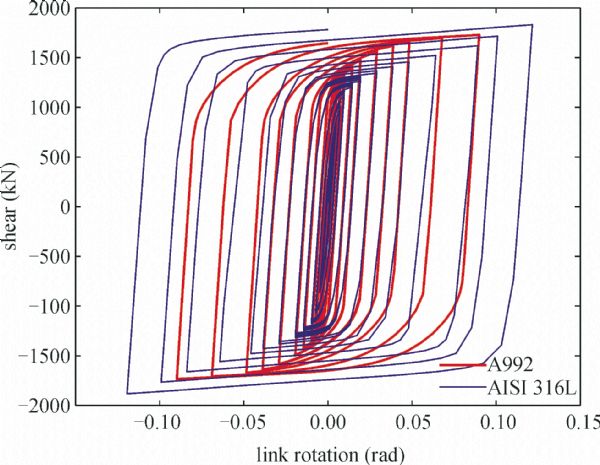
Fig.8  Hysteresis loops of W16 × 77 link beams under cyclic loading
Fig.9  Backbone curve from hysteresis loops of shear link specimens: (a) W10 × 33 link beam; (b) W12 × 50 link beam; (c) W14 × 74 link beam; (d) W16 × 77 link beam
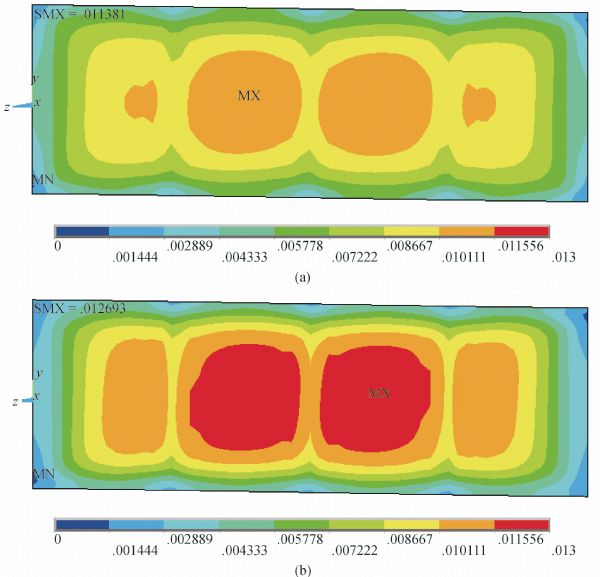
Fig.10  Plastic shear strain contour of W10 × 33 link beams at link rotation γ = 0.015 rad. (a) A992 steel; (b) AISI 316L stainless steel
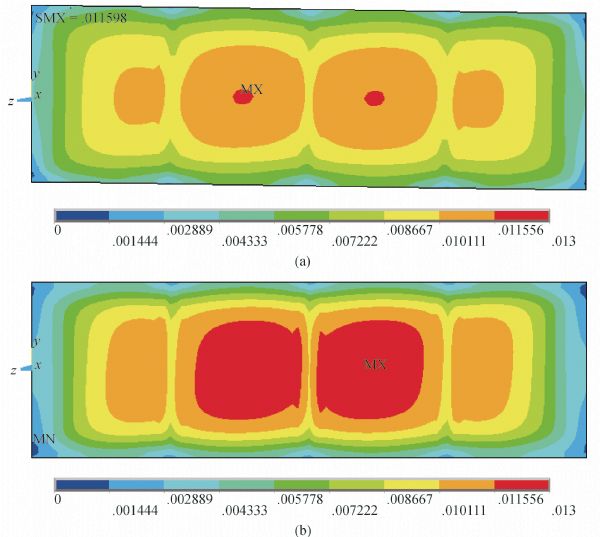
Fig.11  Plastic shear strain contour of W12×50 link beams at link rotation γ = 0.015 rad. (a) A992 steel; (b) AISI 316L stainless steel
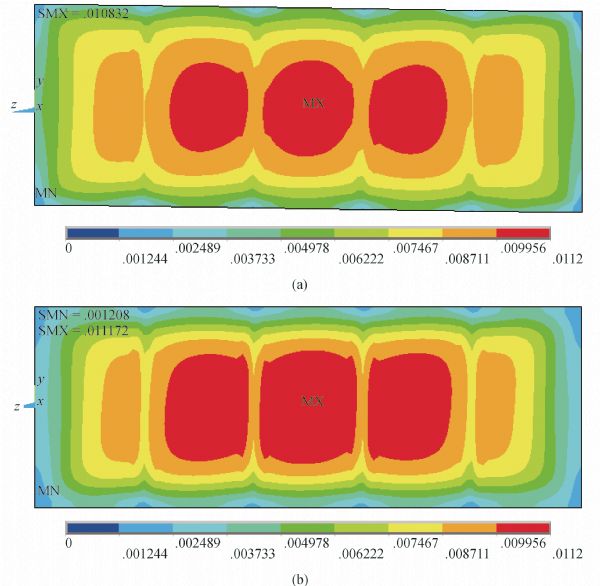
Fig.12  Plastic shear strain contour of W14×74 link beams at link rotation γ = 0.015 rad. (a) A992 steel; (b) AISI 316L stainless steel
Fig.13  Plastic shear strain contour of W14×74 link beams at link rotation γ = 0.015 rad. (a) A992 steel; (b) AISI 316L stainless steel
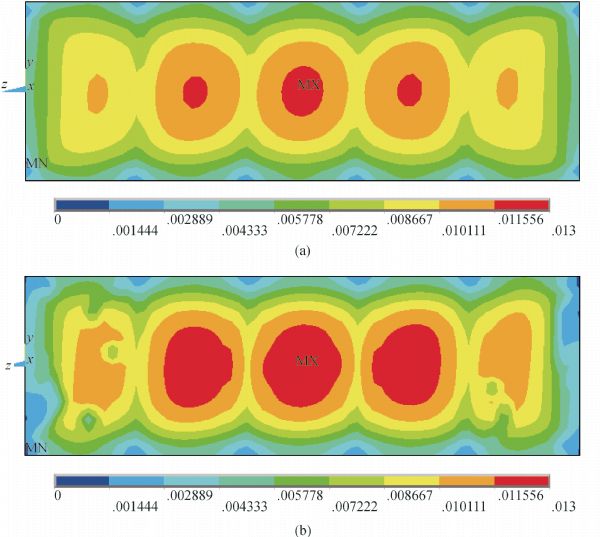
Fig.14  Plastic shear strain contour of W16×77 link beams at link rotation γ = 0.015 rad. (a) A992 steel; (b) AISI 316L stainless steel
C1, γ1 calibrated constants in the equation for χ 1
C2, γ2 calibrated constants in the equation for χ 2
bf specimen flange width
E0 initial elastic modulus
e, m, n calibrated material constants for AISI 316L stainless steel in the two-stage stress strain model modified by K Rasmussen
ρ length ratio of a link beam
d specimen height
k initial yield stress
L specimen length
Mp plastic moment of a link beam
R yielding surface expansion
R 0 , R , b calibrated constants in the equation for R
sgn(x) sign symbol, which takes values among -1, 0, and 1 depending on the sign of x
tf specimen flange thickness
tw specimen web thickness
ts specimen stiffener thickness
Vp plastic shear force of a link beam
Vu ultimate strength of a link beam
Vy yield strength of a link beam
σ stress
σ 0.01 stress at 0.01% plastic strain
σ 0.2 stress at 0.2% plastic strain
σ u ultimate stress
? strain
? u ultimate strain
? p plastic strain
? p accumulated plastic strain
χ back stress derived from the nonlinear kinematic model
χ 1 back stress of the first Chaboche model
χ 2 back stress of the second Chaboche model
ν Poisson’s Ratio
γ link rotation angle of the shear link
Ω over-strength factor
Tab.5  
1 Uang C M, Nakashima M, Tsai K C. Research and application of buckling-restrained braced frames. International Journal of Steel Structures, 2004, 4: 301–313
2 Tsai C, Tsai K. TPEA device as seismic damper for high-rise buildings. Journal of Engineering Mechanics, 1995, 121(10): 1075–1081
3 Kasai K, Popov E. General behavior of WF steel shear link beams. Journal of Structural Engineering, 1986, 112(2): 362–382
4 McDaniel C C, Uang C M, Seible F. Cyclic testing of built-up steel shear links for the New Bay Bridge. Journal of Structural Engineering, 2003, 129(6): 801–809
5 Baddoo N. AISC Design Guide 27: Structural Stainless Steel. American Institute of Steel Construction (AISC), Chicago, Illinois, USA, 2013
6 AISC. Seismic Provisions for Structural Steel Buildings. ANSI/AISC 341–05. Chicago, IL, 2010
7 Kaufmann E J, Metrovich B R, Pense A W. Characterization of cyclic inelastic strain behavior on properties of A572 Gr. 50 and A913 Gr. 50 rolled sections. ATLSS report, No. 01–13. Bethlehem, PA: Lehigh University, 2001
8 Shit J, Dhar S, Acharyya S. Characterization of cyclic plastic behavior of SS 316 stainless steel. International Journal of Engineering Science and Innovative Technology (IJESIT), 2013, 2
9 Rasmussen K J R. Full-range stress–strain curves for stainless steel alloys. Journal of Constructional Steel Research, 2003, 59(1): 47–61
10 Gardner L, Nethercot D A. Numerical modeling of stainless steel structural components—a consistent approach. Journal of Structural Engineering, 2004, 130(10): 1586–1601
11 Ashraf M, Gardner L, Nethercot D A. Finite element modeling of structural stainless steel cross-sections. Thin-walled Structures, 2006, 44(10): 1048–1062
12 Chaboche J L. A review of some plasticity and viscoplasticity constitutive theories. International Journal of Plasticity, 2008, 24(10): 1642–1693
13 Chaboche J L, Rousselier G. On the plastic and viscoplastic constitutive equations—Part I: rules developed with internal variable concept. J. Pressure Vessel Technol, 1983, 105(2): 153–158
14 Chaboche J L, Rousselier G. On the plastic and viscoplastic constitutive equations—Part II: application of internal variable concepts to the 316 stainless steel. J Pressure Vessel Technol, 1983b, 105(2): 159–164
15 Olsson A. Stainless steel plasticity-material modeling and structural applications. Dissertation for the Doctoral Degree. Lulea: Lulea University of Technology, 2001
16 Hyde C J, Sun W, Leen S B. Cyclic thermo-mechanical material modeling and testing of 316 stainless steel. International Journal of Pressure Vessels and Piping, 2010, 87(6): 365–372
17 ANSYS. ANSYS Mechanical APDL, version 14.5, ANSYS Academic Teaching Introductory. ANSYS, Inc, Canonsburg, Pennsylvania, USA, 2014
18 Richards P W, Uang C M. Development of testing protocol for short links in eccentrically braced frames. Report No. SSRP–2003/08, Department of Structural Engineering, University of California at San Diego, La Jolla, Calif, 2003
19 Iwasaki T, Kawashima K, Hasegawa K, Koyama T, Yoshida T. (1987). “Effect of Number of Loading Cycles and Loading Velocity on Reinforced Concrete Bridge Piers”. 19th Joint Meeting US-Japan Panel on Wind and Seismic Effects, UJNR, Tsukuba
20 ANSYS. ANSYS Mechanical APDL Material Reference. ANSYS, Inc, Canonsburg, Pennsylvania, USA, 2013
21 Della Corte G, D’Aniello M, Landolfo R. Analytical and numerical study of plastic overstrength of shear links. Journal of Constructional Steel Research, 2013, 82: 19–32
22 Park R. Evaluation of ductility of structures and structural assemblages from laboratory testing. Bulletin of the New Zealand National Society for Earthquake Engineering, 1989, 22(3): 155–166
23 Okazaki T, Engelhardt M D. Cyclic loading behavior of EBF links constructed of ASTM A992 steel. Journal of Construction Steel Research. 2007, 63: 751–765
[1] Suman HAZARI, Sima GHOSH, Richi Prasad SHARMA. New pseudo-dynamic analysis of two-layered cohesive-friction soil slope and its numerical validation[J]. Front. Struct. Civ. Eng., 2020, 14(6): 1492-1508.
[2] Sadegh ETEDALI. Ranking of design scenarios of TMD for seismically excited structures using TOPSIS[J]. Front. Struct. Civ. Eng., 2020, 14(6): 1372-1386.
[3] Wei XIONG, Shan-Jun ZHANG, Li-Zhong JIANG, Yao-Zhuang LI. Parametric study on the Multangular-Pyramid Concave Friction System (MPCFS) for seismic isolation[J]. Front. Struct. Civ. Eng., 2020, 14(5): 1152-1165.
[4] Sanku KONAI, Aniruddha SENGUPTA, Kousik DEB. Seismic behavior of cantilever wall embedded in dry and saturated sand[J]. Front. Struct. Civ. Eng., 2020, 14(3): 690-705.
[5] Tiago Miguel FERREIRA, João ESTÊVÃO, Rui MAIO, Romeu VICENTE. The use of Artificial Neural Networks to estimate seismic damage and derive vulnerability functions for traditional masonry[J]. Front. Struct. Civ. Eng., 2020, 14(3): 609-622.
[6] Mahrad FAHIMINIA, Aydin SHISHEGARAN. Evaluation of a developed bypass viscous damper performance[J]. Front. Struct. Civ. Eng., 2020, 14(3): 773-791.
[7] Mohammad Abubakar NAVEED, Zulfiqar ALI, Abdul QADIR, Umar Naveed LATIF, Saad HAMID, Umar SARWAR. Geotechnical forensic investigation of a slope failure on silty clay soil—A case study[J]. Front. Struct. Civ. Eng., 2020, 14(2): 501-517.
[8] Hai-Bin MA, Wei-Dong ZHUO, Davide LAVORATO, Camillo NUTI, Gabriele FIORENTINO, Giuseppe Carlo MARANO, Rita GRECO, Bruno BRISEGHELLA. Probabilistic seismic response and uncertainty analysis of continuous bridges under near-fault ground motions[J]. Front. Struct. Civ. Eng., 2019, 13(6): 1510-1519.
[9] Sheng PENG, Chengxiang XU, Xiaoqiang LIU. Truss-arch model for shear strength of seismic-damaged SRC frame columns strengthened with CFRP sheets[J]. Front. Struct. Civ. Eng., 2019, 13(6): 1324-1337.
[10] Yujie YU, Zhihua CHEN, Renzhang YAN. Finite element modeling of cable sliding and its effect on dynamic response of cable-supported truss[J]. Front. Struct. Civ. Eng., 2019, 13(5): 1227-1242.
[11] Alireza FARZAMPOUR, Matthew Roy EATHERTON. Parametric computational study on butterfly-shaped hysteretic dampers[J]. Front. Struct. Civ. Eng., 2019, 13(5): 1214-1226.
[12] Yunlin LIU, Shitao ZHU. Finite element analysis on the seismic behavior of side joint of Prefabricated Cage System in prefabricated concrete frame[J]. Front. Struct. Civ. Eng., 2019, 13(5): 1095-1104.
[13] Yundong ZHOU, Fei ZHANG, Jingquan Wang, Yufeng GAO, Guangyu DAI. Seismic stability of earth slopes with tension crack[J]. Front. Struct. Civ. Eng., 2019, 13(4): 950-964.
[14] Zhenyuan LUO, Weiming YAN, Weibing XU, Qinfei ZHENG, Baoshun WANG. Experimental research on the multilayer compartmental particle damper and its application methods on long-period bridge structures[J]. Front. Struct. Civ. Eng., 2019, 13(4): 751-766.
[15] Hamid Taghavi GANJI, Mohammad ALEMBAGHERI, Mohammad Houshmand KHANEGHAHI. Evaluation of seismic reliability of gravity dam-reservoir-inhomogeneous foundation coupled system[J]. Front. Struct. Civ. Eng., 2019, 13(3): 701-715.
Viewed
Full text


Abstract

Cited

  Shared   
  Discussed