|
|
|
Effect of mineral additives and permeability reducing admixtures having different action mechanisms on mechanical and durability performance of cementitious systems |
Ali NEMATZADEH, Burcu AYTEKIN, Ali MARDANI-AGHABAGLOU( ) ) |
| Department of Civil Engineering, Bursa Uludag University, Nilufer-Bursa 16059, Turkey |
|
|
|
|
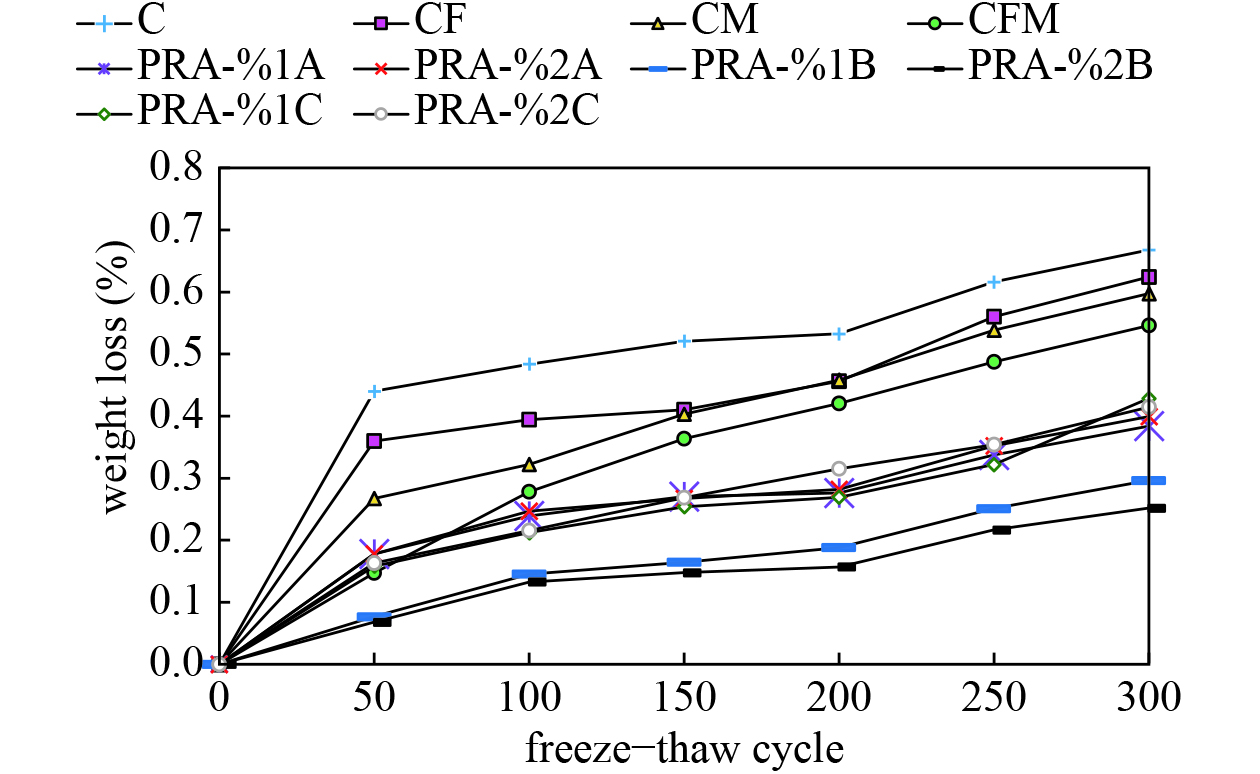
Abstract In this paper, the effect of usage of the permeability reducing admixture (PRA) having different action mechanisms on hardened state properties of cementitious systems containing mineral additives is examined. For this aim, three commercial PRAs were used during investigation. The effective parameters in the first and third PRAs were air-entraining and high-rate air-entraining, respectively. The second one contained the insoluble calcium carbonate residue and had a small amount of the air-entraining property. Mortar mixes with binary and ternary cementitious systems were prepared by partially replacing cement with fly ash and metakaolin. The hardened state properties of mortar mixtures such as compressive strength, ultrasonic pulse velocity, water absorption, drying shrinkage and freeze–thaw resistance were investigated. The ternary cement-based mixture having both fly ash and metakaolin was selected as the most successful mineral-additive bearing mix in regard to hardened state properties. In this sense, PRA-B, with both insoluble residues and a small amount of air-entraining properties, showed the best performance among the mixtures containing PRA. The combined use of mineral additive and PRA had a more positive effect on the properties of the mixes.
|
| Keywords
cementitious system
mineral additive
permeability reducing admixture
mechanical properties
durability performance
|
|
Corresponding Author(s):
Ali MARDANI-AGHABAGLOU
|
|
Online First Date: 27 September 2021
Issue Date: 29 November 2021
|
|
| 1 |
J Cheung, L Roberts, J Liu. Admixtures and sustainability. Cement and Concrete Research, 2018, 114 : 79– 89
https://doi.org/10.1016/j.cemconres.2017.04.011
|
| 2 |
ACI 212.3R-10. Report on Chemical Admixtures for Concrete. Michigan: American Concrete Institute, 2016
|
| 3 |
P Zhan, Z He. Application of shrinkage reducing admixture in concrete: A review. Construction & Building Materials, 2019, 201 : 676– 690
https://doi.org/10.1016/j.conbuildmat.2018.12.209
|
| 4 |
A J Jeknavorian. Synergistic interaction of condensed polyacrylic acid-aminated polyether superplasticizer with calcium salts. Special Publication, 2000, 195 : 585– 600
|
| 5 |
L Lei, J Plank. A concept for a polycarboxylate superplasticizer possessing enhanced clay tolerance. Cement and Concrete Research, 2012, 42( 10): 1299– 1306
https://doi.org/10.1016/j.cemconres.2012.07.001
|
| 6 |
Uyan M, Pekmezci B V, Yıldırım H. Effects of plasticizer admixture and curing conditions on the permeability properties of concrete. Sika Technical Bulletin, 2003: 10–14 (in Turkish)
|
| 7 |
Akman M S. Concrete durability and importance In: The 1st National Concrete Congress. Istanbul: TMMOB chamber of civil engineering, 1989 (in Turkish)
|
| 8 |
J F Young. Review of the pore structure of cement paste and concrete and its influence on permeability. Special Publication, 1988, 108 : 1– 18
|
| 9 |
R Sharma, R A Khan. Sulfate resistance of self compacting concrete incorporating copper slag as fine aggregates with mineral admixtures. Construction & Building Materials, 2021, 287 : 122985–
https://doi.org/10.1016/j.conbuildmat.2021.122985
|
| 10 |
F Kocataşkın. Vapour permeability of concrete. Bulletin of the Technical University of Istanbul, 1957, 10( 1): 53– 59
|
| 11 |
F Kocataşkın. Permeability of concrete. Bulletin of the Technical University of Istanbul, 1995, 8 : 50– 56
|
| 12 |
Neville A. Concrete Technology. 2nd ed. London: Longman, 1984
|
| 13 |
Uyan M. Moisture movements in concrete as a hollow media. In: City Management, Human and Environmental Problems Symposium. İstanbul: TMMOB Chamber of Civil Engineering, 1988, 266–273
|
| 14 |
Ehsani A, Nili M, Shaabani K. Effect of nanosilica on the compressive strength development and water absorption properties of cement paste and concrete containing Fly Ash. KSCE Journal of Civil Engineering, 2017, 21(5): 1854−1864
|
| 15 |
Mehta P K, Monteiro P J M. Concrete: Microstructure, Properties and Materials. 3rd ed. New York: McGraw-Hill, 2006
|
| 16 |
M Choinska, A Khelidj, G Chatzigeorgiou, G Pijaudier-Cabot. Effects and interactions of temperature and stress-level related damage on permeability of concrete. Cement and Concrete Research, 2007, 35( 1): 79– 88
https://doi.org/10.1016/j.cemconres.2006.09.015
|
| 17 |
D R Gardner, R J Lark, B Barr. Effect of conditioning temperature on the strength and permeability of normal- and high-strength concrete. Cement and Concrete Research, 2005, 37( 7): 1400– 1406
https://doi.org/10.1016/j.cemconres.2004.08.012
|
| 18 |
C Shi. Effect of mixing proportions of concrete on its electrical conductivity and the rapid chloride permeability test (ASTM C1202 or ASSHTO T277) results. Cement and Concrete Research, 2004, 34( 3): 537– 545
https://doi.org/10.1016/j.cemconres.2003.09.007
|
| 19 |
S Sahoo, T R Mahapatra, N Priyadarshini, S Mahapatra, S Naik, S Jaypuria. Influence of water binder ratio on strength and acid resistance of concrete made up of mineral admixture as supplementary cementitious material. Materials Today: Proceedings, 2020, 26 : 796– 803
https://doi.org/10.1016/j.matpr.2020.01.028
|
| 20 |
N Duc Van, E Kuroiwa, J Kim, H Choi, Y Hama. Influence of restrained condition on mechanical properties, frost resistance, and carbonation resistance of expansive concrete. Materials (Basel), 2020, 13( 9): 2136–
https://doi.org/10.3390/ma13092136
|
| 21 |
W Shi, M Najimi, B Shafei. Reinforcement corrosion and transport of water and chloride ions in shrinkage-compensating cement concretes. Cement and Concrete Research, 2020, 135 : 106121–
https://doi.org/10.1016/j.cemconres.2020.106121
|
| 22 |
A Mardani-Aghabaglou, pcı lar İ Kalı, G İ Sezer, A Sezer, S Altun. Freeze–thaw resistance and chloride-ion penetration of cement-stabilized clay exposed to sulfate attack. Applied Clay Science, 2015, 115 : 179– 188
https://doi.org/10.1016/j.clay.2015.07.041
|
| 23 |
Li Z. Advanced Concrete Technology. New Jersey: John Wiley & Sons, Inc., 2011
|
| 24 |
Roger Rixom R, Mailvaganam N. Chemical Admixtures for Concrete. 3rd ed. London: E & FN Spon, 1999
|
| 25 |
K A Gruber, T Ramlochan, A Boddy, R D Hooton, M D A Thomas. Increasing concrete durability with high-reactivity metakaolin. Cement and Concrete Composites, 2001, 23( 6): 479– 484
https://doi.org/10.1016/s0958-9465(00)00097-4
|
| 26 |
M Valipour, F Pargar, M Shekarchi, S Khani. Comparing a natural pozzolan, zeolite, to metakaolin and silica fume in terms of their effect on the durability characteristics of concrete: A laboratory study. Construction & Building Materials, 2013, 41 : 879– 888
https://doi.org/10.1016/j.conbuildmat.2012.11.054
|
| 27 |
Felekoğlu B, Baradan B. Use of alternative waterproofing admixtures in concrete production. In: 2nd Chemical Additives in Buildings Congress Symposium Proceedings. Ankara: Chamber of Civil Engineering, 2007, 53–64
|
| 28 |
Akyol K. Study on the effects of waterproofing and water repellent admixtures dosage on the water permeability of concrete and the on comperessive strengths. Thesis for the Master’s Degree. Sakarya: Sakarya University, 2008 (in Turkish)
|
| 29 |
A Mardani-Aghabaglou, M Tuyan, lmaz G Yı, ö z Ö Arı, K Ramyar. Effect of different types of superplasticizer on fresh, rheological and strength properties of self-consolidating concrete. Construction & Building Materials, 2013, 47 : 1020– 1025
https://doi.org/10.1016/j.conbuildmat.2013.05.105
|
| 30 |
Yıldırım H, Gülseren H, Uyan M, Kemerli K. The effect of impermeability admixtures on concrete permeability properties. In: National Concrete Congress. Istanbul: Chamber of civil engineering, 2003, 123–131
|
| 31 |
Moralıoğlu M. Investigation of the effect of chemical additive-biopolymer compatibility on cement mortar properties in the specific kit. Thesis for the Master’s Degree. Manisa: Celal Bayar University, 2015 (in Turkish)
|
| 32 |
F Curcio, B A DeAngelis, S Pagliolico. Metakaolin as a pozzolanic microfiller for high-performance mortars. Cement and Concrete Research, 1998, 28( 6): 803– 809
https://doi.org/10.1016/s0008-8846(98)00045-3
|
| 33 |
J A Kostuch, G V Walters, T R Jones. High performance concrete incorporating metakaolin—A review. Concrete (London), 2000, 2 : 1799– 1811
|
| 34 |
S Wild, J Khatib, A Jones. Relative strength, pozzolanic activity and cement hydration in superplasticised metakaolin concrete. Cement and Concrete Research, 1996, 26( 10): 1537– 1544
https://doi.org/10.1016/0008-8846(96)00148-2
|
| 35 |
J Bai, S Wild, B B Sabir, J Kinuthia. Workability of concrete incorporating pulverised fuel ash and metakaolin. Magazine of Concrete Research, 1999, 51( 3): 207– 216
https://doi.org/10.1680/macr.1999.51.3.207
|
| 36 |
Pacheco-Torgal F, Shahsavandi A, Jalali S. Using metakaolin to improve the compressive strength and the durability of fly ash based concrete. In: Communications in International Conferences. Rabat: Repositórium, 2011
|
| 37 |
N Saboo, S Shivhare, K K Kori, A K Chandrappa. Effect of fly ash and metakaolin on pervious concrete properties. Construction & Building Materials, 2019, 223 : 322– 328
https://doi.org/10.1016/j.conbuildmat.2019.06.185
|
| 38 |
Erdoğan T Y. Concrete Materials with Questions and Answers. 1st ed. Istanbul: THBB Ready Mixed Concrete Magazine, 2003, 975−981 (in Turkish)
|
|
Viewed |
|
|
|
Full text
|
|
|
|
|
Abstract
|
|
|
|
|
Cited |
|
|
|
|
| |
Shared |
|
|
|
|
| |
Discussed |
|
|
|
|